
Define the Outcome Before Rewarding the Saving
The board of a health plan or healthcare organization should require management to explain exactly which result earns a supplier payment. A reduction in paid claims can reflect avoided inappropriate care, but it can also reflect delayed work, incomplete submissions, changed case mix, or decisions later reversed. The incentive must distinguish these possibilities.
CMS’s WISeR model pays participants a share of expenditures associated with averted inappropriate care, adjusts payments for performance, and requires clinician determination of non-payment recommendations.1 This is a defined US Medicare model, not a universal prior-authorization rule or evidence that every savings-based contract is inappropriate.
The executive lesson is to examine the entire incentive and safeguard design. The buyer should identify the clinical or coverage standard, the population and services included, who makes consequential decisions, and how an affected person can obtain timely correction. A commercial savings target should not become the operational definition of appropriate care.
Distinguish Avoided Waste from Unfinished Care
Management should follow cases through submission, information requests, determination, appeal, and final disposition. A supplier should not count a pending or abandoned case as an avoided expense without a defensible attribution rule. Delay can move spending outside the measurement period while leaving the patient’s need unresolved.
The study’s reported completion signals and manual repairs identify a mechanism worth testing in healthcare operations; they do not measure clinical harm or authorization failure rates.2 The buyer should reconcile the supplier’s claimed result with the actual case state and any human work needed to complete it.
For a hypothetical request, missing documentation may cause a nonapproval that is later reversed when the information arrives. The savings assessment should preserve that sequence and distinguish a documentation failure from a conclusion that the service was not appropriate. Otherwise the contract can reward a process defect.
Use an Incentive Safeguard Record
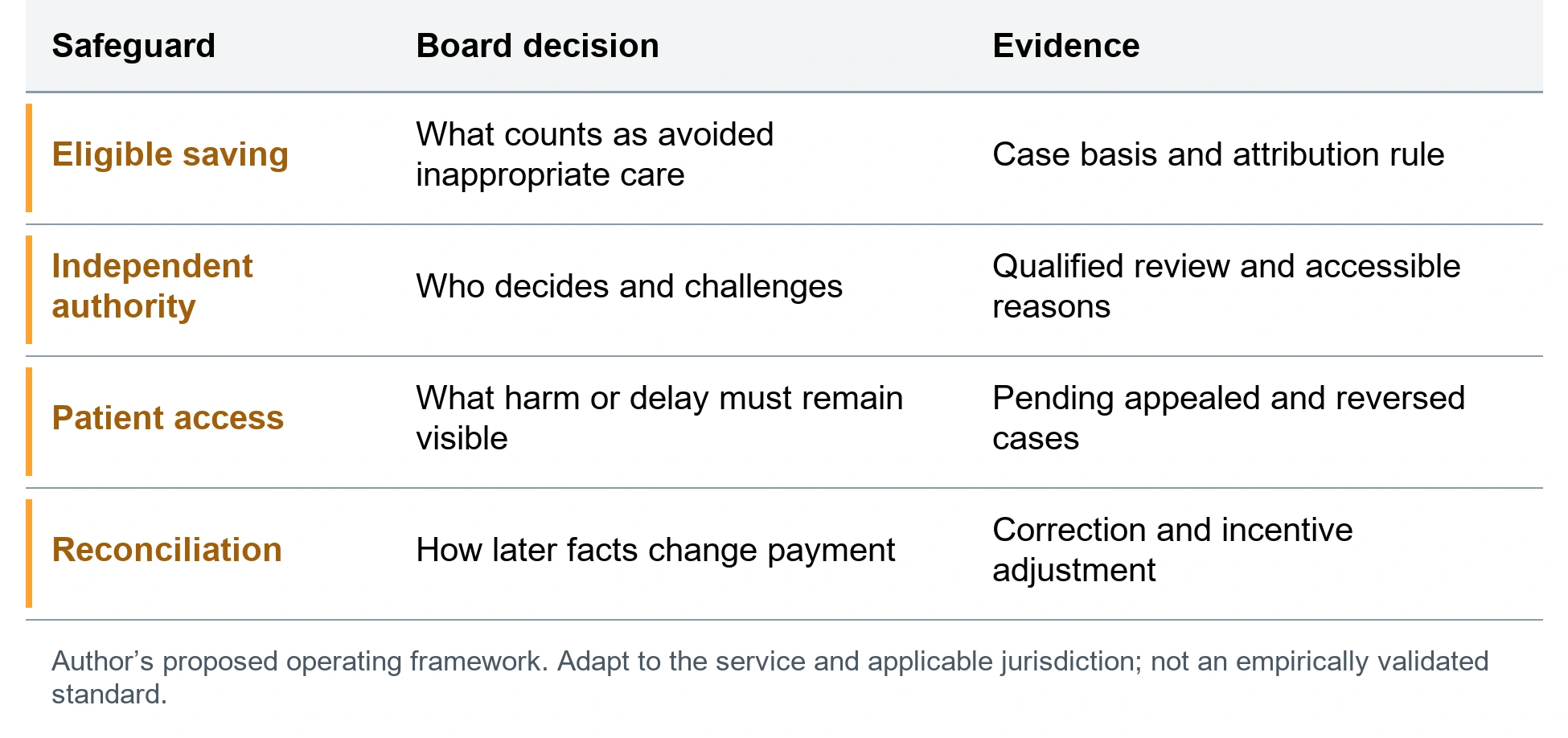
Figure 1 proposes four conditions for approving the commercial design. Define the eligible saving, preserve independent decision authority, measure patient-relevant exceptions, and reconcile later reversals. The contract should state the data, timing, attribution, and review rights required to apply those conditions.
The board should ask who can challenge the supplier’s classification and whether the challenger has access to the evidence. Clinical and coverage specialists should retain the authority required by the relevant service. A review process controlled only by the party earning the saving leaves a conflict that the buyer must address.
Track timeliness, unresolved work, reversals, complaints, and differences across relevant patient or case groups. These measures should be interpreted with case mix and data quality visible. No single rate proves fairness or clinical appropriateness, but unexplained patterns should trigger investigation before the supplier receives credit for the associated saving.
Keep the Legal and Clinical Context Local
The WISeR example does not transfer US Medicare design into EU, UK, Swiss, or other health systems. Each organization should determine the applicable coverage, clinical, privacy, nondiscrimination, appeal, and decision-time requirements. Preserve the distinction between administrative support and a clinical or coverage determination.
McKinsey’s service-economics analysis considers the full cost of an accepted outcome.3 Applied to authorization, the buyer should count additional clinician review, provider follow-up, resubmission, appeals, and retained administration. A lower supplier price or lower paid amount can coexist with higher system effort and unresolved patient need.
Commercial terms should address correction after the payment period. State how later reversals, duplicate counting, and incomplete evidence affect incentive reconciliation. The supplier should remain obliged to cooperate with case resolution even when doing so reduces the saving on which it expected payment.
Approve Savings Only with Demonstrated Safeguards
A reasonable objection is that extensive measurement could make a useful service uneconomic. Focus on the decisions and failure modes material to patient access and the buyer’s obligations. Reuse authoritative case data and existing review functions, but do not remove independent challenge merely to simplify the commercial calculation.
Before expansion, management should run a bounded pilot with representative difficult cases, delayed information, and reversals. The board should receive the incentive definition, independent review results, retained cost, unresolved patient effects, and remediation plan. A forecast saving should remain provisional until the supporting cases can be reconciled.
The decision is whether the supplier is rewarded for a defensible healthcare outcome. Approve the contract when its savings measure, clinical authority, patient protections, and complete economics reinforce one another. Where they conflict, change the incentive before the commercial target begins directing the service.
Evidence and Source Note
The study is a nonrepresentative cross-section of 850 vendor delivery-team respondents on 150 engagements serving Tier 1 financial institutions, collected during January–June 2026. Neither banks nor vendors corroborated the accounts. It establishes reported experience, not causation, legal breach, or market prevalence. Its application here is a mechanism to investigate, not an estimate of conditions in other industries. The author-supplied version 1.8.2 is dated November 1, 2026 and is cited as a forthcoming manuscript consulted October 23, 2026.4
This is an analytical decision paper based on the supplied study and selected primary public sources checked through October 23, 2026. The original contribution is a board incentive-safeguard record linking claimed authorization savings to independent decisions, patient access, full retained effort, and subsequent reversal reconciliation. The proposed method has not been independently validated. Legal requirements depend on the entity, activity, jurisdiction, and effective provisions; supervisory observations, research, and professional commentary have distinct authority.
Notes
- Centers for Medicare & Medicaid Services, “WISeR (Wasteful and Inappropriate Service Reduction) Model,” Centers for Medicare & Medicaid Services, updated October 19, 2026, “Design” and “Participant Information”, https://www.cms.gov/priorities/innovation/innovation-models/wiser. ↩
- Phil Hatch, Agentic AI Outsourcing at Tier 1 Financial Institutions: Full Study Report, version 1.8.2 (Akholi, forthcoming manuscript dated November 1, 2026), Part 3, AI Technology, sec. 4.1, “Accuracy of the Tools’ Own Success and Failure Reports,” indicator C172, https://doi.org/10.2139/ssrn.7164559; Hatch, Agentic AI Outsourcing, Part 5, “The Five Manual Alteration Methods” and “Disclosure of Manual Alteration,” table 5.8. ↩
- Chandana Asif et al., “Where AI Agents Pay Off: A Practical Guide to the Economics of Agentic Workflows,” McKinsey & Company, August 24, 2026, “What drives the unit economics of AI-based workflows?”, https://www.mckinsey.com/capabilities/quantumblack/our-insights/where-ai-agents-pay-off-a-practical-guide-to-the-economics-of-agentic-workflows. ↩
- Hatch, Agentic AI Outsourcing, Introduction, “Executive Summary” and “Evidentiary Basis and Its Limits”. ↩
Bibliography
- Asif, Chandana, Dieter Kiewell, Lari Hämäläinen, Tom Kolaja, and Tunde Olanrewaju. “Where AI Agents Pay Off: A Practical Guide to the Economics of Agentic Workflows.” McKinsey & Company. August 24, 2026. https://www.mckinsey.com/capabilities/quantumblack/our-insights/where-ai-agents-pay-off-a-practical-guide-to-the-economics-of-agentic-workflows.
- Centers for Medicare & Medicaid Services. “WISeR (Wasteful and Inappropriate Service Reduction) Model.” Centers for Medicare & Medicaid Services. Updated October 19, 2026. https://www.cms.gov/priorities/innovation/innovation-models/wiser.
- Hatch, Phil. Agentic AI Outsourcing at Tier 1 Financial Institutions: Full Study Report. Version 1.8.2. Akholi. Forthcoming manuscript dated November 1, 2026. Author-supplied manuscript consulted October 23, 2026. https://doi.org/10.2139/ssrn.7164559.
Explore this subject
Category: Economics and Value
Topics: Customer Protection Outcome Pricing Return on Investment
Audience: Buy-side Boards and Executives
Industry: Healthcare Other Regulated Industries