
Price the Accepted Healthcare Workflow
The provider executive should define the outcome for which the customer pays and identify the human work needed to achieve it. Administrative preparation, successful submission, clinical review, and final case completion are different results. The commercial model should state which the supplier performs and which remain with the healthcare organization.
McKinsey’s workflow-economics analysis includes costs beyond model inference.1 Applied to healthcare outsourcing, the provider should measure the actual staff, tools, assurance, and support behind accepted work. Generic AI productivity estimates cannot establish the cost of the offered service.
Begin with representative cases and follow them to the agreed terminal state. Identify work performed by the provider, customer clinicians, administrators, and downstream parties. A service that reduces supplier effort while increasing customer follow-up should be presented with that boundary visible.
Separate Qualified Judgment from Avoidable Rework
Some human contribution is a necessary feature of the service. Clinical authority, complex case interpretation, and patient-sensitive escalation may require qualified people. Repeated reentry, missing-document repair, or failed transfer can indicate a different cost that should be reduced through better design.
The study reports human intervention sustaining delivery across its banking sample.2 It does not measure healthcare staffing or clinical risk. The provider should use the mechanism to examine its own work rather than assume that agent-generated output represents a completed healthcare outcome.
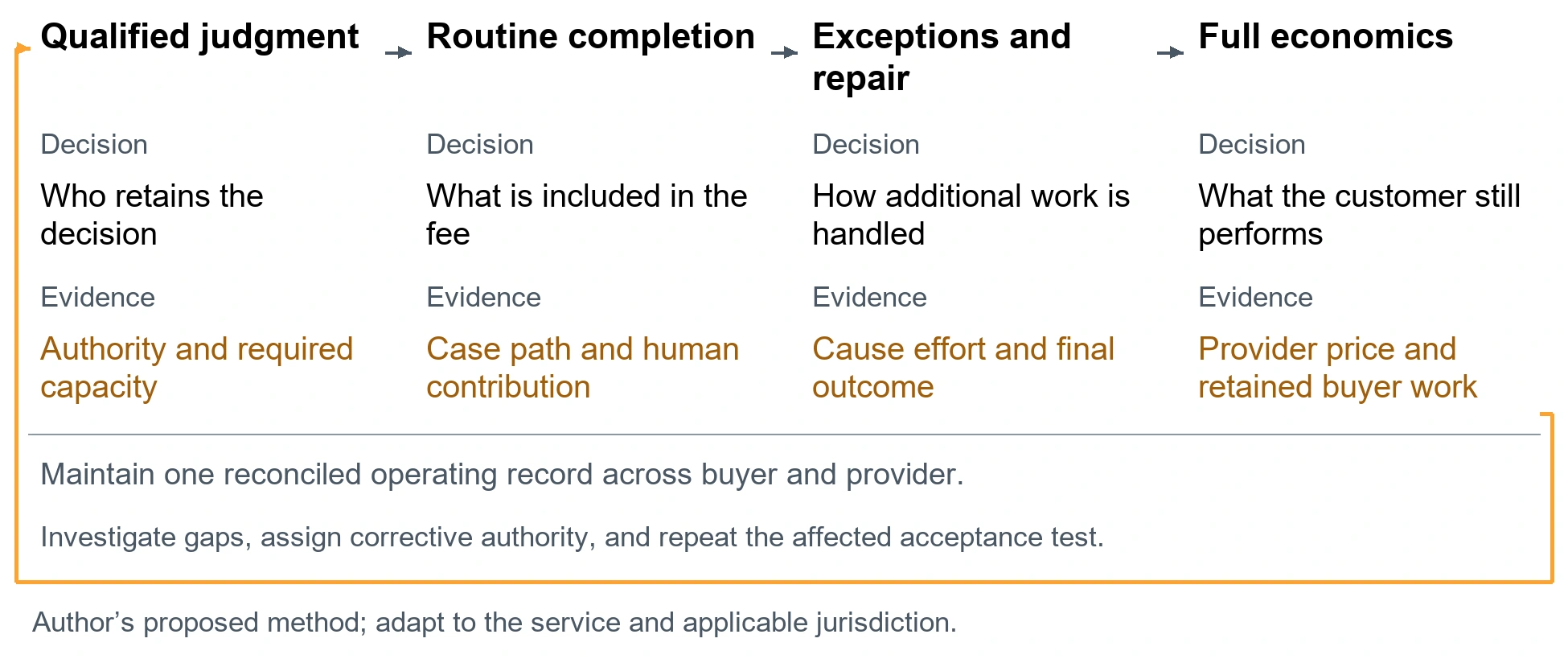
For a hypothetical referral service, the agent may prepare documentation while staff locate missing information and verify the destination. The offer should specify whether that work is included, purchased separately, or retained by the customer. A vague exception clause should not absorb routine tasks essential to normal completion.
Use a Human Work and Price Record
Figure 1 proposes a record connecting case type, required human contribution, cost owner, and accepted outcome. Include normal work, difficult cases, correction, assurance, and recovery readiness. The provider needs enough evidence to understand cost variability rather than price only the easiest demonstration cases.
Bain’s tech-services analysis links provider adaptation to delivery, pricing, and talent strategy.3 The healthcare offer should align those elements: sales should promise a result the delivery team can achieve with the qualified capacity funded in the price.
Keep the buyer expenditure view separate from provider internal cost. The buyer already pays for provider labor through the agreed fee; adding that internal cost again would double count it. The provider should still disclose relevant customer prerequisites and retained work so the buyer can assess its total economics.
Preserve Safety and Service Authority in the Commercial Model
The price should not reward removal of review that the service requires. Define the agent’s administrative boundary, the qualified decisions retained, and the response when necessary staff are unavailable. A case should remain pending or move to an approved route rather than be reported complete to satisfy an outcome target.
EU, UK, Swiss, US, and other healthcare settings may impose different clinical, privacy, professional, device, and records requirements. The provider should identify the local scope of its offer and the customer responsibilities it cannot assume. One global staffing assumption may not support every permitted use.
Contract terms should address material changes in case mix, volume, clinical scope, and customer prerequisites. State how the parties investigate a shortfall and adjust the service or price. The provider should not make an unbounded guarantee that depends on decisions or resources outside its authority.
Demonstrate the Economics Before Scaling the Offer
A reasonable objection is that detailed costing slows commercial development. Use a bounded pilot with transparent assumptions and a limited commitment. Measure accepted outcomes and actual human effort under representative exceptions. The objective is to discover whether the offer can be sustained, not to produce an artificially precise price before evidence exists.
Review quality, timeliness, unresolved cases, customer effort, and provider cost together. A favorable margin achieved by returning unfinished work to the healthcare organization is a changed service boundary, not necessarily delivery improvement. Reconcile that change before presenting the offer as equivalent.
The provider should price the healthcare result it can support with real people and operating evidence. Necessary human work should be visible and funded, while avoidable rework should have an improvement plan. That discipline creates a more credible offer than a low agent price whose essential completion work remains unpaid or unexplained.
Evidence and Source Note
The study is a nonrepresentative cross-section of 850 vendor delivery-team respondents on 150 engagements serving Tier 1 financial institutions, collected during January–June 2026. Neither banks nor vendors corroborated the accounts. It establishes reported experience, not causation, legal breach, or market prevalence. Its application here is a mechanism to investigate, not an estimate of conditions in other industries. The author-supplied version 1.8.2 is dated November 1, 2026 and is cited as a forthcoming manuscript consulted October 23, 2026.4
This is an analytical decision paper based on the supplied study and selected primary public sources checked through October 23, 2026. The original contribution is a healthcare provider pricing record that connects accepted case outcomes to funded qualified judgment, routine human completion, exception work, and transparent buyer prerequisites. The proposed method has not been independently validated. Legal requirements depend on the entity, activity, jurisdiction, and effective provisions; supervisory observations, research, and professional commentary have distinct authority.
Notes
- Chandana Asif et al., “Where AI Agents Pay Off: A Practical Guide to the Economics of Agentic Workflows,” McKinsey & Company, August 24, 2026, “What drives the unit economics of AI-based workflows?”, https://www.mckinsey.com/capabilities/quantumblack/our-insights/where-ai-agents-pay-off-a-practical-guide-to-the-economics-of-agentic-workflows. ↩
- Phil Hatch, Agentic AI Outsourcing at Tier 1 Financial Institutions: Full Study Report, version 1.8.2 (Akholi, forthcoming manuscript dated November 1, 2026), Part 5, “The Five Manual Alteration Methods” and “Disclosure of Manual Alteration,” table 5.8, https://doi.org/10.2139/ssrn.7164559. ↩
- Megha Chawla et al., “Tech Services: Cracking the Code on AI-led Growth,” Bain & Company, September 29, 2026, “At a Glance” and discussion of commercial models, https://www.bain.com/insights/tech-services-cracking-the-code-on-ai-led-growth-technology-report-2026/. ↩
- Hatch, Agentic AI Outsourcing, Introduction, “Executive Summary” and “Evidentiary Basis and Its Limits”. ↩
Bibliography
- Asif, Chandana, Dieter Kiewell, Lari Hämäläinen, Tom Kolaja, and Tunde Olanrewaju. “Where AI Agents Pay Off: A Practical Guide to the Economics of Agentic Workflows.” McKinsey & Company. August 24, 2026. https://www.mckinsey.com/capabilities/quantumblack/our-insights/where-ai-agents-pay-off-a-practical-guide-to-the-economics-of-agentic-workflows.
- Chawla, Megha, Mark Brinda, Sushant Khandelwal, and Sandeep Nayak. “Tech Services: Cracking the Code on AI-led Growth.” Bain & Company. September 29, 2026. https://www.bain.com/insights/tech-services-cracking-the-code-on-ai-led-growth-technology-report-2026/.
- Hatch, Phil. Agentic AI Outsourcing at Tier 1 Financial Institutions: Full Study Report. Version 1.8.2. Akholi. Forthcoming manuscript dated November 1, 2026. Author-supplied manuscript consulted October 23, 2026. https://doi.org/10.2139/ssrn.7164559.
Explore this subject
Category: Economics and Value
Topics: Functional Baselines Hidden Human Work Return on Investment
Audience: Service Providers
Industry: Healthcare Other Regulated Industries