
Require One Reconciled Investment Story
The board should require finance, operations, risk, and the service sponsor to reconcile the business case before approving material expansion. Each function may hold a different view: a lower invoice, faster processing, greater retained review, or unresolved control work. The investment decision needs those views connected to the same business function and period.
McKinsey’s agentic-workflow economics analysis emphasizes the full cost of producing accepted work.1 For a bank, the cost boundary should include the retained activities necessary to deliver the required function and meet applicable obligations. Removing a cost from the provider’s scope does not remove it from the bank’s economics.
Define the purchased outcome, workload, quality, timing, control conditions, and baseline. When delivery changes the process fundamentally, compare equivalent business results rather than force old process phases onto the new design. The board should see which comparisons are observed and which are reconstructed estimates.
Trace Claimed Savings to the Work That Remains
The study reports manual intervention and difficulties in observed outcomes alongside the intended agentic process.2 These reports do not establish this bank’s financial return. They identify places where the bank should investigate omitted effort, unfinished work, and unsupported assumptions.
Ask management to reconcile the provider’s accepted-work count with bank records and the cost model. Include correction, exception handling, access support, control testing, investigation, and recovery readiness where attributable. Avoid double counting labor already included in provider fees when presenting the buyer’s expenditure view.
A hypothetical service may reduce the provider invoice while requiring more bank analysts to verify results. The board should see the net recurring cost and the effect on quality and timeliness. Released capacity, cash savings, avoided recruitment, and improved service should be reported as distinct benefit mechanisms.
Use a Bank Business Case Evidence Bridge
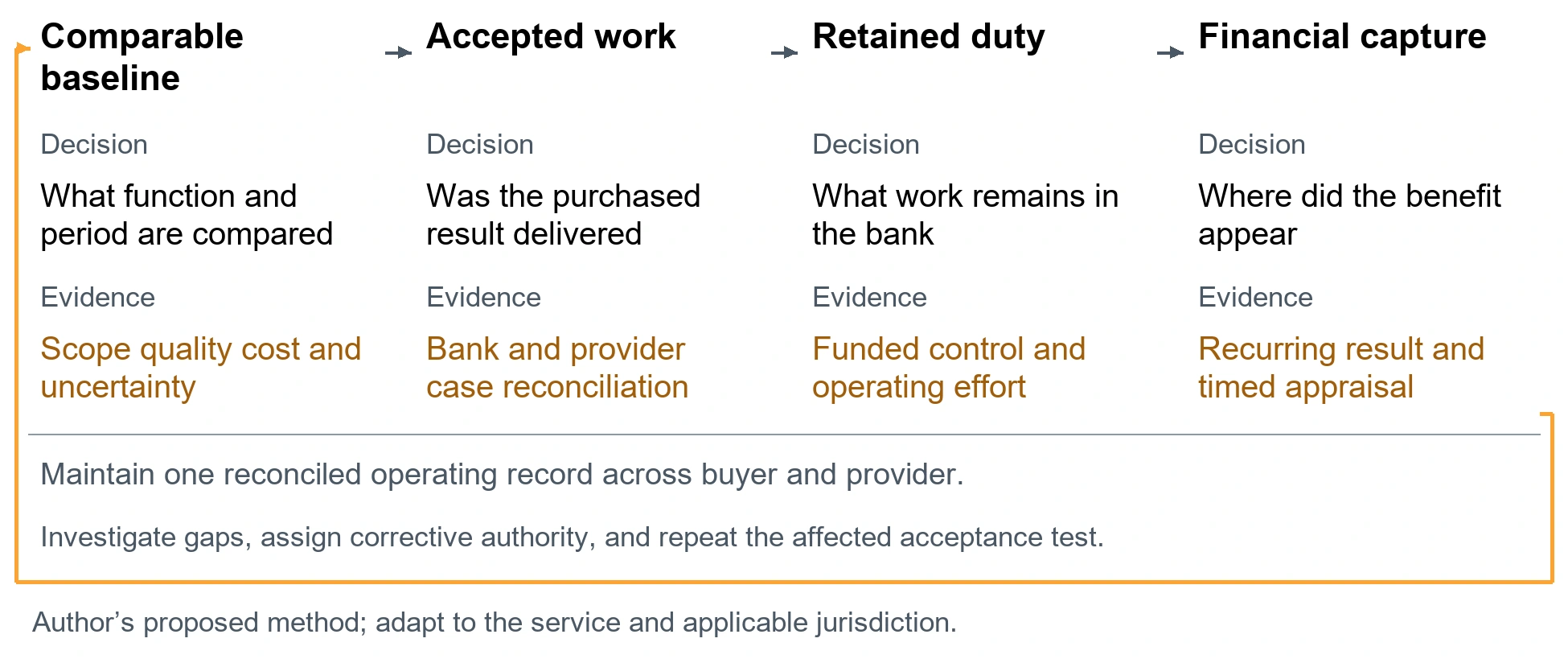
Figure 1 proposes a bridge from baseline to accepted result, retained cost, and financial capture. Each material number should have an owner, source, period, and status as observation, allocation, estimate, or forecast. The bridge should expose the assumptions that could change the approval decision.
Transition investment belongs in a separate timed investment appraisal, alongside the recurring comparison. Include migration, integration, training, dual operation, and required control changes where relevant. A recurring unit-cost reduction should not be labeled investment ROI without considering the investment and benefit timing.
Risk and compliance should identify the control activities the business case assumes. If an activity has not been funded or demonstrated, finance should not count its absence as a saving while management continues to rely on it as a deployment condition. The bank should either provide the capability or change the approved scope.
Keep Outcomes and Local Duties Comparable
The FCA’s current practice review links AI oversight to consumer outcomes and continuing responsibility for outsourced services.3 That UK discussion supports examining the actual service consequence, not treating a financial improvement as sufficient when the purchased outcome deteriorates.
EU, UK, Swiss, and US entities may require different retained controls, data handling, and customer processes. Preserve those differences before aggregation. A global price reduction should not conceal a location where additional work or an unresolved obligation changes the investment conclusion.
Management should test the main uncertainties: accepted volume, exception mix, review effort, consumption charges, service quality, and benefit timing. Use transparent scenarios. A more precise forecast is not more reliable if its underlying acceptance count or cost boundary cannot be substantiated.
Release the Commitment Against Evidence
A reasonable objection is that cross-functional reconciliation can delay a useful opportunity. Stage the investment around the uncertainty that matters most. The board can approve a bounded commitment with evidence milestones and limits while requiring stronger proof before the next stage. It need not choose between immediate scale and indefinite analysis.
The committee should receive the reconciled baseline, actual and forecast costs, accepted outcomes, control prerequisites, captured benefits, and unresolved assumptions. Require management to update the bridge when the delivery model changes. The original business case should not remain the authority for a materially different service.
The board should approve the financial result the bank can explain through service and control evidence. A lower supplier price can be part of that result, but the decision concerns the whole bank function. Value is defensible when accepted outcomes, retained duties, and financial capture reconcile to the investment claim.
Evidence and Source Note
The study is a nonrepresentative cross-section of 850 vendor delivery-team respondents on 150 engagements serving Tier 1 financial institutions, collected during January–June 2026. Neither banks nor vendors corroborated the accounts. It establishes reported experience, not causation, legal breach, or market prevalence. The author-supplied version 1.8.2 is dated November 1, 2026 and is cited as a forthcoming manuscript consulted October 23, 2026.4
This is an analytical decision paper based on the supplied study and selected primary public sources checked through October 23, 2026. The original contribution is a bank business-case evidence bridge reconciling accepted service outcomes, retained control duties, complete buyer cost, and captured financial benefit. The proposed method has not been independently validated. Legal requirements depend on the entity, activity, jurisdiction, and effective provisions; supervisory observations, research, and professional commentary have distinct authority.
Notes
- Chandana Asif et al., “Where AI Agents Pay Off: A Practical Guide to the Economics of Agentic Workflows,” McKinsey & Company, August 24, 2026, “What drives the unit economics of AI-based workflows?”, https://www.mckinsey.com/capabilities/quantumblack/our-insights/where-ai-agents-pay-off-a-practical-guide-to-the-economics-of-agentic-workflows. ↩
- Phil Hatch, Agentic AI Outsourcing at Tier 1 Financial Institutions: Full Study Report, version 1.8.2 (Akholi, forthcoming manuscript dated November 1, 2026), Part 5, “The Five Manual Alteration Methods” and “Disclosure of Manual Alteration,” table 5.8, https://doi.org/10.2139/ssrn.7164559; Hatch, Agentic AI Outsourcing, Part 1, “Customer Satisfaction, Delivery Performance, and Measured Return”. ↩
- Financial Conduct Authority, “AI in Financial Services: Good Practice and Areas for Improvement,” Financial Conduct Authority, October 19, 2026; updated October 20, 2026, secs. 1.2, 2, 3.4 and 4.2; illustrative practices, not new requirements, https://www.fca.org.uk/publications/good-poor-practice/ai-financial-services. ↩
- Hatch, Agentic AI Outsourcing, Introduction, “Executive Summary” and “Evidentiary Basis and Its Limits”. ↩
Bibliography
- Asif, Chandana, Dieter Kiewell, Lari Hämäläinen, Tom Kolaja, and Tunde Olanrewaju. “Where AI Agents Pay Off: A Practical Guide to the Economics of Agentic Workflows.” McKinsey & Company. August 24, 2026. https://www.mckinsey.com/capabilities/quantumblack/our-insights/where-ai-agents-pay-off-a-practical-guide-to-the-economics-of-agentic-workflows.
- Financial Conduct Authority. “AI in Financial Services: Good Practice and Areas for Improvement.” Financial Conduct Authority. October 19, 2026; updated October 20, 2026. https://www.fca.org.uk/publications/good-poor-practice/ai-financial-services.
- Hatch, Phil. Agentic AI Outsourcing at Tier 1 Financial Institutions: Full Study Report. Version 1.8.2. Akholi. Forthcoming manuscript dated November 1, 2026. Author-supplied manuscript consulted October 23, 2026. https://doi.org/10.2139/ssrn.7164559.
Explore this subject
Category: Economics and Value
Topics: Evidence and Traceability Functional Baselines Return on Investment
Audience: Buy-side Boards and Executives
Industry: Banking Financial Services