
Separate Value Creation from Value Allocation
The executive should ask how the agentic service creates value before negotiating how to divide it. Provider capability, buyer data, process redesign, retained expertise, and faster decisions may all contribute. A commercially agreed share can be valid without proving that one party caused the entire benefit.
BCG’s services research identifies friction between enterprise expectations and supplier commitments.1 The proposed allocation method addresses a specific negotiation problem, not a measured universal solution. The parties should establish their own outcome, baseline, and contribution evidence.
For a hypothetical collections-support service, improved recovery may reflect better provider analysis, changed buyer policy, customer mix, or market conditions. Agree which effects the contract measures and which remain outside attribution. Avoid treating a before-and-after difference as proof of one cause.
Make Dependencies Observable
The study reports mismatched decision speed, manual work, and process limitations.2 Those reports do not quantify each party’s contribution to value. They identify operating dependencies that should become explicit before the firms assign payment or blame.
Define buyer prerequisites and provider commitments in terms that can be observed: approved access, decision-ready cases, response authority, accepted quality, and agreed timing. A dependency should identify the affected work and consequence rather than excuse the entire service whenever any buyer system is involved.
Preserve the complete functional baseline and cost comparison. Include retained work and transition. If the parties change the service scope or acceptance standard, record the bridge from the original case so that value is not created on paper by changing the denominator.
Use a Shared Value Allocation Record
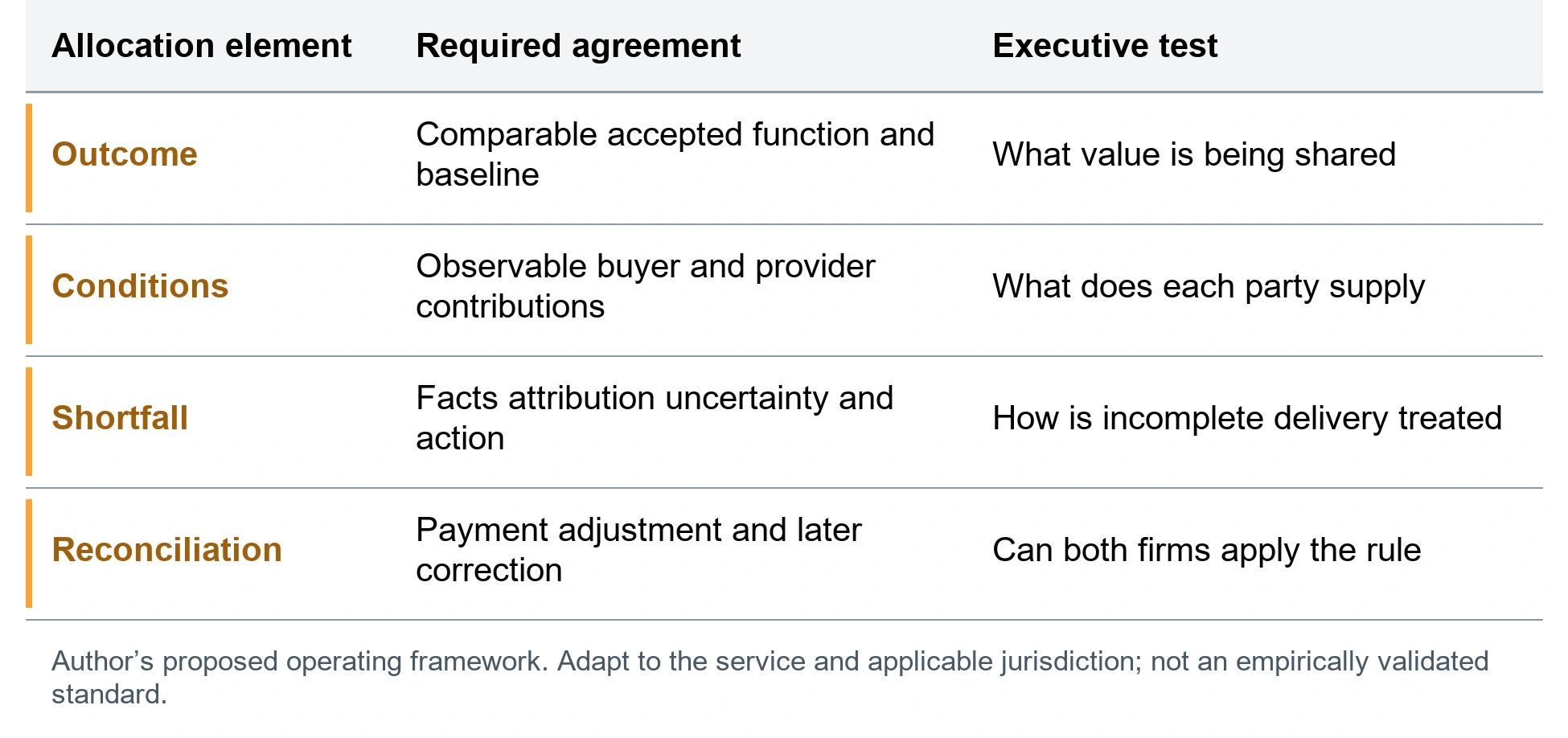
Figure 1 proposes four elements: purchased outcome, contribution conditions, shortfall classification, and commercial reconciliation. Separate observed facts from attribution judgments and negotiated allocation. Record uncertainty when evidence cannot establish a single cause.
Morgan Lewis’s outsourcing overview identifies pricing and governance as connected design issues.3 The contract should support a joint evidence review and correction process. A dispute over allocation should not prevent immediate action necessary to protect the service or affected people.
Define treatment of changed volume, case mix, external events, buyer delay, provider defect, and jointly designed limitations. Use fair, bounded adjustment rules. Neither party should be able to redefine the outcome retrospectively to protect its preferred economic result.
Keep Correction Separate from Commercial Blame
When delivery falls short, first identify what must be contained, completed, or corrected and who has authority to act. Preserve evidence and reservations about responsibility. A commercial debate should run alongside urgent operating work rather than become an unplanned prerequisite for it.
EU, UK, Swiss, US, and other legal and sector requirements can affect liability, customer duties, remedies, tax, and data sharing. Qualified specialists should establish the applicable conclusions. A negotiated value share does not automatically determine statutory responsibility or an affected person’s rights.
Review incentives at the margin. Shared savings can encourage useful collaboration, but it can also reward under-provisioned controls or deferred work if the cost boundary is incomplete. Include necessary assurance, recovery, and retained expertise in the economics.
Reconcile the Agreement Against Actual Delivery
A reasonable objection is that attribution is too uncertain for outcome-based economics. Where causation cannot be established, use a transparent negotiated rule or another pricing model. The important requirement is that both firms understand the uncertainty and can apply the agreed calculation consistently.
During a bounded period, reconcile accepted outcomes, costs, dependencies, shortfalls, and later corrections. Test whether the allocation supports improvement or encourages each team to move work outside its boundary. Revise the commercial design when it undermines the intended function.
The executive should approve an allocation that remains fair and usable when delivery is imperfect. Shared value becomes commercially credible when outcomes, conditions, evidence, correction, and payment fit together. A broad promise to partner does not supply that operating discipline.
Evidence and Source Note
The study is a nonrepresentative cross-section of 850 vendor delivery-team respondents on 150 engagements serving Tier 1 financial institutions, collected during January–June 2026. Neither banks nor vendors corroborated the accounts. It establishes reported experience, not causation, legal breach, or market prevalence. Its application here is a mechanism to investigate, not an estimate of conditions in other industries. The author-supplied version 1.8.2 is dated November 1, 2026 and is cited as a forthcoming manuscript consulted October 23, 2026.4
This is an analytical decision paper based on the supplied study and selected primary public sources checked through October 23, 2026. The original contribution is a shared-value allocation record distinguishing observed delivery, causal uncertainty, negotiated economics, and immediate corrective action. The proposed method has not been independently validated. Legal requirements depend on the entity, activity, jurisdiction, and effective provisions; supervisory observations, research, and professional commentary have distinct authority.
Notes
- Vikash Jain et al., “The $200 Billion Agentic AI Opportunity for Tech Service Providers,” Boston Consulting Group, February 20, 2026, demand and supply survey methodology; expectation and commitment gaps, https://www.bcg.com/publications/2026/the-200-billion-dollar-ai-opportunity-in-tech-services. ↩
- Phil Hatch, Agentic AI Outsourcing at Tier 1 Financial Institutions: Full Study Report, version 1.8.2 (Akholi, forthcoming manuscript dated November 1, 2026), Part 2, sec. 5.2, “Joint Decision Speed Mismatched to Agent Speed”, https://doi.org/10.2139/ssrn.7164559; Hatch, Agentic AI Outsourcing, Part 2, “The Shift From Managing People to Managing Agents”; Part 6, “The Executive Action Plan”. ↩
- Barbara Murphy Melby et al., “AI-Enabled Outsourcing: Key Contract, Pricing, and Governance Considerations,” Morgan Lewis, July 2026, public report overview and key takeaways, https://www.morganlewis.com/pubs/2026/07/ai-enabled-outsourcing-key-contract-pricing-and-governance-considerations. ↩
- Hatch, Agentic AI Outsourcing, Introduction, “Executive Summary” and “Evidentiary Basis and Its Limits”. ↩
Bibliography
- Hatch, Phil. Agentic AI Outsourcing at Tier 1 Financial Institutions: Full Study Report. Version 1.8.2. Akholi. Forthcoming manuscript dated November 1, 2026. Author-supplied manuscript consulted October 23, 2026. https://doi.org/10.2139/ssrn.7164559.
- Jain, Vikash, Sudhanshu Chawla, Saurav Mohanty, Hiren Mittal, Anoop Gopal Singh, Sahib Katyal, and Shailee Raychaudhuri. “The $200 Billion Agentic AI Opportunity for Tech Service Providers.” Boston Consulting Group. February 20, 2026. https://www.bcg.com/publications/2026/the-200-billion-dollar-ai-opportunity-in-tech-services.
- Melby, Barbara Murphy, Marina G. Aronchik, and C. Kari Krusmark. “AI-Enabled Outsourcing: Key Contract, Pricing, and Governance Considerations.” Morgan Lewis. July 2026. https://www.morganlewis.com/pubs/2026/07/ai-enabled-outsourcing-key-contract-pricing-and-governance-considerations.
Explore this subject
Category: Economics and Value
Topics: Joint Operating Model Outcome Pricing Return on Investment
Audience: Buy-side Boards and Executives
Industry: Cross-industry