
Approve a Route to Resolution
The board should ask management what happens when the provider’s agent cannot resolve a customer issue or the customer needs another form of support. The relevant outcome is access to appropriate assistance, not merely an option labeled human. The person receiving the case needs enough context, authority, and capacity to act.
Ofcom’s 2026 telecom discussion warns against AI acting as a barrier to required support channels.1 It does not create a universal new right to human contact for every interaction. The carrier should identify the support duties applicable to its services and make the outsourced operating route capable of fulfilling them.
Start with material customer situations: service loss, disputed billing, failed cancellation, suspected fraud, accessibility needs, and unresolved complaints. Different cases may need different expertise and urgency. One general callback queue should not be assumed to provide an adequate route for all of them.
Preserve Context Across the Handoff
The supplier should transfer the customer’s request, relevant account state, actions already attempted, policy basis, uncertainty, and any commitments made. A customer should not have to restart the case because the automated service and human team cannot share a usable record. Privacy controls should support an authorized handoff rather than leave context inaccessible.
The study’s accounts of fragmented visibility and slow joint decisions identify a transferable handoff problem, not a telecom harm rate.2 The board should require management to test whether the carrier and provider can maintain one accountable case when responsibility moves between them.
For a hypothetical failed cancellation, the human should know whether the agent submitted a request, whether the account changed, and whether further charges remain pending. Without that information, the person may repeat the action, give an incorrect assurance, or send the customer to another team without resolving ownership.
Use an Escalation Capability Record
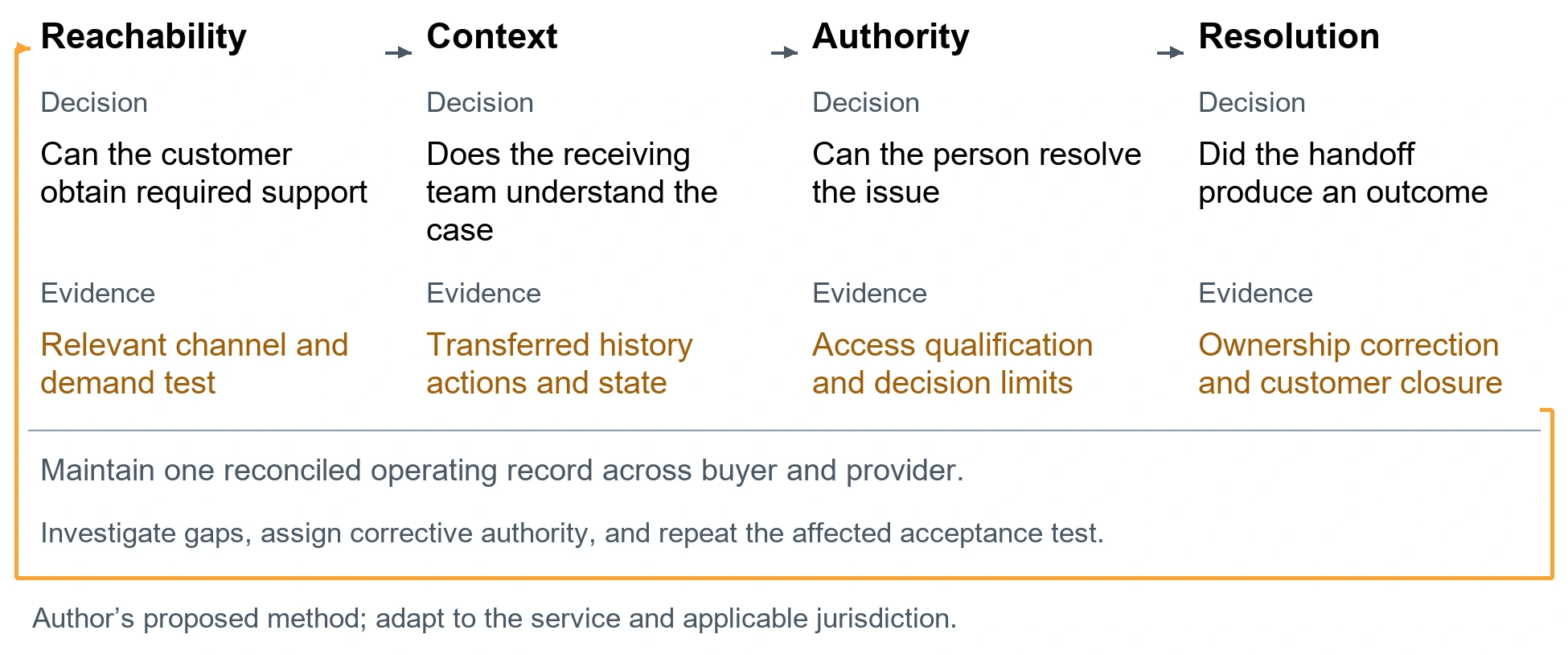
Figure 1 proposes four conditions: reachable support, usable context, decision authority, and completed resolution. Management should identify who owns each condition and how it is evidenced. A supplier response-time metric should not substitute for proof that the receiving person can perform the required work.
Test representative periods of demand, unavailable specialists, failed transfers, and cases needing urgent action. Record waiting time, abandoned handoffs, repeat contacts, unresolved cases, and final outcomes. Interpret these measures with case type and customer needs visible rather than compress them into one average.
CMA guidance addresses the need for accurate customer support and the ability to exercise relevant rights when AI is used.3 The carrier should ensure its provider’s efficiency targets do not reward routing that prevents customers from reaching the function required to act.
Fund the Authority and Capacity Behind the Promise
Identify the qualified people, access, tools, training, and decision limits required. Separate capacity included in the provider fee from carrier specialist support. The same scarce team should not be counted as fully available for several services at once, particularly during a common outage.
EU, UK, Swiss, US, and other telecom, consumer, privacy, accessibility, and complaint duties differ. Management should maintain the local applicability record and support instructions. A common escalation design can organize delivery, while local obligations determine which routes and deadlines must be preserved.
When capacity is exceeded, the service should restrict promises, preserve case ownership, and use an approved contingency route. It should not conceal the backlog by marking a transfer complete. Customers should receive an accurate account of the next step and the current service state.
Make Expansion Depend on a Tested Handoff
A reasonable objection is that additional human support can consume automation savings. Include the necessary capacity in the business case and examine whether better initial resolution reduces avoidable demand. The carrier should not count an unavailable escalation function as both a control and a saving.
The board should receive the capability record, test results, material backlog, unresolved customer effects, and funded remediation. Require reassessment when agent scope, volume, policy, or supplier staffing changes. A successful pilot with low demand should not automatically approve production-scale support.
The human escalation promise is fulfilled when customers can reach appropriate assistance and the case can be resolved under clear authority. The supplier boundary should preserve context and ownership. A human name in the contract is useful only when the operating service behind it works.
Evidence and Source Note
The study is a nonrepresentative cross-section of 850 vendor delivery-team respondents on 150 engagements serving Tier 1 financial institutions, collected during January–June 2026. Neither banks nor vendors corroborated the accounts. It establishes reported experience, not causation, legal breach, or market prevalence. Its application here is a mechanism to investigate, not an estimate of conditions in other industries. The author-supplied version 1.8.2 is dated November 1, 2026 and is cited as a forthcoming manuscript consulted October 23, 2026.4
This is an analytical decision paper based on the supplied study and selected primary public sources checked through October 23, 2026. The original contribution is a telecom escalation-capability record testing whether contracted human support remains reachable, informed, authorized, and able to complete resolution. The proposed method has not been independently validated. Legal requirements depend on the entity, activity, jurisdiction, and effective provisions; supervisory observations, research, and professional commentary have distinct authority.
Notes
- Ofcom, AI in Telecoms Markets: The Impact on Consumers’ Experiences So Far and How It May Develop, Ofcom, September 25, 2026, secs. 1.16–1.18 and 6; discussion and existing framework, not new rules, https://www.ofcom.org.uk/siteassets/resources/documents/internet-based-services/technology/discussion_the-impact-of-ai-in-telecoms-markets-on-consumers-experiences-so-far-and-how-it-may-develop.pdf?v=425794. ↩
- Phil Hatch, Agentic AI Outsourcing at Tier 1 Financial Institutions: Full Study Report, version 1.8.2 (Akholi, forthcoming manuscript dated November 1, 2026), Part 2, sec. 5.1, “Agent Actions Visible Only Inside Each Firm’s Own Tools”, https://doi.org/10.2139/ssrn.7164559; Hatch, Agentic AI Outsourcing, Part 2, sec. 5.2, “Joint Decision Speed Mismatched to Agent Speed”. ↩
- Competition and Markets Authority, “Complying with Consumer Law When Using AI Agents,” Competition and Markets Authority, March 9, 2026, “When it comes to dealing with your customers” and “Monitor how your AI agents are performing”, https://www.gov.uk/government/publications/complying-with-consumer-law-when-using-ai-agents/complying-with-consumer-law-when-using-ai-agents. ↩
- Hatch, Agentic AI Outsourcing, Introduction, “Executive Summary” and “Evidentiary Basis and Its Limits”. ↩
Bibliography
- Competition and Markets Authority. “Complying with Consumer Law When Using AI Agents.” Competition and Markets Authority. March 9, 2026. https://www.gov.uk/government/publications/complying-with-consumer-law-when-using-ai-agents/complying-with-consumer-law-when-using-ai-agents.
- Hatch, Phil. Agentic AI Outsourcing at Tier 1 Financial Institutions: Full Study Report. Version 1.8.2. Akholi. Forthcoming manuscript dated November 1, 2026. Author-supplied manuscript consulted October 23, 2026. https://doi.org/10.2139/ssrn.7164559.
- Ofcom. AI in Telecoms Markets: The Impact on Consumers’ Experiences So Far and How It May Develop. Ofcom. September 25, 2026. https://www.ofcom.org.uk/siteassets/resources/documents/internet-based-services/technology/discussion_the-impact-of-ai-in-telecoms-markets-on-consumers-experiences-so-far-and-how-it-may-develop.pdf?v=425794.
Explore this subject
Category: Governance and Accountability
Topics: Customer Protection Human Oversight Outcome Pricing
Audience: Buy-side Boards and Executives
Industry: Other Regulated Industries Telecommunications