
Give Finance Its Own Acceptance Decision
The CFO should require a finance-owned value assessment before approving a material agentic outsourcing commitment. The provider can describe its offer and the sponsor can explain the opportunity, but neither should be the sole authority for measuring the resulting benefit. Finance needs access to the underlying workload, cost, and acceptance evidence.
McKinsey’s operating-economics analysis distinguishes value from token spending and identifies material costs outside model calls.1 The buyer should therefore test the complete financial claim rather than verify only that the provider’s unit price is lower. The governing question is whether the purchased business function improves after all relevant buyer work and investment are counted.
Start by specifying the decision finance must support: approve investment, release the next stage, continue operation, expand scope, or renegotiate. These decisions need different evidence. A promising pilot can justify further bounded learning without establishing the return from a full transition.
Freeze the Comparison Before the Claim Moves
Define the functional outcome, period, workload mix, acceptance rule, and currency. Preserve the pretransition cost and performance on that basis. A provider may redesign the delivery sequence so extensively that old process steps disappear; finance should compare the business function rather than require a misleading phase-by-phase match.
Where a baseline is missing, reconstruct it from invoices, operating records, time evidence, and service outcomes. State the method and uncertainty. A reconstructed estimate can support a conditional decision, but it should not be presented as an observed historic result. Record which missing evidence would most affect the conclusion.
The study’s reported manual work and outcome difficulties identify possible omissions from a provider business case.2 They are not a cost schedule for this buyer. Finance should use them to investigate retained review, correction, escalation, and unfinished work in its own service.
Reconcile the Claim to Buyer Evidence
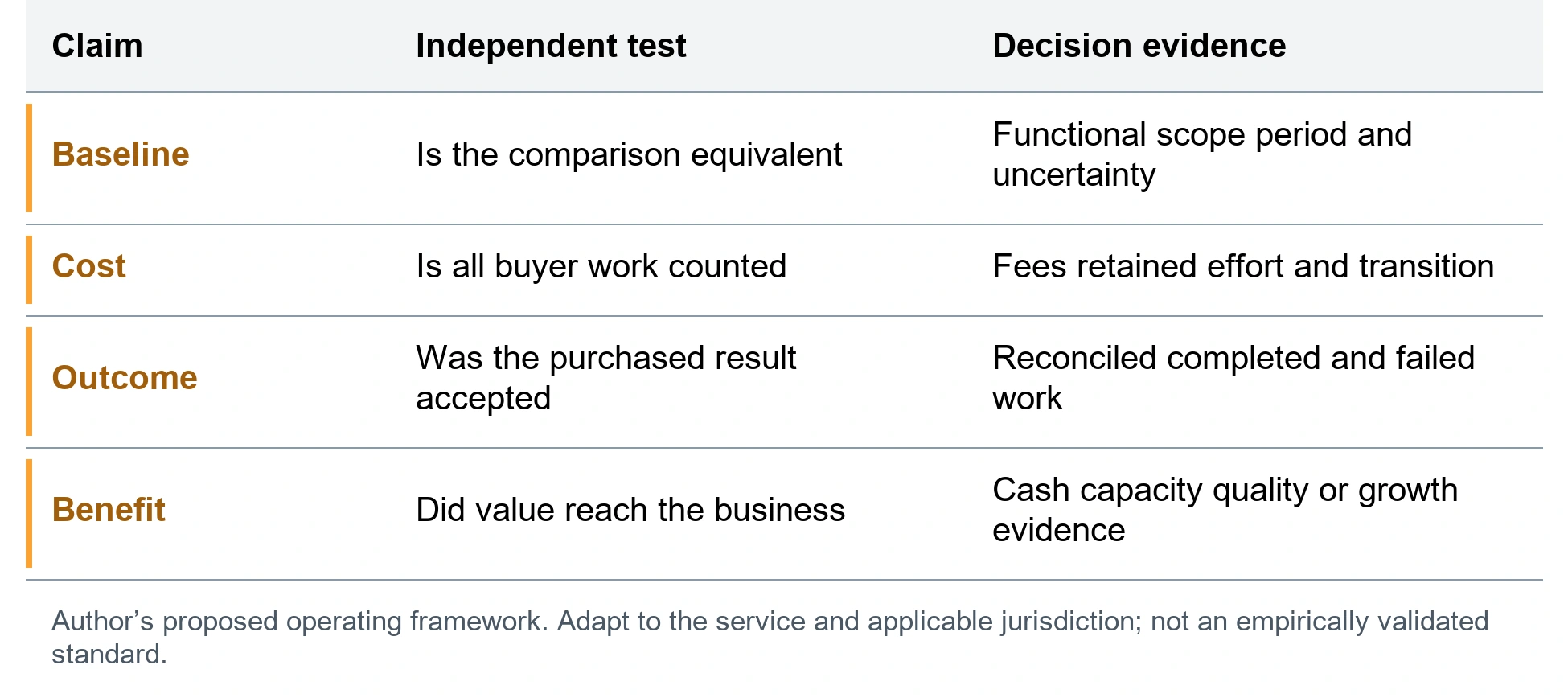
Figure 1 proposes an independent challenge record. Reconcile provider charges with contract terms, retained effort with operating evidence, accepted outcomes with receiving-system records, and claimed benefits with financial or business measures. Separate direct observations, allocations, estimates, and forecasts so disagreement can be resolved at the correct level.
For a hypothetical service, a team may release hours while payroll expense remains unchanged. The released capacity can still be valuable if it supports more accepted work or avoids future recruitment, but finance should identify that mechanism. It should not describe every saved hour as a current cash saving.
Keep transition investment separate from recurring service cost. A lower recurring unit cost can coexist with an unattractive investment if transition expense is high or benefits arrive late. The investment appraisal should state timing, uncertainty, discounting method where relevant, and alternative uses of funds rather than label a unit-cost reduction ROI.
Challenge the Assumptions That Could Reverse Approval
Stanford’s selected successful-deployment cases emphasize complementary organizational investment; they do not establish a universal return or deployment success rate.3 Finance should examine the buyer changes required to capture the benefit, including process redesign, access, training, controls, and management capacity.
Test the assumptions most capable of changing the decision: accepted volume, case complexity, exception work, provider consumption charges, service quality, and benefit timing. Use scenarios with stated assumptions rather than unsupported precision. A lower average cost should not conceal a service that fails on the difficult work the buyer must still complete.
For a multinational service, retain local cost, currency, workload, and control differences before aggregation. EU, UK, Swiss, and US operations may require different retained functions and service conditions. A global average can conceal a location where the proposed economics are unfavorable or the required outcome is not achieved.
Release Investment Against Verified Value
An independent assessment should not become a reason to wait for perfect information. Finance can approve a bounded stage with an exposure limit, evidence milestones, and a clear continuation test. The unresolved uncertainty should determine the size of the commitment and the next measurement, rather than disappear from the investment paper.
Agree a reporting cadence that reconciles forecasts with actual accepted outcomes, costs, and captured benefits. Investigate differences and update the business case. If the provider’s delivery method changes, reassess the cost boundary and the work retained by the buyer before carrying the original value claim forward.
The CFO should approve the claim that survives this reconciliation. The resulting decision may support expansion, redesign, or withdrawal. In every case, finance should be able to explain what improved, what it cost, where the benefit appeared, and which assumptions remain material to the investment.
Evidence and Source Note
The study is a nonrepresentative cross-section of 850 vendor delivery-team respondents on 150 engagements serving Tier 1 financial institutions, collected during January–June 2026. Neither banks nor vendors corroborated the accounts. It establishes reported experience, not causation, legal breach, or market prevalence. Its application here is a mechanism to investigate, not an estimate of conditions in other industries. The author-supplied version 1.8.2 is dated November 1, 2026 and is cited as a forthcoming manuscript consulted October 23, 2026.4
This is an analytical decision paper based on the supplied study and selected primary public sources checked through October 23, 2026. The original contribution is a finance-owned challenge record separating baseline quality, complete buyer cost, accepted outcomes, and captured benefit from sponsor and provider claims. The proposed method has not been independently validated. Legal requirements depend on the entity, activity, jurisdiction, and effective provisions; supervisory observations, research, and professional commentary have distinct authority.
Notes
- Lari Hämäläinen et al., “Is That AI Agent Worth It? Agentic Economics and the Modern Operating Model,” McKinsey & Company, July 13, 2026, “Why the operating expenditure bill keeps rising” and “The implications for competitive dynamics”, https://www.mckinsey.com/capabilities/quantumblack/our-insights/is-that-ai-agent-worth-it-agentic-economics-and-the-modern-operating-model. ↩
- Phil Hatch, Agentic AI Outsourcing at Tier 1 Financial Institutions: Full Study Report, version 1.8.2 (Akholi, forthcoming manuscript dated November 1, 2026), Part 5, “The Five Manual Alteration Methods” and “Disclosure of Manual Alteration,” table 5.8, https://doi.org/10.2139/ssrn.7164559; Hatch, Agentic AI Outsourcing, Part 1, “Customer Satisfaction, Delivery Performance, and Measured Return”. ↩
- Elisa Pereira et al., The Enterprise AI Playbook: Lessons from 51 Successful Deployments, Stanford Digital Economy Lab, April 2026, methodology and chapters 1–3 and 8; purposive successful-case sample, https://digitaleconomy.stanford.edu/app/uploads/2026/03/EnterpriseAIPlaybook_PereiraGraylinBrynjolfsson.pdf. ↩
- Hatch, Agentic AI Outsourcing, Introduction, “Executive Summary” and “Evidentiary Basis and Its Limits”. ↩
Bibliography
- Hatch, Phil. Agentic AI Outsourcing at Tier 1 Financial Institutions: Full Study Report. Version 1.8.2. Akholi. Forthcoming manuscript dated November 1, 2026. Author-supplied manuscript consulted October 23, 2026. https://doi.org/10.2139/ssrn.7164559.
- Hämäläinen, Lari, Mark Patel, Sven Blumberg, Tanguy Catlin, and Wasim Lala. “Is That AI Agent Worth It? Agentic Economics and the Modern Operating Model.” McKinsey & Company. July 13, 2026. https://www.mckinsey.com/capabilities/quantumblack/our-insights/is-that-ai-agent-worth-it-agentic-economics-and-the-modern-operating-model.
- Pereira, Elisa, Alvin Wang Graylin, and Erik Brynjolfsson. The Enterprise AI Playbook: Lessons from 51 Successful Deployments. Stanford Digital Economy Lab. April 2026. https://digitaleconomy.stanford.edu/app/uploads/2026/03/EnterpriseAIPlaybook_PereiraGraylinBrynjolfsson.pdf.
Explore this subject
Category: Economics and Value
Topics: Evidence and Traceability Functional Baselines Return on Investment
Audience: Buy-side Boards and Executives
Industry: Cross-industry