
Start with the Business Time Constraint
The manager should identify the latest useful completion time and work backward through the joint workflow. Some services have external cutoffs; others have customer commitments, operational tolerances, or practical limits before information becomes stale. A generic fast-response target should not replace that business context.
McKinsey’s organizational analysis emphasizes clearer decision rights and reduced unnecessary handoffs.1 The proposed budget applies that idea to an individual two-party workflow. It is a management design method, not a validated universal response-time standard.
For a hypothetical access service, an urgent exception may need a qualified buyer decision within the remaining service window. The provider’s fast detection creates value only if it delivers enough information to the person authorized to act and leaves time for execution.
Separate Queue Time from Decision Work
The study reports joint decisions mismatched to agentic delivery speed.2 The manager should test the actual causes of waiting rather than assume every approval is unnecessary. Delays can arise from incomplete evidence, uncertain ownership, unavailable specialists, or required deliberation.
Record request time, evidence-ready time, assignment, decision, and execution. Distinguish necessary review effort from waiting for information or authority. If the business clock continues while an internal metric pauses, preserve both facts so that reported responsiveness does not conceal late outcomes.
Identify decision classes and consequences. Routine bounded approvals, professional judgments, financial authority, and emergency containment need different coverage and escalation. One shared mailbox with one response target is unlikely to describe those distinctions adequately.
Use a Decision Time Budget
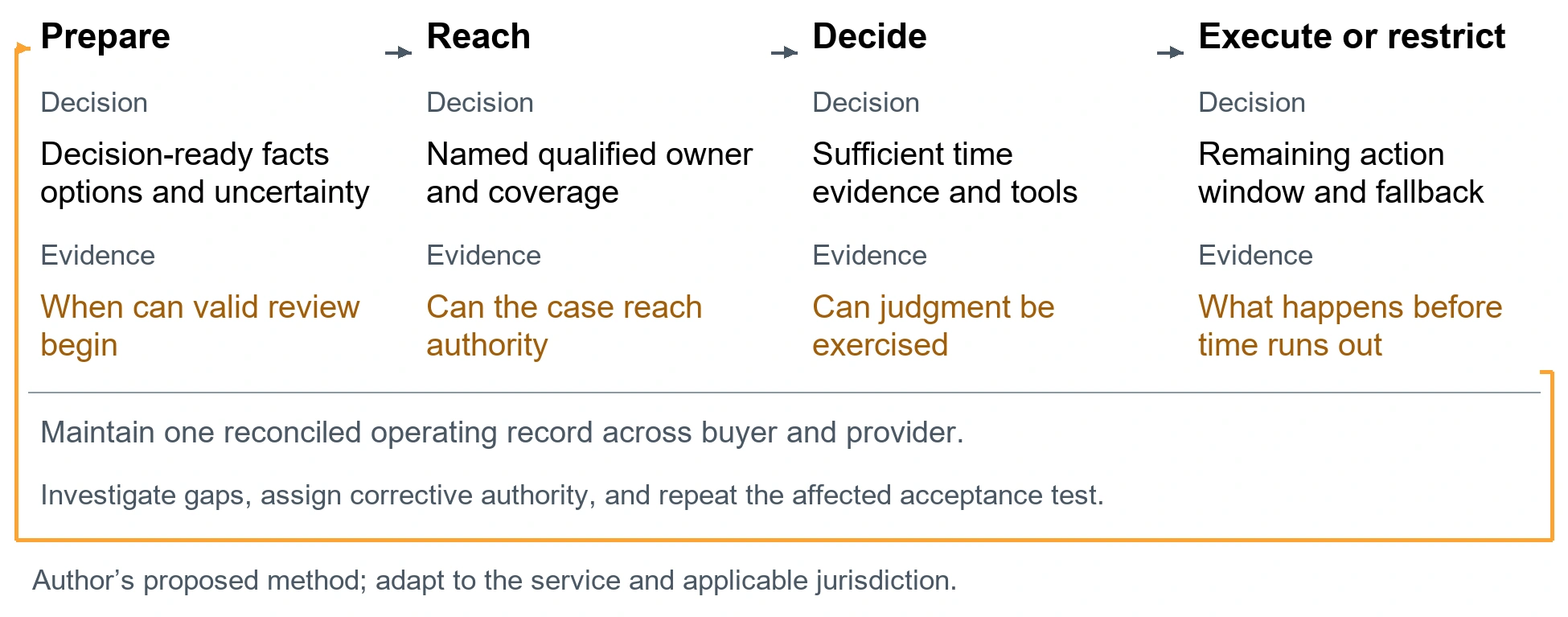
Figure 1 proposes four allocations: prepare the case, reach the owner, decide, and execute or restrict. Assign an owner and evidence standard to each. Include a buffer appropriate to uncertainty and define the latest safe point for escalation.
Test peak demand, absences, time zones, conflicting instructions, and simultaneous issues. Measure whether qualified decision capacity is sufficient, including the information and tools required. A named deputy is not coverage if the deputy lacks permission or the relevant expertise.
Stanford’s selected deployment cases emphasize task-appropriate human oversight.3 They do not validate a particular time budget. The manager should demonstrate that the designed review can operate at the intended workload and still exercise meaningful judgment.
Agree What Happens When the Budget Is Exhausted
A late decision should trigger an approved operating response: pause, restrict, defer, use a qualified alternate, or follow another authorized route. Silence should not become permission by default unless the governing authority has explicitly established a lawful and suitable rule.
EU, UK, Swiss, US, and other obligations can reserve decisions or require specific qualifications, notices, and evidence. Qualified owners should determine those constraints. The time budget should accommodate required judgment rather than erase it to satisfy a service metric.
Commercial terms should identify buyer and provider dependencies and the evidence used to assess delay. Keep urgent resolution separate from cost attribution. A disagreement about which party consumed the time should not prevent a necessary restriction or corrective action.
Improve the Slowest Consequential Decision
A reasonable objection is that precise time allocation is artificial in variable work. Use ranges and stated assumptions where appropriate. The purpose is to expose a design that cannot meet its own outcome, not to claim certainty about every case.
Run a representative exercise with the actual roles and configuration. Compare the budget with observed time to a usable authorized decision and accepted result. Improve the largest avoidable waits, verify the effect, and review the budget after material changes in volume or scope.
The manager should be able to explain how the service obtains the decisions it needs before the outcome is lost. A decision-time budget makes that capability testable. It joins evidence, people, authority, and execution into one realistic operating commitment.
Evidence and Source Note
The study is a nonrepresentative cross-section of 850 vendor delivery-team respondents on 150 engagements serving Tier 1 financial institutions, collected during January–June 2026. Neither banks nor vendors corroborated the accounts. It establishes reported experience, not causation, legal breach, or market prevalence. Its application here is a mechanism to investigate, not an estimate of conditions in other industries. The author-supplied version 1.8.2 is dated November 1, 2026 and is cited as a forthcoming manuscript consulted October 23, 2026.4
This is an analytical decision paper based on the supplied study and selected primary public sources checked through October 23, 2026. The original contribution is a workflow-level decision-time budget separating evidence preparation, access to authority, qualified judgment, and the remaining execution window. The proposed method has not been independently validated. Legal requirements depend on the entity, activity, jurisdiction, and effective provisions; supervisory observations, research, and professional commentary have distinct authority.
Notes
- McKinsey & Company, “AI Is Changing Work. Now It Has to Change the Organization,” McKinsey & Company, October 5, 2026, “Operating model,” “Talent,” and “Enabling AI reinvention”, https://www.mckinsey.com/capabilities/people-and-organization/our-insights/ai-is-changing-work-now-it-has-to-change-the-organization. ↩
- Phil Hatch, Agentic AI Outsourcing at Tier 1 Financial Institutions: Full Study Report, version 1.8.2 (Akholi, forthcoming manuscript dated November 1, 2026), Part 2, sec. 5.2, “Joint Decision Speed Mismatched to Agent Speed”, https://doi.org/10.2139/ssrn.7164559. ↩
- Elisa Pereira et al., The Enterprise AI Playbook: Lessons from 51 Successful Deployments, Stanford Digital Economy Lab, April 2026, methodology and chapters 1–3 and 8; purposive successful-case sample, https://digitaleconomy.stanford.edu/app/uploads/2026/03/EnterpriseAIPlaybook_PereiraGraylinBrynjolfsson.pdf. ↩
- Hatch, Agentic AI Outsourcing, Introduction, “Executive Summary” and “Evidentiary Basis and Its Limits”. ↩
Bibliography
- Hatch, Phil. Agentic AI Outsourcing at Tier 1 Financial Institutions: Full Study Report. Version 1.8.2. Akholi. Forthcoming manuscript dated November 1, 2026. Author-supplied manuscript consulted October 23, 2026. https://doi.org/10.2139/ssrn.7164559.
- McKinsey & Company. “AI Is Changing Work. Now It Has to Change the Organization.” McKinsey & Company. October 5, 2026. https://www.mckinsey.com/capabilities/people-and-organization/our-insights/ai-is-changing-work-now-it-has-to-change-the-organization.
- Pereira, Elisa, Alvin Wang Graylin, and Erik Brynjolfsson. The Enterprise AI Playbook: Lessons from 51 Successful Deployments. Stanford Digital Economy Lab. April 2026. https://digitaleconomy.stanford.edu/app/uploads/2026/03/EnterpriseAIPlaybook_PereiraGraylinBrynjolfsson.pdf.
Explore this subject
Category: Delivery and Operations
Topics: Decision Latency Delegated Authority Joint Operating Model
Audience: Buy-side Delivery and Vendor Managers
Industry: Cross-industry