
Start with the Outcome and Work Backward
The executive should define the accepted business result before approving an agentic process design. Map what must happen from the initiating need to final disposition, including buyer work, provider work, external dependencies, controls, and recovery. Existing organizational boundaries should be inputs to redesign, not an assumption that every inherited handoff must remain.
McKinsey’s scaling blueprint emphasizes redesigning work rather than layering agents onto unchanged processes.1 It is practitioner guidance, not a controlled validation of one operating model. The buyer-provider task is to determine which changes improve the specific outsourced function.
For a hypothetical order service, faster preparation may create little benefit if buyer approval remains slow and exceptions return without usable evidence. The executive should consider the complete sequence, including whether a handoff can be removed, a decision delegated within limits, or information supplied earlier.
Map Authority Alongside Work
A process map should show who can decide, what evidence supports the decision, and which system enforces the resulting authority. An agent may change the number and timing of decisions even when the nominal task remains the same. The retained organization and provider team must be designed together.
The study reports processes and organizations not optimized for agentic delivery, along with mismatched joint decision speed.2 These reports do not prove a particular redesign will improve performance. They identify operating assumptions that management should test before scaling.
Separate mandatory controls from inherited administrative steps. Remove unnecessary friction where justified, but preserve the purpose of required review, qualified judgment, and customer choice. A redesigned process should explain how the control objective is achieved, not simply show fewer boxes.
Use a Two Firm Outcome Design Record
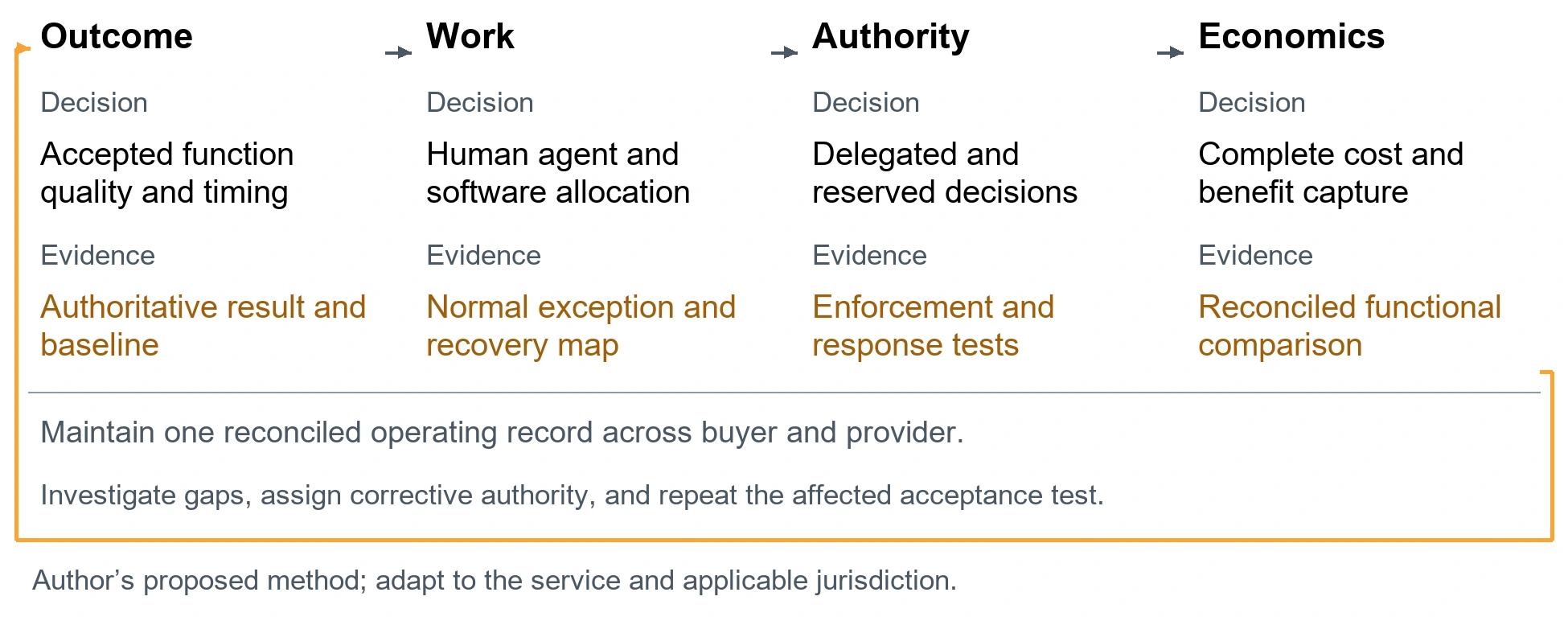
Figure 1 proposes four layers: accepted result, work allocation, decision authority, and evidence. Identify the human, agent, conventional software, or combined method best suited to each part. Autonomy should earn its place through useful performance rather than be a design target in itself.
Map exceptions and recovery with the normal path. Include human corrections, work returned to the buyer, pending decisions, and actions that cannot be reversed by stopping the agent. A process that works only when no exception occurs is an incomplete production design.
PwC’s shared-services discussion emphasizes outcome-oriented operating change beyond labor arbitrage.3 The proposed record applies that direction across two organizations. Compare the complete functional cost and performance before and after transition rather than force equivalence between obsolete process phases.
Align Contract Tools People and Measures
The contract should reflect the actual operating model: scope, authority, prerequisites, accepted outcomes, change, evidence, intervention, and transition. Resolve contradictions between commercial promises and practical permissions before release. Staff should not be expected to bridge them informally.
EU, UK, Swiss, US, and other local obligations can constrain delegation, data use, professional decisions, or recovery. Qualified owners should incorporate those conclusions into the workflow. A common operating method can preserve jurisdiction-specific requirements without recreating unnecessary local variation.
Fund the retained and provider capabilities needed for the design. Include training, decision coverage, evidence systems, assurance, and recovery. If the redesigned service costs more in one component but improves the complete function, evaluate that trade-off at the functional level.
Demonstrate the New Method Before Expanding It
A reasonable objection is that full redesign delays value. Use a bounded function with a clear outcome, representative cases, and a staged commitment. Learn from the complete operating sequence before repeating it across the portfolio. A pilot should test organization and control as well as technology.
Compare accepted outcomes, elapsed time, total cost, quality, retained work, and material exceptions against a stated baseline. Record uncertainty and conditions not represented. Revise the design where a bottleneck or hidden dependency remains rather than preserve it to defend the original plan.
The executive should approve an improved delivery method, not a block swap. Agentic capability changes what can be performed and how firms must coordinate. Value emerges when the work, authority, people, tools, and evidence are deliberately organized around the result the buyer needs.
Evidence and Source Note
The study is a nonrepresentative cross-section of 850 vendor delivery-team respondents on 150 engagements serving Tier 1 financial institutions, collected during January–June 2026. Neither banks nor vendors corroborated the accounts. It establishes reported experience, not causation, legal breach, or market prevalence. Its application here is a mechanism to investigate, not an estimate of conditions in other industries. The author-supplied version 1.8.2 is dated November 1, 2026 and is cited as a forthcoming manuscript consulted October 23, 2026.4
This is an analytical decision paper based on the supplied study and selected primary public sources checked through October 23, 2026. The original contribution is a two-firm outcome design record connecting end-to-end process redesign to authority, exception handling, and functional economics. The proposed method has not been independently validated. Legal requirements depend on the entity, activity, jurisdiction, and effective provisions; supervisory observations, research, and professional commentary have distinct authority.
Notes
- McKinsey & Company, “Stacking the Odds: A Blueprint for Successfully Scaling Agentic AI,” McKinsey & Company, September 14, 2026, workflow redesign, technical foundation, and operating-model blueprint, https://www.mckinsey.com/capabilities/operations/our-insights/stacking-the-odds-a-blueprint-for-successfully-scaling-agentic-ai. ↩
- Phil Hatch, Agentic AI Outsourcing at Tier 1 Financial Institutions: Full Study Report, version 1.8.2 (Akholi, forthcoming manuscript dated November 1, 2026), Part 2, “The Shift From Managing People to Managing Agents”; Part 6, “The Executive Action Plan”, https://doi.org/10.2139/ssrn.7164559; Hatch, Agentic AI Outsourcing, Part 2, sec. 5.2, “Joint Decision Speed Mismatched to Agent Speed”. ↩
- Namit Kapoor et al., “Agentic-First GBS: Moving beyond Labor Arbitrage,” PwC, May 2026, business outcomes and full cost of capability, https://www.pwc.com/us/en/services/consulting/business-transformation/intelligence-over-arbitrage-agentic-gbs.html. ↩
- Hatch, Agentic AI Outsourcing, Introduction, “Executive Summary” and “Evidentiary Basis and Its Limits”. ↩
Bibliography
- Hatch, Phil. Agentic AI Outsourcing at Tier 1 Financial Institutions: Full Study Report. Version 1.8.2. Akholi. Forthcoming manuscript dated November 1, 2026. Author-supplied manuscript consulted October 23, 2026. https://doi.org/10.2139/ssrn.7164559.
- Kapoor, Namit, Mukund Kumar, and Fuad Abdelhadi. “Agentic-First GBS: Moving beyond Labor Arbitrage.” PwC. May 2026. https://www.pwc.com/us/en/services/consulting/business-transformation/intelligence-over-arbitrage-agentic-gbs.html.
- McKinsey & Company. “Stacking the Odds: A Blueprint for Successfully Scaling Agentic AI.” McKinsey & Company. September 14, 2026. https://www.mckinsey.com/capabilities/operations/our-insights/stacking-the-odds-a-blueprint-for-successfully-scaling-agentic-ai.
Explore this subject
Category: Delivery and Operations
Topics: Joint Operating Model Outcome Verification Process Redesign
Audience: Buy-side Boards and Executives
Industry: Cross-industry