
Sell the Service the Customer Will Receive
The provider executive should specify the continuing business work it will perform after implementation. An agentic solution can involve tool use, case decisions, human support, monitoring, configuration changes, and recovery. A contract that describes only access to software leaves essential operating duties unresolved.
Mayer Brown’s services-contract analysis distinguishes autonomous service delivery from a passive software-access model.1 The provider should use that distinction to define a bounded, supportable offer. It should not promise an unlimited business result merely because the agent can plan a sequence of tasks.
Identify the customer outcome, permitted actions, workload, quality, timing, and exclusions. State which decisions remain with the buyer and which prerequisites the buyer must supply. The offer should be clear enough for sales, delivery, assurance, and the customer to describe the same service.
Make the Continuing Work Visible
The service definition should include how exceptions are detected, who resolves them, what human capacity is available, and how unfinished work is returned. An operating commitment needs a case-state model and an escalation route, not simply a help-desk address for software faults.
The study reports manual work that supports delivery alongside processes poorly matched to agents.2 Those findings do not establish the cost of the provider’s offer. They identify operating tasks that should be measured and assigned rather than disappear behind an autonomy description.
For a hypothetical procurement-support service, the agent may gather options while people resolve missing specifications and supplier restrictions. The provider should state whether that judgment is included, separately priced, or retained by the buyer. An ambiguous boundary can create disputes about both completion and margin.
Use an Operating Service Schedule
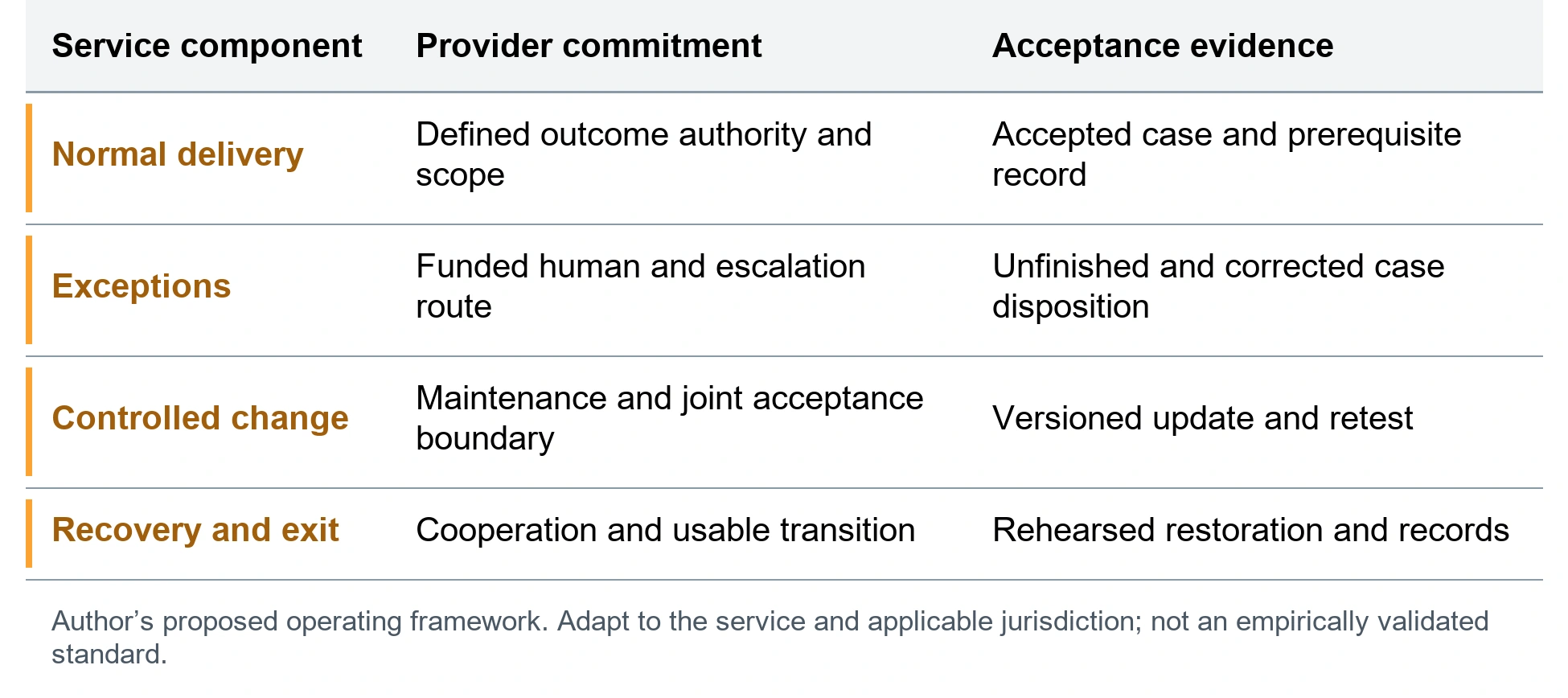
Figure 1 proposes four parts of the continuing offer: normal delivery, exceptions, controlled change, and recovery. Each should identify an owner, service commitment, required buyer input, and evidence of completion. The schedule should explain what happens when a prerequisite is unavailable.
Define the provider’s monitoring and evidence duties. The customer needs information about actual outcomes, human intervention, unresolved work, material changes, and operating limitations. A dashboard of model calls or uptime can support technical management but should not replace the measures of the purchased business function.
The offer should state what is maintained as technology changes. Model updates, tool changes, policy revisions, and new dependencies can alter service behavior. Identify included maintenance, changes requiring joint acceptance, and expansion treated as a new commercial decision. A broad improvement clause should not erase the agreed authority boundary.
Price Resilience and Governance as Real Work
Morgan Lewis’s outsourcing report links AI transformation to continuing responsibilities, milestones, and governance.3 The provider should include the work needed to sustain the promise: assurance, access administration, incident cooperation, training, evidence retention, and transition readiness. Unfunded operating duties remain delivery risks even if the initial implementation is profitable.
Distinguish provider cost from the buyer’s total cost. The provider should disclose relevant customer prerequisites and retained tasks without claiming to know all buyer expenditure. A transparent service boundary helps the buyer evaluate value and helps the provider avoid guaranteeing savings that depend on actions outside its control.
For global services, maintain a common operating description with local conditions for privacy, employment, professional duties, records, and regulated activity. EU, UK, Swiss, and US operations may require different support and assurance. State which local assessments are included and which remain the customer’s responsibility.
Accept the Offer Through a Joint Operating Demonstration
A reasonable objection is that a broad operating service creates excessive provider liability. Bound the scope and authority, identify dependencies, and negotiate remedies appropriate to the actual promise. Precision can reduce exposure for both sides. An undefined software disclaimer does not resolve the commercial expectation that the supplier is performing work.
Before launch, demonstrate normal delivery, a material exception, a controlled update, and recovery from interruption. Confirm the evidence each party receives and who decides acceptance. Record remaining limits and the conditions for expansion. The sales description should be revised if the demonstrated service is narrower than the proposed offer.
The provider should sell an operating commitment it can sustain throughout the contract. Clear responsibilities for exceptions, evidence, change, and recovery make that commitment reviewable. The offer becomes credible when the customer can understand not only how the service begins, but how it continues to deliver accepted work as conditions change.
Evidence and Source Note
The study is a nonrepresentative cross-section of 850 vendor delivery-team respondents on 150 engagements serving Tier 1 financial institutions, collected during January–June 2026. Neither banks nor vendors corroborated the accounts. It establishes reported experience, not causation, legal breach, or market prevalence. Its application here is a mechanism to investigate, not an estimate of conditions in other industries. The author-supplied version 1.8.2 is dated November 1, 2026 and is cited as a forthcoming manuscript consulted October 23, 2026.4
This is an analytical decision paper based on the supplied study and selected primary public sources checked through October 23, 2026. The original contribution is an operating-service schedule that turns an agentic offer into explicit continuing commitments for normal work, exceptions, change, evidence, recovery, and exit. The proposed method has not been independently validated. Legal requirements depend on the entity, activity, jurisdiction, and effective provisions; supervisory observations, research, and professional commentary have distinct authority.
Notes
- Rohith P. George et al., “Contracting for Agentic AI Solutions: Shifting the Model from SaaS to Services,” Mayer Brown, February 17, 2026, secs. 1–6, https://www.mayerbrown.com/en/insights/publications/2026/02/contracting-for-agentic-ai-solutions-shifting-the-model-from-saas-to-services. ↩
- Phil Hatch, Agentic AI Outsourcing at Tier 1 Financial Institutions: Full Study Report, version 1.8.2 (Akholi, forthcoming manuscript dated November 1, 2026), Part 5, “The Five Manual Alteration Methods” and “Disclosure of Manual Alteration,” table 5.8, https://doi.org/10.2139/ssrn.7164559; Hatch, Agentic AI Outsourcing, Part 2, “The Shift From Managing People to Managing Agents”; Part 6, “The Executive Action Plan”. ↩
- Barbara Murphy Melby et al., “AI-Enabled Outsourcing: Key Contract, Pricing, and Governance Considerations,” Morgan Lewis, July 2026, public report overview and key takeaways, https://www.morganlewis.com/pubs/2026/07/ai-enabled-outsourcing-key-contract-pricing-and-governance-considerations. ↩
- Hatch, Agentic AI Outsourcing, Introduction, “Executive Summary” and “Evidentiary Basis and Its Limits”. ↩
Bibliography
- George, Rohith P., Joe Pennell, Brad L. Peterson, and Oliver Yaros. “Contracting for Agentic AI Solutions: Shifting the Model from SaaS to Services.” Mayer Brown. February 17, 2026. https://www.mayerbrown.com/en/insights/publications/2026/02/contracting-for-agentic-ai-solutions-shifting-the-model-from-saas-to-services.
- Hatch, Phil. Agentic AI Outsourcing at Tier 1 Financial Institutions: Full Study Report. Version 1.8.2. Akholi. Forthcoming manuscript dated November 1, 2026. Author-supplied manuscript consulted October 23, 2026. https://doi.org/10.2139/ssrn.7164559.
- Melby, Barbara Murphy, Marina G. Aronchik, and C. Kari Krusmark. “AI-Enabled Outsourcing: Key Contract, Pricing, and Governance Considerations.” Morgan Lewis. July 2026. https://www.morganlewis.com/pubs/2026/07/ai-enabled-outsourcing-key-contract-pricing-and-governance-considerations.
Explore this subject
Category: Delivery and Operations
Topics: Change Control Joint Operating Model Outcome Verification
Audience: Service Providers
Industry: Cross-industry