
Treat Successor Operation as a Service Requirement
The provider leader should ask what the public authority must continue after the contract ends or the supplier becomes unavailable. The relevant outcome may include ongoing delivery, restricted service, explanation of historical decisions, and completion of pending cases. An export alone does not establish those capabilities.
The UK government AI playbook identifies successor transfer and intellectual property as procurement considerations.1 The provider should assess the actual local contract and public-sector requirements. It should not assume all authorities need ownership of the same artifacts or unrestricted disclosure of background technology.
Define the intended handover scope, receiving roles, artifacts, formats, rights, assistance, and performance limits. State which parts of the service can transfer and which require replacement or reengineering. An honest transition design is preferable to an untested promise of seamless exit.
Capture the Knowledge Needed to Continue
The study reports knowledge in personal notes and incomplete downstream dependency maps.2 It does not measure public-sector transition outcomes. It identifies why the provider should turn important operating knowledge into usable, maintained transfer assets.
For a hypothetical public-enquiry service, a successor may need approved policy versions, retrieval sources, unresolved commitments, escalation rules, and evidence of prior actions. Transcripts alone may not explain which cases remain open or which statements require correction.
Separate public-authority information, buyer-specific configuration, supplier background IP, and third-party material. Agree the permissions and substitutes needed for successor operation. Protect legitimate proprietary interests while ensuring the authority can exercise the rights necessary for its public function.
Use a Successor Operability Record
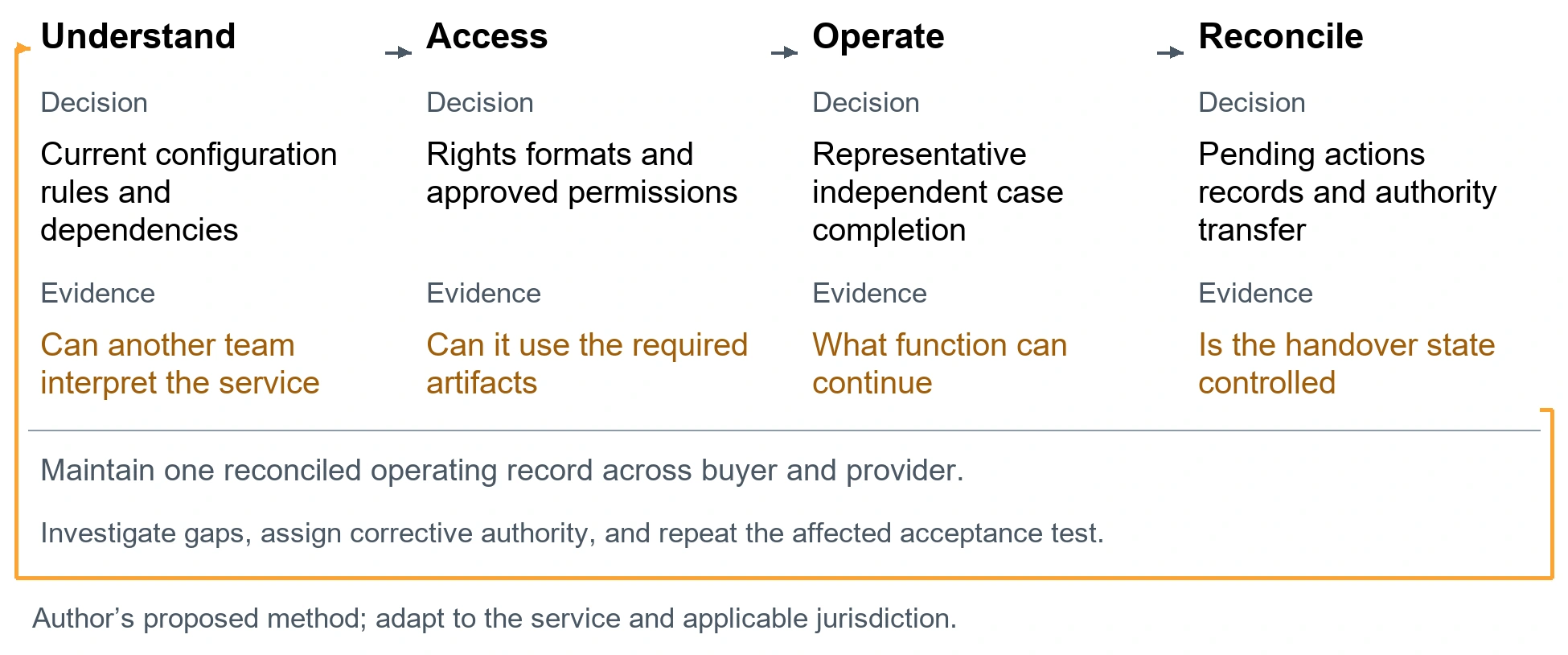
Figure 1 proposes four demonstrations: understand the service, obtain lawful access, complete representative work, and reconcile transition state. Maintain the record during delivery rather than assemble it only after termination notice. Material changes should update the relevant handover assets.
Ask a receiving team to use the documentation, artifacts, and approved access without routine help from the primary delivery expert. Include a difficult case and incomplete work. Record the assistance still required and the cost or delay of replacing a nontransferable component.
Morgan Lewis’s contracting analysis addresses continuing access and transition rights.3 The proposed operability test makes those commitments concrete. It gives the provider and authority a shared basis for deciding which transition capability exists and which remains an assumption.
Preserve Accountability During the Handover
EU, UK, Swiss, US, and other public bodies have different procurement, privacy, records, transparency, security, and IP duties. Agree the applicable local conditions with qualified owners. Transfer should preserve authorized access and required records without distributing sensitive information unnecessarily.
Reconcile pending cases, queued actions, active delegations, external commitments, and unresolved incidents. Identify the point at which the successor takes responsibility for each. Withdraw incumbent permissions in a controlled sequence and prevent both firms from executing the same business intent.
Plan for both cooperative transition and supplier failure. Assistance promised at a planned exit may be unavailable during distress or dispute. State which critical artifacts and capabilities the authority can access independently and which need additional protection or a different continuity design.
Demonstrate the Transfer Before It Is Urgent
A reasonable objection is that successor readiness weakens the provider’s commercial position. A credible transition capability can improve buyer trust and reduce disputes over lock-in. The provider can compete on service quality and innovation while making essential continuity terms clear and fairly priced.
Agree a proportionate exercise during mobilization and repeat it after material change. Record accepted scope, missing rights, unusable formats, knowledge gaps, and corrective owners. Include transition maintenance in the delivery economics instead of assuming it is costless.
The provider should offer a public service that remains governable beyond its own tenure. Successor operability does not require every platform component to transfer. It requires a lawful, usable, and tested route for the authority to continue the function and explain the work on which the public has relied.
Evidence and Source Note
The study is a nonrepresentative cross-section of 850 vendor delivery-team respondents on 150 engagements serving Tier 1 financial institutions, collected during January–June 2026. Neither banks nor vendors corroborated the accounts. It establishes reported experience, not causation, legal breach, or market prevalence. Its application here is a mechanism to investigate, not an estimate of conditions in other industries. The author-supplied version 1.8.2 is dated November 1, 2026 and is cited as a forthcoming manuscript consulted October 23, 2026.4
This is an analytical decision paper based on the supplied study and selected primary public sources checked through October 23, 2026. The original contribution is a provider successor-operability record connecting maintained transfer assets, practical execution, and reconciled public-service responsibility. The proposed method has not been independently validated. Legal requirements depend on the entity, activity, jurisdiction, and effective provisions; supervisory observations, research, and professional commentary have distinct authority.
Notes
- Government Digital Service, Artificial Intelligence Playbook for the UK Government (Government Digital Service, February 10, 2025), Contractual issues, Intellectual property, including copyright, and Buying AI, https://www.gov.uk/government/publications/ai-playbook-for-the-uk-government/artificial-intelligence-playbook-for-the-uk-government-html. ↩
- Phil Hatch, Agentic AI Outsourcing at Tier 1 Financial Institutions: Full Study Report, version 1.8.2 (Akholi, forthcoming manuscript dated November 1, 2026), Part 4, “Knowledge at Risk of Departure”, https://doi.org/10.2139/ssrn.7164559; Hatch, Agentic AI Outsourcing, Part 3, Third-Party Ecosystem, sec. 6.1, “Mapping of Third and Fourth Party Dependencies,” indicator C196. ↩
- Doneld Shelkey, “Negotiating AI Provisions in Commercial and Technology Contracts: Where the Market Is Heading,” The Licensing Journal, May 1, 2026, pp. 1–2, intellectual property and transition, https://www.morganlewis.com/-/media/files/publication/outside-publication/article/2026/negotiating-ai-provisions-in-commercial-and-technology-contracts-where-the-market-is-heading-the-licensing-journal.pdf. ↩
- Hatch, Agentic AI Outsourcing, Introduction, “Executive Summary” and “Evidentiary Basis and Its Limits”. ↩
Bibliography
- Government Digital Service. Artificial Intelligence Playbook for the UK Government. Government Digital Service, February 10, 2025. https://www.gov.uk/government/publications/ai-playbook-for-the-uk-government/artificial-intelligence-playbook-for-the-uk-government-html.
- Hatch, Phil. Agentic AI Outsourcing at Tier 1 Financial Institutions: Full Study Report. Version 1.8.2. Akholi. Forthcoming manuscript dated November 1, 2026. Author-supplied manuscript consulted October 23, 2026. https://doi.org/10.2139/ssrn.7164559.
- Shelkey, Doneld. “Negotiating AI Provisions in Commercial and Technology Contracts: Where the Market Is Heading.” The Licensing Journal. May 1, 2026. https://www.morganlewis.com/-/media/files/publication/outside-publication/article/2026/negotiating-ai-provisions-in-commercial-and-technology-contracts-where-the-market-is-heading-the-licensing-journal.pdf.
Explore this subject
Category: Resilience and Exit
Topics: Exit and Portability Intellectual Property and Reuse Service Continuity
Audience: Service Providers
Industry: Government and Public Services Other Regulated Industries