
Define the New Business Capability
The executive should ask what the proposed service enables the business to do, for whom, and with what value. Examples can include more frequent analysis, broader service coverage, faster coordination, or a new decision-support function. The business need should determine the offer, not the novelty of the agent architecture.
BCG’s services analysis forecasts new demand as agentic capability expands.1 It is a market forecast, not realized revenue or proof of buyer value. The executive should require evidence for the specific capability rather than use a market-size estimate as an investment justification.
For a hypothetical function, daily review of a large information set may become feasible where the organization previously performed a limited periodic review. The business case should define the additional decisions or outcomes that justify the service and the authority it needs.
Use the Right Counterfactual
A new function may not have a historical cost-per-case baseline. Do not manufacture one by assuming the organization would have employed a large manual team. Compare feasible alternatives, including narrower service, a different technology, retained work, or not creating the capability.
The study reports process and manual-work limitations in existing banking delivery.2 It does not measure demand for new capabilities. It identifies costs and dependencies that should be included when assessing whether a new provider service can deliver its promised result.
Separate the value of additional capacity from cash savings. A useful new service can increase total expenditure while improving the business. State the benefit mechanism, evidence needed, responsible owner, and uncertainty rather than describe every investment as cost reduction.
Use a New Capability Investment Record
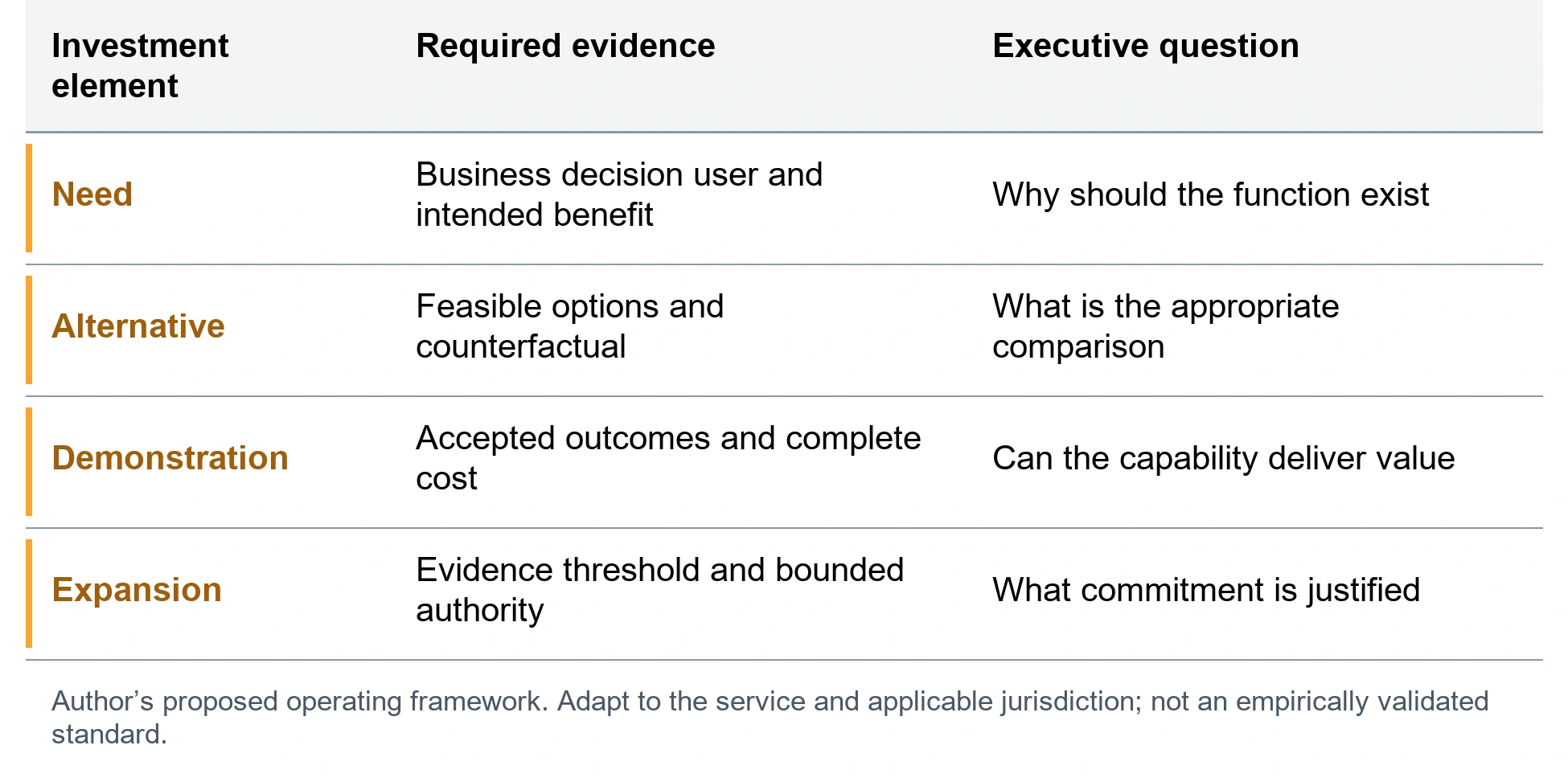
Figure 1 proposes four decisions: business need, feasible alternative, demonstration, and bounded expansion. Define the accepted outcome, users, scope, quality, timing, and consequential action limits. Identify which claims are observed, modeled, or still exploratory.
McKinsey’s global-business-services discussion considers expansion into new kinds of work.3 It is practitioner commentary, not a guarantee of successful capability creation. The buyer should test the function and surrounding operating model under representative conditions.
Include buyer decisions, data meaning, retained expertise, human review, evidence systems, and recovery. A new capability is not independent of the organization simply because the provider hosts it. The executive should understand the work and authority the buyer must supply.
Protect the Ability to Learn and Change Direction
Use a bounded stage to test the most consequential uncertainty before broad dependency. Limit spend, volume, data exposure, and action authority where appropriate. Define continuation, redesign, restriction, and exit criteria before the demonstration begins.
EU, UK, Swiss, US, and other legal, sector, privacy, professional, and contract conditions may apply to a new function even when no prior process existed. Qualified owners should establish the relevant conclusions. Novelty does not create an exemption from obligations.
Agree access to evidence, rights to relevant artifacts, change governance, and transition. A provider may supply proprietary capability while the buyer retains enough context and judgment to assess value and replace the service. Make the boundary practical and testable.
Approve Demonstrated Capability and a Credible Value Mechanism
A reasonable objection is that new capabilities cannot prove all benefits before launch. The executive can fund learning with explicit uncertainty. The important distinction is between a bounded investment to establish value and a full-scale commitment justified by benefits no one can substantiate.
Review accepted outcomes, user decisions, complete cost, quality, and material exceptions after the initial stage. Determine whether the capability changes a business result worth funding. Adjust the scope or stop where the benefit mechanism does not survive the evidence.
The executive should buy new capability when it expands what the organization can usefully and responsibly accomplish. Agentic providers can create opportunity beyond replacing existing labor. The investment remains a decision about demonstrable function, complete economics, and a credible route from capability to business value.
Evidence and Source Note
The study is a nonrepresentative cross-section of 850 vendor delivery-team respondents on 150 engagements serving Tier 1 financial institutions, collected during January–June 2026. Neither banks nor vendors corroborated the accounts. It establishes reported experience, not causation, legal breach, or market prevalence. Its application here is a mechanism to investigate, not an estimate of conditions in other industries. The author-supplied version 1.8.2 is dated November 1, 2026 and is cited as a forthcoming manuscript consulted October 23, 2026.4
This is an analytical decision paper based on the supplied study and selected primary public sources checked through October 23, 2026. The original contribution is a new-capability investment record distinguishing additional business value from unsupported labor-replacement savings and staged learning from proven return. The proposed method has not been independently validated. Legal requirements depend on the entity, activity, jurisdiction, and effective provisions; supervisory observations, research, and professional commentary have distinct authority.
Notes
- Vikash Jain et al., “The $200 Billion Agentic AI Opportunity for Tech Service Providers,” Boston Consulting Group, February 20, 2026, demand and supply survey methodology; expectation and commitment gaps, https://www.bcg.com/publications/2026/the-200-billion-dollar-ai-opportunity-in-tech-services. ↩
- Phil Hatch, Agentic AI Outsourcing at Tier 1 Financial Institutions: Full Study Report, version 1.8.2 (Akholi, forthcoming manuscript dated November 1, 2026), Part 2, “The Shift From Managing People to Managing Agents”; Part 6, “The Executive Action Plan”, https://doi.org/10.2139/ssrn.7164559; Hatch, Agentic AI Outsourcing, Part 5, “The Five Manual Alteration Methods” and “Disclosure of Manual Alteration,” table 5.8. ↩
- McKinsey & Company, “Agentic AI and the Future of Global Business Services,” McKinsey & Company, August 11, 2026, edited podcast transcript with Christian Johnson, Heiko Heimes, and Josh Peters, https://www.mckinsey.com/capabilities/operations/our-insights/agentic-ai-and-the-future-of-global-business-services. ↩
- Hatch, Agentic AI Outsourcing, Introduction, “Executive Summary” and “Evidentiary Basis and Its Limits”. ↩
Bibliography
- Hatch, Phil. Agentic AI Outsourcing at Tier 1 Financial Institutions: Full Study Report. Version 1.8.2. Akholi. Forthcoming manuscript dated November 1, 2026. Author-supplied manuscript consulted October 23, 2026. https://doi.org/10.2139/ssrn.7164559.
- Jain, Vikash, Sudhanshu Chawla, Saurav Mohanty, Hiren Mittal, Anoop Gopal Singh, Sahib Katyal, and Shailee Raychaudhuri. “The $200 Billion Agentic AI Opportunity for Tech Service Providers.” Boston Consulting Group. February 20, 2026. https://www.bcg.com/publications/2026/the-200-billion-dollar-ai-opportunity-in-tech-services.
- McKinsey & Company. “Agentic AI and the Future of Global Business Services.” McKinsey & Company. August 11, 2026. https://www.mckinsey.com/capabilities/operations/our-insights/agentic-ai-and-the-future-of-global-business-services.
Explore this subject
Category: Economics and Value
Topics: Outcome Verification Return on Investment Sourcing Strategy
Audience: Buy-side Boards and Executives
Industry: Cross-industry