
Buy the Rights the Public Function Needs
The accountable executive should identify which information and artifacts the authority needs during delivery, investigation, change, and exit. These may include source data, instructions, configurations, decision records, retrieval materials, outputs, and operational documentation. Different rights can apply to each.
The UK government AI playbook identifies intellectual property, transparency, and successor-supplier transfer as contractual considerations.1 It is public-sector guidance within its stated context. The executive should use the relevant local procurement and legal framework to determine the required rights.
Begin with the public function and a plausible transition. Ask what a successor would need to complete pending work and explain historical decisions. A contract that promises data ownership but withholds usable configurations or records can leave the authority dependent on the incumbent.
Separate Ownership from Permission and Practical Access
Ownership, license, confidentiality, privacy, database rights, and access are different questions. A right to possess an output may not permit reuse of third-party material within it. A license may permit continued operation without transferring ownership. Counsel should assess the actual artifacts and intended uses.
The study describes knowledge held by individuals and incomplete downstream dependency mapping.2 It does not establish public-sector IP disputes. The transferable concern is whether the authority can obtain the operational knowledge and artifacts needed beyond the prime contract.
For a hypothetical benefits service, the authority may need to preserve the policy version, case evidence, and approved decision logic while the provider retains general platform technology. Define a usable boundary that supports public accountability without assuming every supplier asset must become public property.
Use a Public Service Rights Record
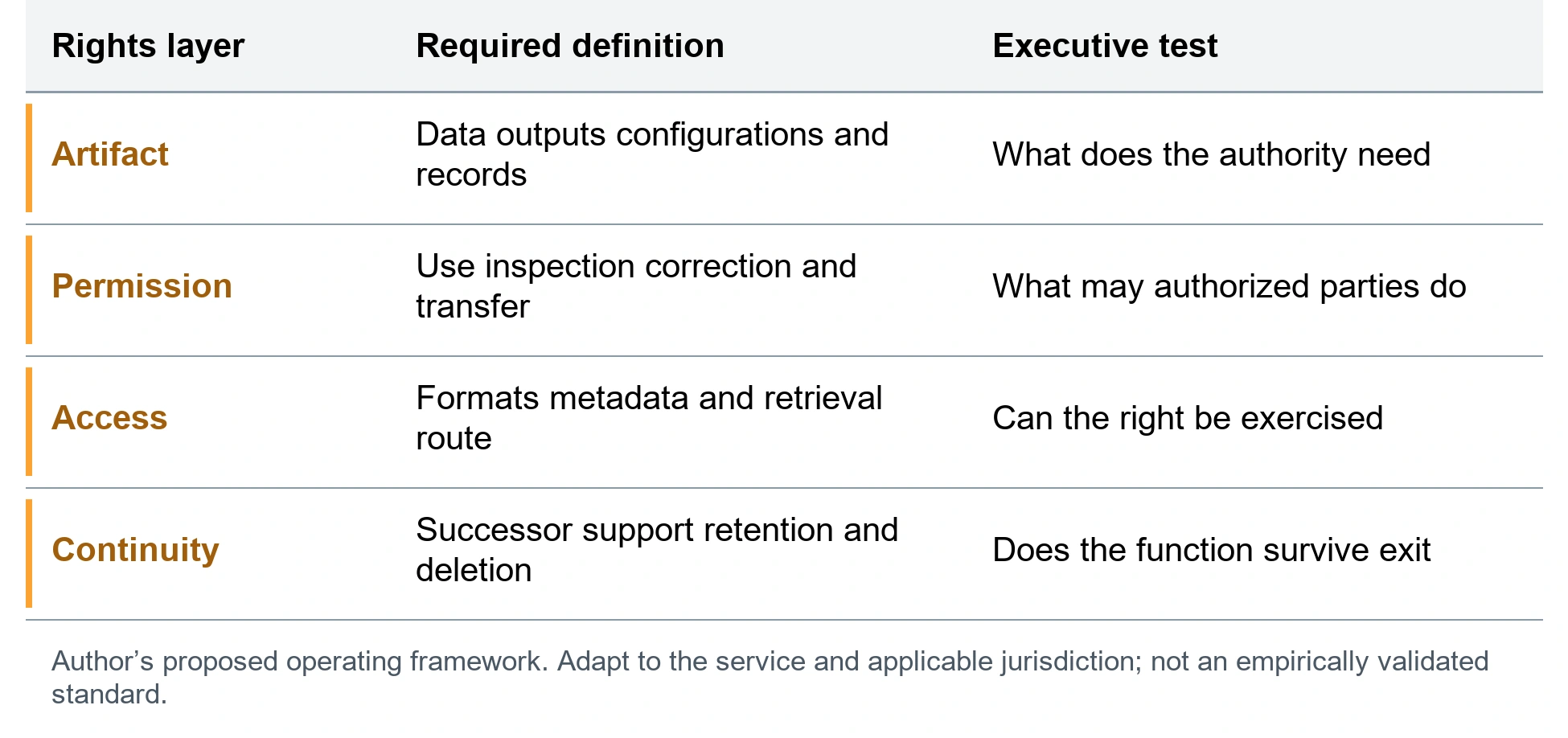
Figure 1 proposes a record of artifact, permitted use, access mechanism, and continuity treatment. Include relevant third-party restrictions, further training or reuse, retention, deletion, and the right to provide material to authorized reviewers or successor suppliers.
The UK copyright-and-AI report examines licensing and policy questions without establishing one universal ownership outcome.3 The authority should therefore avoid a generic clause that assumes AI-generated material is always owned, unrestricted, or legally equivalent across jurisdictions.
Test practical access as well as legal language. Export representative records and configurations into agreed usable formats, with explanatory metadata. Confirm that an authorized receiving team can interpret them. A contractual right to an unusable archive does not preserve the ability to operate the service.
Protect Public Duties and Legitimate Supplier Interests
EU, UK, Swiss, US, and other public bodies face different procurement, transparency, records, privacy, security, and IP requirements. Establish the relevant local conclusions. A confidentiality clause should be assessed alongside public-law disclosure duties rather than assumed to override them.
Protect supplier background technology and third-party rights through proportionate licenses and controlled access. The authority’s objective is sufficient capability for its function and obligations. Requiring unnecessary ownership can raise cost or deter suppliers without improving continuity or accountability.
Address reuse and learning explicitly. Determine whether the supplier can use service data, outputs, human corrections, or derived knowledge to improve other services. Permission for a defined delivery purpose should not silently become permission for unrelated shared-model training.
Settle Rights Before Dependency Becomes Material
A reasonable objection is that detailed rights negotiations delay innovation. Prioritize artifacts and uses that support material operation, challenge, and exit. Agree a standard record and resolve exceptional restrictions early, when the authority can still change scope or supplier.
Before commitment, run a rights-and-access exercise covering an investigation, a material change, and a successor handover. Record missing permissions, format limits, costs, and assistance requirements. Incorporate the remedies into the contract and transition plan.
Approve the service when the authority has a credible right and practical ability to use the artifacts its public function requires. The durable asset is not a broad ownership statement. It is an enforceable, usable arrangement for operating, explaining, correcting, and transferring the service.
Evidence and Source Note
The study is a nonrepresentative cross-section of 850 vendor delivery-team respondents on 150 engagements serving Tier 1 financial institutions, collected during January–June 2026. Neither banks nor vendors corroborated the accounts. It establishes reported experience, not causation, legal breach, or market prevalence. Its application here is a mechanism to investigate, not an estimate of conditions in other industries. The author-supplied version 1.8.2 is dated November 1, 2026 and is cited as a forthcoming manuscript consulted October 23, 2026.4
This is an analytical decision paper based on the supplied study and selected primary public sources checked through October 23, 2026. The original contribution is a public-service rights record separating ownership, permission, practical access, and successor operability in agentic outsourcing. The proposed method has not been independently validated. Legal requirements depend on the entity, activity, jurisdiction, and effective provisions; supervisory observations, research, and professional commentary have distinct authority.
Notes
- Government Digital Service, Artificial Intelligence Playbook for the UK Government (Government Digital Service, February 10, 2025), Contractual issues, Intellectual property, including copyright, and Buying AI, https://www.gov.uk/government/publications/ai-playbook-for-the-uk-government/artificial-intelligence-playbook-for-the-uk-government-html. ↩
- Phil Hatch, Agentic AI Outsourcing at Tier 1 Financial Institutions: Full Study Report, version 1.8.2 (Akholi, forthcoming manuscript dated November 1, 2026), Part 4, “Knowledge at Risk of Departure”, https://doi.org/10.2139/ssrn.7164559; Hatch, Agentic AI Outsourcing, Part 3, Third-Party Ecosystem, sec. 6.1, “Mapping of Third and Fourth Party Dependencies,” indicator C196. ↩
- UK Department for Science Innovation and Technology Department for Culture Media and Sport and Intellectual Property Office, “Report on Copyright and Artificial Intelligence,” UK Department for Science Innovation and Technology Department for Culture Media and Sport and Intellectual Property Office, March 18, 2026, sections A and G; policy report, not a new ownership rule, https://www.gov.uk/government/publications/report-and-impact-assessment-on-copyright-and-artificial-intelligence/report-on-copyright-and-artificial-intelligence. ↩
- Hatch, Agentic AI Outsourcing, Introduction, “Executive Summary” and “Evidentiary Basis and Its Limits”. ↩
Bibliography
- Government Digital Service. Artificial Intelligence Playbook for the UK Government. Government Digital Service, February 10, 2025. https://www.gov.uk/government/publications/ai-playbook-for-the-uk-government/artificial-intelligence-playbook-for-the-uk-government-html.
- Hatch, Phil. Agentic AI Outsourcing at Tier 1 Financial Institutions: Full Study Report. Version 1.8.2. Akholi. Forthcoming manuscript dated November 1, 2026. Author-supplied manuscript consulted October 23, 2026. https://doi.org/10.2139/ssrn.7164559.
- UK Department for Science Innovation and Technology Department for Culture Media and Sport and Intellectual Property Office. “Report on Copyright and Artificial Intelligence.” UK Department for Science Innovation and Technology Department for Culture Media and Sport and Intellectual Property Office. March 18, 2026. https://www.gov.uk/government/publications/report-and-impact-assessment-on-copyright-and-artificial-intelligence/report-on-copyright-and-artificial-intelligence.
Explore this subject
Category: Commercial and Vendor Management
Topics: Exit and Portability Intellectual Property and Reuse Privacy and Data Rights
Audience: Buy-side Boards and Executives
Industry: Government and Public Services Other Regulated Industries