
Define Reconciliation Closure Before Automation
The operations manager should identify the accounts, records, timing, and permitted differences that determine a completed reconciliation. Matching records is a means to that result. A service can produce a high match rate while leaving the most consequential differences unresolved or excluding items from the population.
FINMA’s AI guidance emphasizes documentation and controls appropriate to the use and risk.1 It does not prescribe this reconciliation method. The bank should define the evidence needed for its particular financial, operational, and recordkeeping obligations.
Establish the authoritative sources, cutoff, population, tolerances, break categories, and owner for unresolved items. Distinguish a timing difference from an error and a proposed correction from a completed posting. The provider should not silently redefine closure to fit what the agent can complete.
Preserve the Difference That Required Judgment
The study reports manual alteration and completion evidence inconsistent with observed results.2 Those accounts do not establish that every reconciliation agent produces incorrect balances. They identify why the bank should inspect the path from original difference through correction to final state.
For a hypothetical unmatched transaction, a provider employee might alter a reference or mapping to create a match. The manager should determine whether the alteration corrects a valid data defect or hides a genuine difference. Preserve the original record, explanation, authority, and effect on other items.
The service should account for every eligible item as matched, unresolved, excluded under an approved rule, or corrected through an authorized process. An item should not disappear between populations because the provider changed the processing route or returned it to the bank.
Use a Reconciliation Closure Record
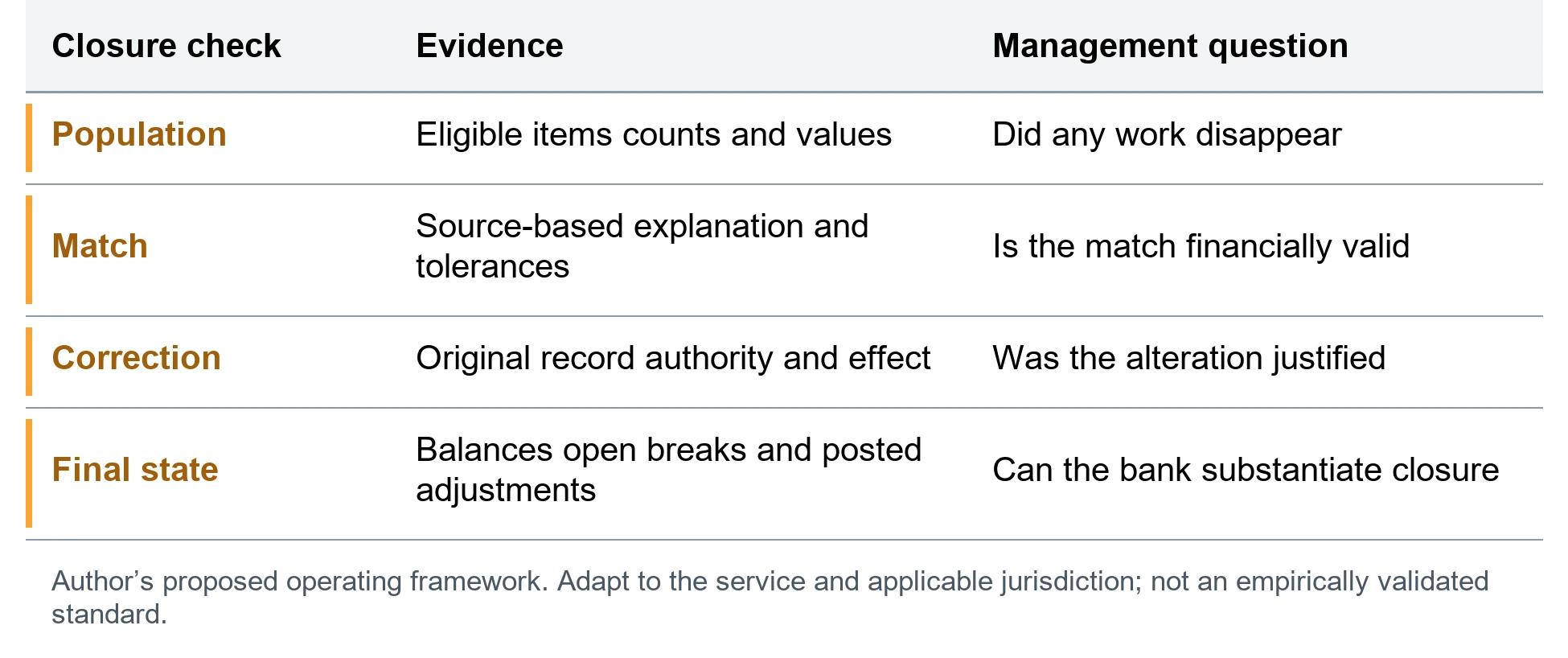
Figure 1 proposes four checks: complete population, valid match, controlled correction, and verified closure. Reconcile counts and relevant financial values where appropriate. A count alone can conceal a small number of high-value differences, while aggregate equality can conceal offsetting errors.
Test duplicate records, late arrivals, reversals, currency differences, changed reference data, and partial failures. Confirm what happens when a correction succeeds in one system and fails in another. The case should remain open or explicitly restricted until the relevant states have been reconciled.
BCG’s enterprise-agent discussion emphasizes traceable action and controlled access in regulated workflows.3 Those capabilities support the service, but the bank must define the financial meaning of completion and test it in the receiving systems.
Keep Correction Authority and Finality Distinct
An agent authorized to identify a break is not necessarily authorized to alter the ledger or instruct a counterparty. Define separate permissions for analysis, proposed adjustment, approval, execution, and confirmation. Retain the sequence so that retrospective review does not appear to be prior authorization.
EU, UK, Swiss, US, and other banking operations have different legal, accounting, settlement, and recordkeeping conditions. Specialists should establish the relevant finality and correction rules. A reconciled internal record does not itself establish that an external transfer is legally final or recoverable.
Agree the evidence the provider must return with unresolved work. A generic exception flag may be inadequate for a buyer operator to act before the cutoff. The handoff should contain the sources, discrepancy, attempted actions, urgency, and specific decision required.
Accept Closure Through Independent Verification
A reasonable objection is that independent checks duplicate the reconciliation. Design proportionate checks around population completeness, consequential adjustments, and exception risk. The objective is to validate the result through evidence independent of the agent’s own assertion, not to repeat every computational step manually.
Before scaling, select representative closed and unresolved cases and reconstruct them against authoritative systems. Include manually corrected items and failures. Assign remediation where the service cannot explain an exclusion, correction, or final balance, and retest the affected route.
The manager should accept reconciliation automation when the bank can substantiate closure. A persuasive explanation, high match rate, or green dashboard can support that decision only if the population, corrections, outstanding differences, and final financial state remain visible and defensible.
Evidence and Source Note
The study is a nonrepresentative cross-section of 850 vendor delivery-team respondents on 150 engagements serving Tier 1 financial institutions, collected during January–June 2026. Neither banks nor vendors corroborated the accounts. It establishes reported experience, not causation, legal breach, or market prevalence. The author-supplied version 1.8.2 is dated November 1, 2026 and is cited as a forthcoming manuscript consulted October 23, 2026.4
This is an analytical decision paper based on the supplied study and selected primary public sources checked through October 23, 2026. The original contribution is a reconciliation-closure method separating match rate, correction authority, population completeness, and independently verified financial state. The proposed method has not been independently validated. Legal requirements depend on the entity, activity, jurisdiction, and effective provisions; supervisory observations, research, and professional commentary have distinct authority.
Notes
- Swiss Financial Market Supervisory Authority, Governance and Risk Management When Using Artificial Intelligence (Swiss Financial Market Supervisory Authority, December 18, 2024), FINMA Guidance 08/2024, secs. 2.1–2.7, https://www.finma.ch/~/media/finma/dokumente/dokumentencenter/myfinma/4dokumentation/finma-aufsichtsmitteilungen/20241218-finma-aufsichtsmitteilung-08-2024.pdf?hash=60E2745D7AC1D7F4E06CE43474539F68&sc_lang=en. ↩
- Phil Hatch, Agentic AI Outsourcing at Tier 1 Financial Institutions: Full Study Report, version 1.8.2 (Akholi, forthcoming manuscript dated November 1, 2026), Part 5, “The Five Manual Alteration Methods” and “Disclosure of Manual Alteration,” table 5.8, https://doi.org/10.2139/ssrn.7164559; Hatch, Agentic AI Outsourcing, Part 3, AI Technology, sec. 4.1, “Accuracy of the Tools’ Own Success and Failure Reports,” indicator C172. ↩
- Daniel Martines et al., “Building Enterprise AI Agents in Regulated Industries,” Boston Consulting Group, July 20, 2026, enterprise platform and identity control sections, https://www.bcg.com/publications/2026/building-enterprise-ai-agents-in-regulated-industries. ↩
- Hatch, Agentic AI Outsourcing, Introduction, “Executive Summary” and “Evidentiary Basis and Its Limits”. ↩
Bibliography
- Hatch, Phil. Agentic AI Outsourcing at Tier 1 Financial Institutions: Full Study Report. Version 1.8.2. Akholi. Forthcoming manuscript dated November 1, 2026. Author-supplied manuscript consulted October 23, 2026. https://doi.org/10.2139/ssrn.7164559.
- Martines, Daniel, Cullen Breithaupt, Drew Ingalls, Sawan Ruparel, and Prithvi Vadlamudi. “Building Enterprise AI Agents in Regulated Industries.” Boston Consulting Group. July 20, 2026. https://www.bcg.com/publications/2026/building-enterprise-ai-agents-in-regulated-industries.
- Swiss Financial Market Supervisory Authority. Governance and Risk Management When Using Artificial Intelligence. Swiss Financial Market Supervisory Authority, December 18, 2024. https://www.finma.ch/~/media/finma/dokumente/dokumentencenter/myfinma/4dokumentation/finma-aufsichtsmitteilungen/20241218-finma-aufsichtsmitteilung-08-2024.pdf?hash=60E2745D7AC1D7F4E06CE43474539F68&sc_lang=en.
Explore this subject
Category: Delivery and Operations
Topics: Evidence and Traceability Financial Control and Finality Outcome Verification
Audience: Buy-side Delivery and Vendor Managers
Industry: Banking Capital Markets Financial Services