
Make Intervention Visible to the Bank
The bank’s outsourcing governance owner should require a common intervention record across the provider’s delivery chain. Human correction can protect service quality, but an unrecorded correction can also conceal a failed process, unauthorized decision, or misleading performance claim. The control objective is to preserve useful work while exposing consequential departures.
The study reports manual alteration somewhere in all 150 sampled engagements across five methods. Separately, 13 of 1,004 pooled valid answers to three bank-disclosure questions reported discussion with the financial institution, or 1.29%. These are different denominators: the latter counts answers, can include repeated respondents, and does not establish what the bank knew.1
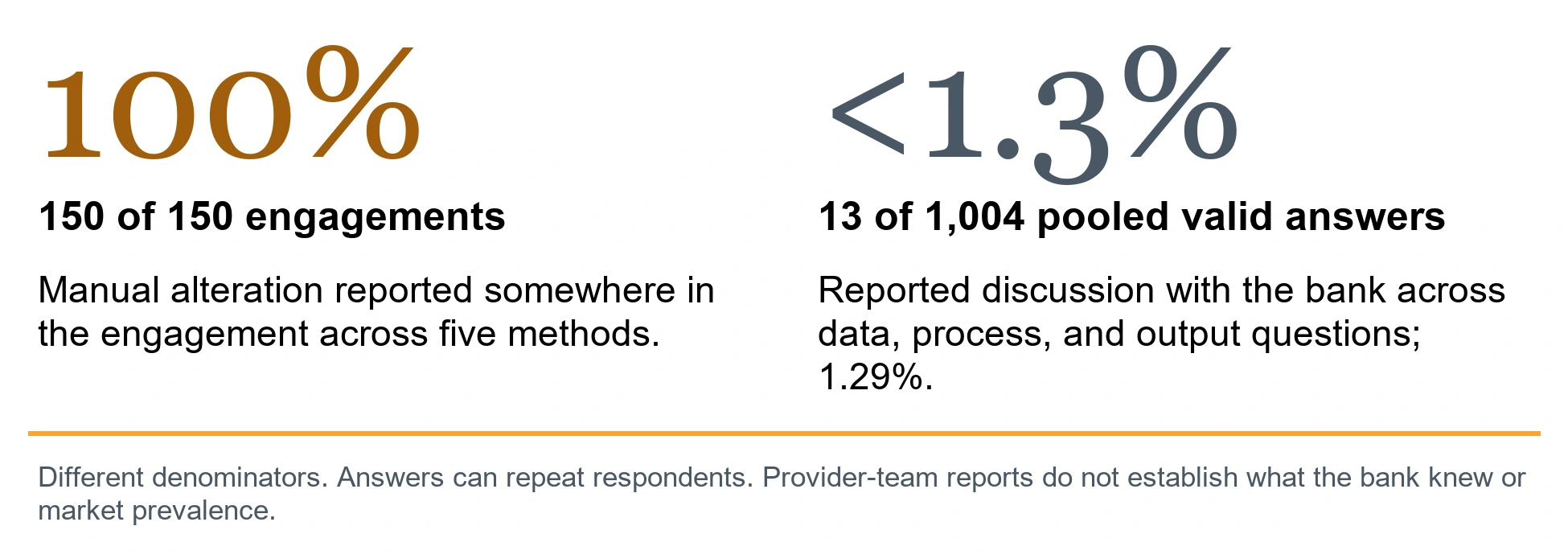
Managers should use the contrast to commission reconciliation, rather than infer universal concealment. The bank needs to know what changed, whether it was authorized, how the result was checked, and whether reported service performance reflects the work required. A general assurance that staff only correct minor issues cannot answer those questions.
Define Five Methods Without Treating Them as Equivalent
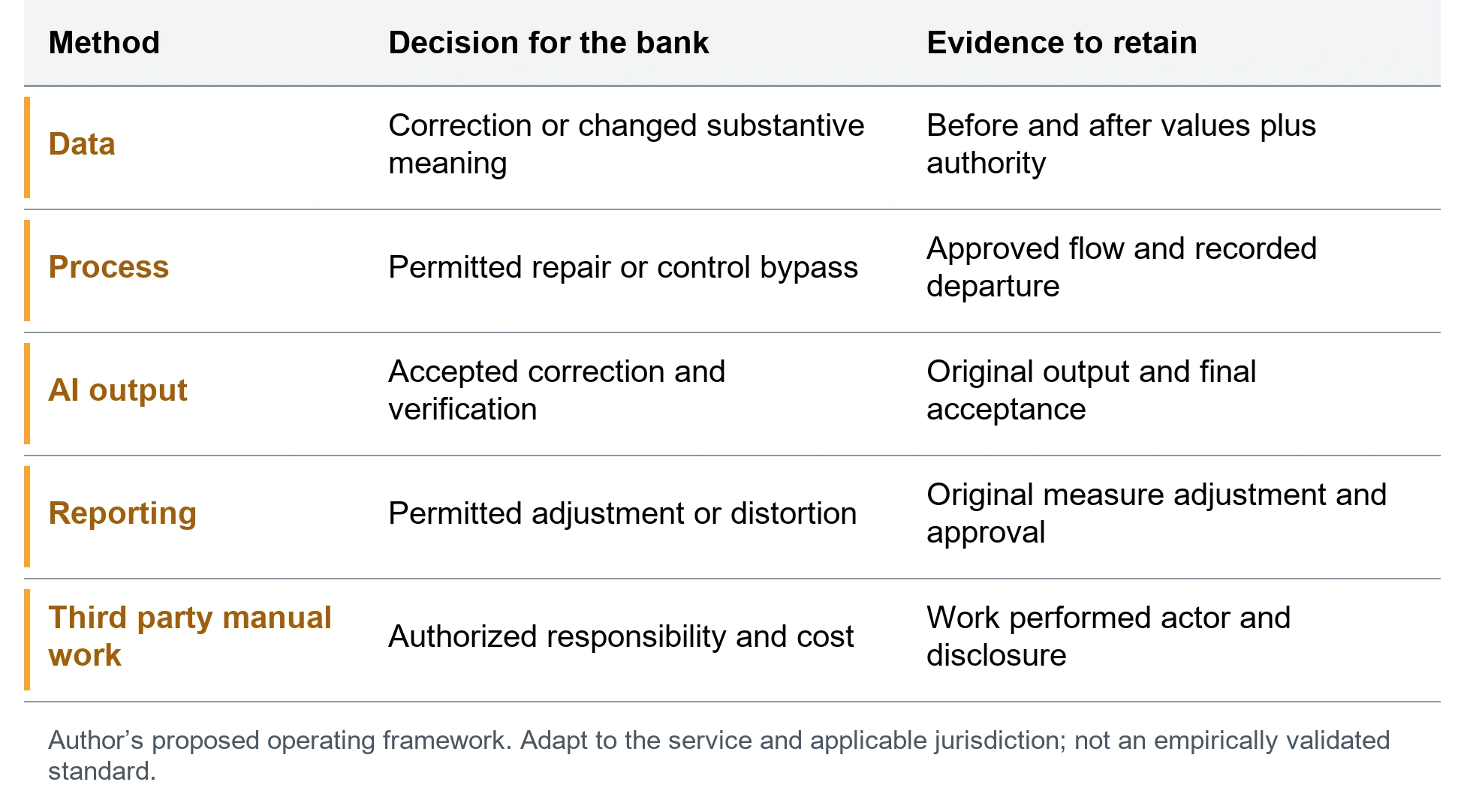
The protocol should cover changes to bank-provided data, bank processes, AI outputs, delivery reporting, and work for third parties performed by hand. A data correction may preserve accuracy; a change to a control step may alter authority; a reporting edit may distort the bank’s view of performance. The same disclosure rule should not treat all three as identical events.
Distinguish routine correction within an approved instruction from a departure requiring approval or notification. For example, correcting a transcription error under an agreed procedure differs from changing a customer’s substantive information or bypassing a required review. The bank’s process and compliance owners should define the boundary for each workflow.
Do not allow reporting alteration to disappear inside ordinary output correction. The record should preserve original measures, adjustments, reasons, and approval. A corrected customer result may be acceptable while the provider’s original completion or automation claim remains inaccurate. Both facts belong in the service review.
Implement an Intervention Record That Can Be Reconciled
Figure 2 proposes the core record. Each consequential intervention should identify the case, method, original state, changed state, actor, reason, authority, verification, and disclosure disposition. The record should link to evidence rather than duplicate unnecessary personal data. Managers should agree who can read it and how long it is retained.
Set notification timing by consequence and urgency. A material unauthorized action or suspected report distortion may require immediate escalation; routine approved corrections can be aggregated if the bank retains case-level access. The agreement should prevent an aggregation threshold from concealing repeated small changes that collectively undermine the process.
Emergency repair needs a defined route. Staff should know which protective actions they may take, which require prior approval, and when escalation is mandatory. Preserve evidence and arrange independent review afterward. The protocol should remove incentives to choose between meeting the service target and admitting that the intended process failed.
Reconcile Reported Performance to Actual Work
Select cases from completed, corrected, failed, and reopened work. Trace each from raw input through agent actions, manual changes, delivered output, and management reporting. Sampling should be risk based and independently designed; the proposed categories are starting points rather than a statistically sufficient assurance plan.
Compare intervention records with access logs, work queues, staff effort, and output revisions. The study’s accounts of completion flags inconsistent with actual results show why the provider’s own reported success should not be the only reconciliation source. This is a reported mechanism, not proof that every success flag is unreliable.2
Include the economics. If provider staff repeatedly complete tasks by hand, the service’s cost and capacity depend on that work. The bank should distinguish a legitimate hybrid service from a claim of autonomous completion that excludes necessary human effort. Correct reporting and commercial measures together.
Put the Protocol into the Operating Agreement
The agreement should identify disclosure duties, approval thresholds, access to records, audit rights, and consequences of repeated unauthorized changes. It should also require the provider to obtain equivalent cooperation from relevant subcontractors. A disclosure duty without access to underlying evidence can become another untested reporting promise.
The service review should include a discrepancy register linking intervention records to performance corrections. If a provider reports a case as completed autonomously and later acknowledges manual completion, preserve both the corrected delivery classification and any change to the commercial measure. The bank should assign a due date for explaining repeated discrepancies. A provider should be able to disclose legitimate correction without losing the evidence of why the original process or report was inaccurate.
Mayer Brown identifies performance commitments, dependencies, and governance as distinct contract issues in agentic integration. For bank outsourcing, the proposed intervention protocol applies that reasoning to the work performed and the evidence reported. Counsel should adapt it to the actual service and applicable banking duties.3
Use local annexes for EU, UK, Swiss, and US notification, secrecy, privacy, and retention requirements. A contractual notification to the bank does not automatically discharge the bank’s own duties to authorities or customers. The incident owner should connect intervention escalation to those processes when required.
Use Disclosure to Repair the Delivery Method
The monthly service review should examine recurring interventions by cause, consequence, and owner. Repeated access workarounds, unstable reference data, or unmanageable review queues require changes to the delivery method. Closing individual cases while preserving the same underlying defect leaves the bank dependent on continued informal repair.
The manager should accept remediation only when a retest shows the intended process operating and the reporting reflecting actual work. The purpose of the protocol is a service the bank can understand and govern, including its human contribution. Transparent correction should improve that understanding rather than disappear from the performance record.
Evidence and Source Note
The study is a nonrepresentative cross-section of 850 vendor delivery-team respondents on 150 engagements serving Tier 1 financial institutions, collected during January–June 2026. Neither banks nor vendors corroborated the accounts. It establishes reported experience, not causation, legal breach, or market prevalence. The author-supplied version 1.8.2 is dated November 1, 2026 and is cited as a forthcoming manuscript consulted October 23, 2026.4
This is an analytical decision paper based on the supplied study and selected primary public sources checked through October 23, 2026. The original contribution is a five-method intervention protocol that links authority, disclosure, performance reconciliation, and recurring-cause repair. The proposed method has not been independently validated. Legal requirements depend on the entity, activity, jurisdiction, and effective provisions; supervisory observations, research, and professional commentary have distinct authority.
Notes
- Phil Hatch, Agentic AI Outsourcing at Tier 1 Financial Institutions: Full Study Report, version 1.8.2 (Akholi, forthcoming manuscript dated November 1, 2026), Part 5, “Five Manual Alteration Methods” and “Disclosure of Manual Alteration,” table 5.8, https://doi.org/10.2139/ssrn.7164559. ↩
- Hatch, Agentic AI Outsourcing, Part 3, AI Technology, sec. 4.1, “Accuracy of the Tools’ Own Success and Failure Reports,” indicator C172. ↩
- Rohith P. George et al., “Key Contract Issues in Agentic AI Implementation and Integration Deals,” Mayer Brown, June 16, 2026, “Liability,” “Performance commitments and dependencies,” and “Exit and transition”, https://www.mayerbrown.com/en/insights/publications/2026/06/key-contract-issues-in-agentic-ai-implementation-and-integration-deals. ↩
- Hatch, Agentic AI Outsourcing, Introduction, “Executive Summary” and “Evidentiary Basis and Its Limits”. ↩
Bibliography
- George, Rohith P., Veronica R. Glick, Arsen Kourinian, et al.. “Key Contract Issues in Agentic AI Implementation and Integration Deals.” Mayer Brown. June 16, 2026. https://www.mayerbrown.com/en/insights/publications/2026/06/key-contract-issues-in-agentic-ai-implementation-and-integration-deals.
- Hatch, Phil. Agentic AI Outsourcing at Tier 1 Financial Institutions: Full Study Report. Version 1.8.2. Akholi. Forthcoming manuscript dated November 1, 2026. Author-supplied manuscript consulted October 23, 2026. https://doi.org/10.2139/ssrn.7164559.
Explore this subject
Category: Assurance and Audit
Topics: Disclosure and Transparency Evidence and Traceability Manual Alterations
Audience: Buy-side Delivery and Vendor Managers
Industry: Banking Financial Services