
Define Who the Service Is Dealing With
The executive should ask how the carrier knows which customer an external agent represents and what it may request. A machine can compare offers, ask questions, negotiate, or submit changes. Those actions should not inherit the same authority merely because they arrive through one interface.
Ofcom’s 2026 discussion considers how AI agents may change consumer interactions and raises accountability questions.1 It reports limited evidence of systemic AI harm to date rather than assuming widespread current failure. The carrier should test the emerging interaction at the actual service boundary.
For a hypothetical plan change, the customer’s agent may be authorized to research options but not accept a new term or price. The outsourced carrier service should establish the relevant mandate before acting. A well-formed machine request is not itself evidence of customer permission.
Preserve Intent Through Two Agentic Chains
A customer agent and provider agent can each use tools, memory, and delegated components. The carrier needs an agreed way to connect the instruction to the represented account, permitted action, limits, and expiry. Do not assume that technical authentication settles every business-authority question.
The study reports visibility and identity difficulties across buyer-provider delivery.2 It does not measure consumer-agent adoption or telecom harm. The transferable issue is whether the carrier can reconstruct which instruction governed the action and where authority was established.
Separate proposal, acceptance, execution, and confirmation. Preserve the terms presented and any material change. If the account action differs from the accepted proposal, the service should detect and resolve the mismatch rather than send a generic success message to the customer’s agent.
Use a Customer Agent Interaction Record
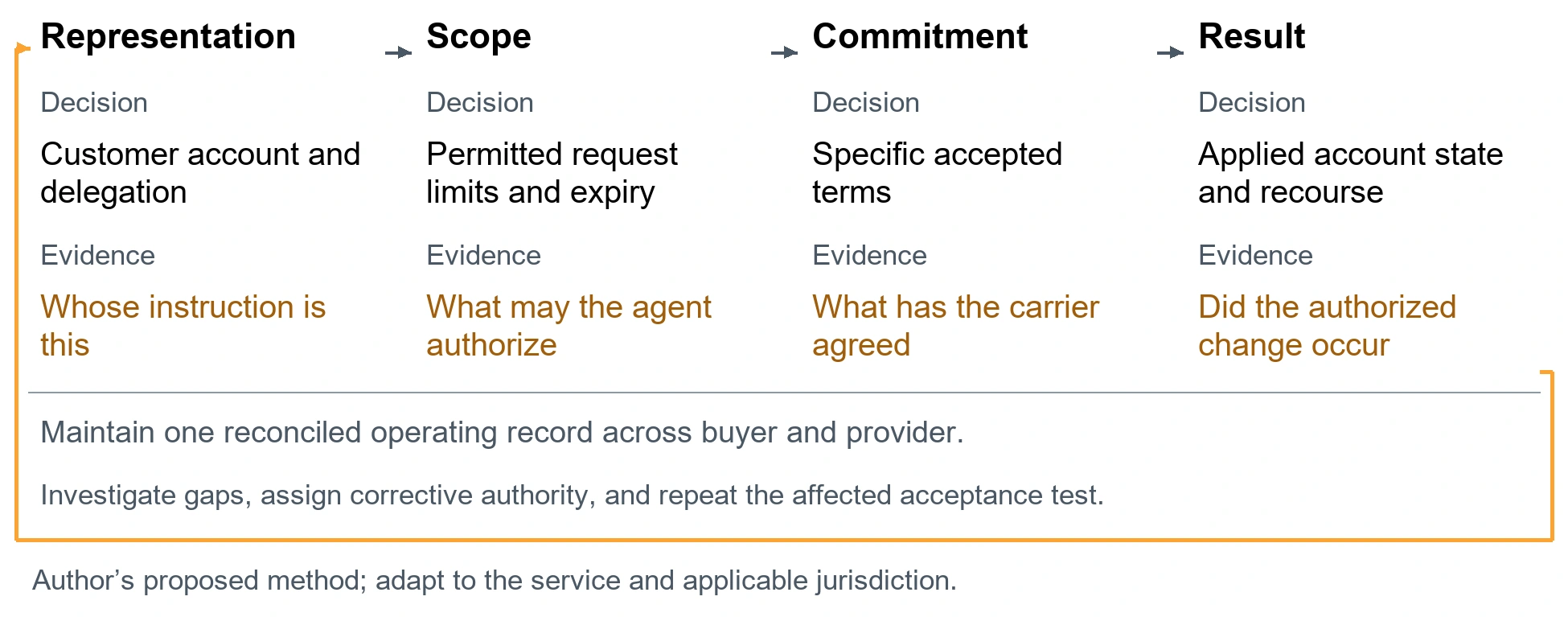
Figure 1 proposes four questions: represented customer, permitted request, accepted commitment, and applied result. The carrier should define the evidence and owner for each. Establish a route for ambiguous authority and a means for the customer to inspect or challenge a consequential change.
NIST’s identity analysis distinguishes agent identity and delegated entitlements.3 The carrier should connect those technical concepts to its account and consumer obligations. An identity standard can support the interaction without deciding what the customer legally authorized.
Test expired mandates, changed proposals, duplicate requests, conflicting customer instructions, unavailable account information, and failed execution. Include an interaction in which the correct response is clarification or refusal. Completion should not be the only measure of a successful exchange.
Keep Customer Rights and Provider Duties Connected
EU, UK, Swiss, US, and other telecom, consumer, privacy, accessibility, and contract rules differ. Qualified owners should determine applicable information, consent, cancellation, and recourse requirements. Neither agent should be allowed to infer a waiver merely because the exchange is automated.
The carrier’s provider agreement should define operating authority, evidence access, change, escalation, and correction. The customer should not be forced to resolve a dispute between agents or suppliers before reaching the carrier’s responsible function.
Preserve a route to a qualified person where needed. The person should receive the relevant instruction, terms, action history, and current account state. Repeating the same automated exchange does not establish meaningful resolution when the problem is a disputed mandate or incorrect commitment.
Pilot the Interaction Before Broad Acceptance
A reasonable objection is that external-agent standards are still developing. Use a bounded service and explicit authority requirements rather than wait for universal interoperability or accept every machine request. State what is supported and which actions remain restricted.
Run representative interactions through the actual outsourced configuration and receiving account systems. Verify the mandate, accepted terms, action, and confirmation. Record unresolved limitations and monitor changes in customer-agent behavior and provider tools.
The executive should approve machine-mediated telecom delivery when the carrier can explain whose instruction it acted on, what was agreed, and what changed. Interoperability creates a channel. Customer authority and a defensible account outcome make that channel suitable for consequential service.
Evidence and Source Note
The study is a nonrepresentative cross-section of 850 vendor delivery-team respondents on 150 engagements serving Tier 1 financial institutions, collected during January–June 2026. Neither banks nor vendors corroborated the accounts. It establishes reported experience, not causation, legal breach, or market prevalence. Its application here is a mechanism to investigate, not an estimate of conditions in other industries. The author-supplied version 1.8.2 is dated November 1, 2026 and is cited as a forthcoming manuscript consulted October 23, 2026.4
This is an analytical decision paper based on the supplied study and selected primary public sources checked through October 23, 2026. The original contribution is a customer-agent interaction record connecting two agentic chains to account authority, accepted terms, execution evidence, and carrier recourse. The proposed method has not been independently validated. Legal requirements depend on the entity, activity, jurisdiction, and effective provisions; supervisory observations, research, and professional commentary have distinct authority.
Notes
- Ofcom, AI in Telecoms Markets: The Impact on Consumers’ Experiences So Far and How It May Develop, Ofcom, September 25, 2026, secs. 1.16–1.18 and 6; discussion and existing framework, not new rules, https://www.ofcom.org.uk/siteassets/resources/documents/internet-based-services/technology/discussion_the-impact-of-ai-in-telecoms-markets-on-consumers-experiences-so-far-and-how-it-may-develop.pdf?v=425794. ↩
- Phil Hatch, Agentic AI Outsourcing at Tier 1 Financial Institutions: Full Study Report, version 1.8.2 (Akholi, forthcoming manuscript dated November 1, 2026), Part 2, sec. 5.1, “Agent Actions Visible Only Inside Each Firm’s Own Tools”, https://doi.org/10.2139/ssrn.7164559; Hatch, Agentic AI Outsourcing, Part 3, Financial Institution Readiness, sec. 4.1, “Ability to Provision Access and Identities for Agents,” indicator C108. ↩
- Bill Fisher and Ryan Galluzzo, “Back to the Future: Why Agentic AI Needs a Strong Identity Foundation,” National Institute of Standards and Technology, August 27, 2026, “Credential Sharing” and “Static and Long-lived Credentials”, https://www.nist.gov/blogs/cybersecurity-insights/back-future-why-agentic-ai-needs-strong-identity-foundation. ↩
- Hatch, Agentic AI Outsourcing, Introduction, “Executive Summary” and “Evidentiary Basis and Its Limits”. ↩
Bibliography
- Fisher, Bill, and Ryan Galluzzo. “Back to the Future: Why Agentic AI Needs a Strong Identity Foundation.” National Institute of Standards and Technology. August 27, 2026. https://www.nist.gov/blogs/cybersecurity-insights/back-future-why-agentic-ai-needs-strong-identity-foundation.
- Hatch, Phil. Agentic AI Outsourcing at Tier 1 Financial Institutions: Full Study Report. Version 1.8.2. Akholi. Forthcoming manuscript dated November 1, 2026. Author-supplied manuscript consulted October 23, 2026. https://doi.org/10.2139/ssrn.7164559.
- Ofcom. AI in Telecoms Markets: The Impact on Consumers’ Experiences So Far and How It May Develop. Ofcom. September 25, 2026. https://www.ofcom.org.uk/siteassets/resources/documents/internet-based-services/technology/discussion_the-impact-of-ai-in-telecoms-markets-on-consumers-experiences-so-far-and-how-it-may-develop.pdf?v=425794.
Explore this subject
Category: Governance and Accountability
Topics: Agent Identity Customer Protection Delegated Authority
Audience: Buy-side Boards and Executives
Industry: Other Regulated Industries Telecommunications