
Design Backward from the Governing Deadline
The operations manager should identify the relevant product, infrastructure, market, date, and cutoff before defining service targets. The time available for an agent is only one part of the complete window. Buyer approval, funding, data readiness, submission, confirmation, and correction may all consume it.
The CPSS-IOSCO principles address settlement finality and operational reliability for financial market infrastructures.1 They do not prescribe one deadline for every outsourced service. The manager should obtain the actual applicable infrastructure rules and bank requirements.
For a hypothetical transaction, a provider may produce an instruction quickly but send an exception to a buyer approver after the remaining correction window has closed. The service should be designed around the latest safe decision and submission times, not only average processing speed.
Expose Waiting Across Both Firms
The study reports joint decisions that did not match agentic speed.2 These accounts do not measure settlement failure. They identify why the manager should track the complete time path and distinguish execution from the waits that determine whether the transaction can finish.
Record when the case becomes ready, when a decision is requested, when sufficient evidence arrives, when authority is granted, and when the external system accepts the action. Missing information should remain visible rather than pause an internal metric while the business clock continues.
Include time zones, holidays, late source data, queues, retries, and peak volume. Average performance can conceal a small set of cases that repeatedly reach the deadline without a feasible resolution route. Prioritize the consequential tail and aging work in operating review.
Use a Settlement Time Allocation Record
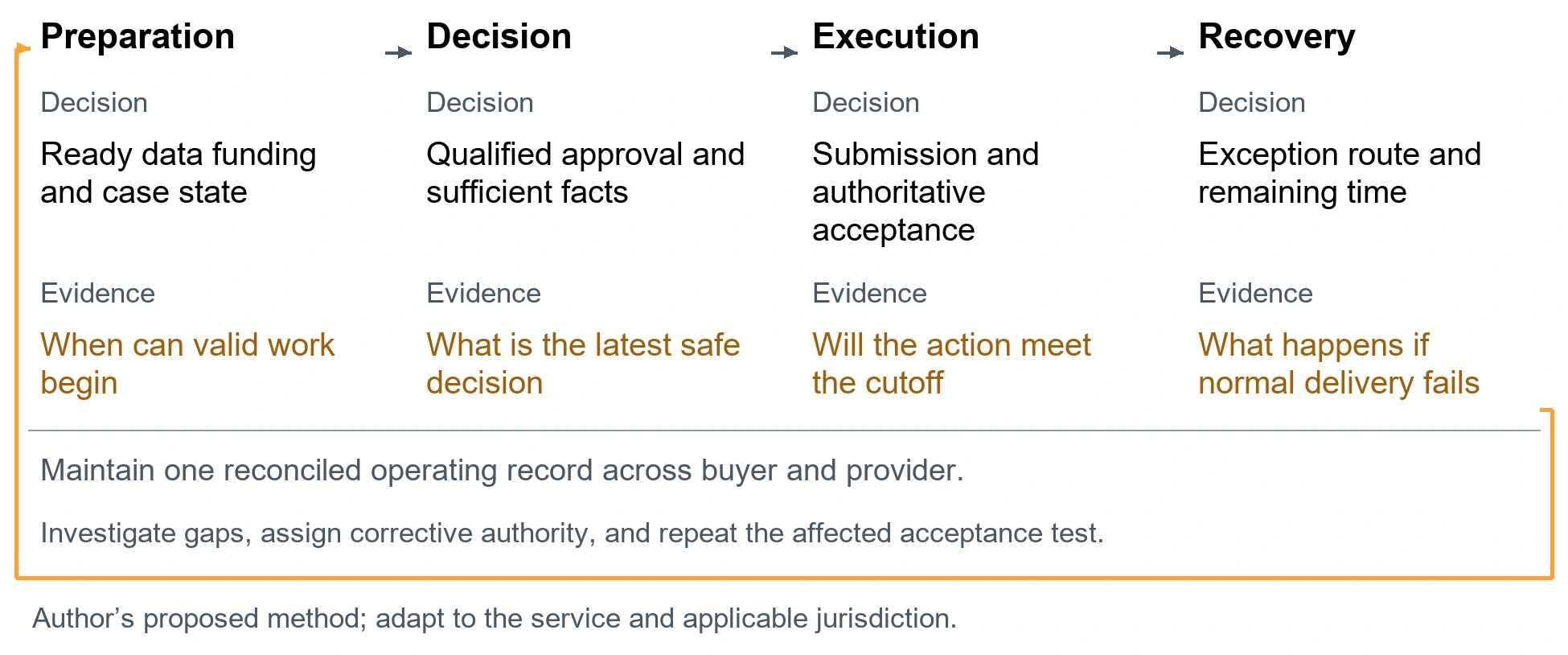
Figure 1 proposes four windows: preparation, authorized decision, external execution, and exception recovery. Allocate time with the parties that control each step. Preserve a buffer proportionate to uncertainty and consequence rather than fill the entire window with planned processing.
Define triggers for escalation, restricted action, deferral, or another authorized route when the remaining time is insufficient. Urgency should not create new transaction authority. The manager needs an approved decision on what can safely occur when normal completion is no longer feasible.
Mayer Brown’s services analysis emphasizes defined authority and operational performance obligations.3 The contract should connect those obligations to the business deadline and buyer prerequisites. A provider-only clock may be commercially useful but should not conceal the final settlement exposure.
Test Recovery Before the Window Closes
Run failed submission, missing approval, partial completion, delayed acknowledgement, and uncertain prior execution scenarios. Confirm whether a retry can duplicate an instruction and which evidence establishes the actual state. The recovery path must fit the remaining time and preserve appropriate authority.
EU, UK, Swiss, US, and other markets differ in cutoff, finality, cancellation, funding, and record requirements. Qualified legal and operational owners should establish the relevant conclusions. One global service target should not imply that all transactions share the same deadline or reversibility.
The provider should return decision-ready exceptions with urgency, facts, options, prior attempts, and the specific authority needed. The buyer should maintain appropriate coverage. Faster transmission of an incomplete case does not create a usable decision window.
Accept Timeliness Through the Full Transaction
A reasonable objection is that external market events cannot be guaranteed. The manager should distinguish controlled commitments, shared dependencies, and external uncertainty. State the residual exposure and the action available when it occurs. A realistic limit is stronger than an unqualified promise of timely completion.
Before scaling, measure representative end-to-end cases under normal and stressed conditions. Reconcile actual timing to the allocated windows and accepted outcomes. Correct the largest avoidable waits and retest the deadline-sensitive route.
The manager should judge the service by whether the authorized transaction reaches the required state in time. Agent speed is valuable only within that complete design. The settlement clock belongs in the operating model, acceptance evidence, and commercial discussion from the beginning.
Evidence and Source Note
The study is a nonrepresentative cross-section of 850 vendor delivery-team respondents on 150 engagements serving Tier 1 financial institutions, collected during January–June 2026. Neither banks nor vendors corroborated the accounts. It establishes reported experience, not causation, legal breach, or market prevalence. The author-supplied version 1.8.2 is dated November 1, 2026 and is cited as a forthcoming manuscript consulted October 23, 2026.4
This is an analytical decision paper based on the supplied study and selected primary public sources checked through October 23, 2026. The original contribution is a settlement time-allocation record linking joint decision latency, external cutoffs, and feasible exception recovery. The proposed method has not been independently validated. Legal requirements depend on the entity, activity, jurisdiction, and effective provisions; supervisory observations, research, and professional commentary have distinct authority.
Notes
- Committee on Payment and Settlement Systems and Technical Committee of the International Organization of Securities Commissions, Principles for Financial Market Infrastructures (Committee on Payment and Settlement Systems and Technical Committee of the International Organization of Securities Commissions, April 2012), principles 8, 12, and 17; scope in sec. 1, https://www.bis.org/publications/principles-financial-market-infrastructures.pdf. ↩
- Phil Hatch, Agentic AI Outsourcing at Tier 1 Financial Institutions: Full Study Report, version 1.8.2 (Akholi, forthcoming manuscript dated November 1, 2026), Part 2, sec. 5.2, “Joint Decision Speed Mismatched to Agent Speed”, https://doi.org/10.2139/ssrn.7164559. ↩
- Rohith P. George et al., “Contracting for Agentic AI Solutions: Shifting the Model from SaaS to Services,” Mayer Brown, February 17, 2026, secs. 1–6, https://www.mayerbrown.com/en/insights/publications/2026/02/contracting-for-agentic-ai-solutions-shifting-the-model-from-saas-to-services. ↩
- Hatch, Agentic AI Outsourcing, Introduction, “Executive Summary” and “Evidentiary Basis and Its Limits”. ↩
Bibliography
- Committee on Payment and Settlement Systems and Technical Committee of the International Organization of Securities Commissions. Principles for Financial Market Infrastructures. Committee on Payment and Settlement Systems and Technical Committee of the International Organization of Securities Commissions, April 2012. https://www.bis.org/publications/principles-financial-market-infrastructures.pdf.
- George, Rohith P., Joe Pennell, Brad L. Peterson, and Oliver Yaros. “Contracting for Agentic AI Solutions: Shifting the Model from SaaS to Services.” Mayer Brown. February 17, 2026. https://www.mayerbrown.com/en/insights/publications/2026/02/contracting-for-agentic-ai-solutions-shifting-the-model-from-saas-to-services.
- Hatch, Phil. Agentic AI Outsourcing at Tier 1 Financial Institutions: Full Study Report. Version 1.8.2. Akholi. Forthcoming manuscript dated November 1, 2026. Author-supplied manuscript consulted October 23, 2026. https://doi.org/10.2139/ssrn.7164559.
Explore this subject
Category: Delivery and Operations
Topics: Architecture and Dependencies Decision Latency Financial Control and Finality
Audience: Buy-side Delivery and Vendor Managers
Industry: Banking Capital Markets Financial Services