
Define the Function That Must Move
The vendor manager should identify the outcome, scope, pending work, and minimum performance needed after transfer. Moving a file is different from moving an operable service. The successor may need instructions, configurations, tool connections, permissions, retrieval materials, memory, and domain knowledge.
Morgan Lewis’s contracting analysis addresses transition access and rights in AI services.1 The operating task is to establish whether those rights produce a usable handover. A contract should support practical transfer rather than leave the receiving team to infer how exported artifacts fit together.
Start with a representative part of the service and a defined receiving team. Identify what that team controls independently and what remains dependent on the incumbent. Record the difference between a planned cooperative exit and a sudden supplier failure or disputed termination.
Find the Dependencies an Export Does Not Contain
The study reports knowledge in personal notes and incomplete downstream dependency mapping.2 It does not establish a portability success rate. The manager should test whether the knowledge and rights needed for the service exist beyond the incumbent’s staff and systems.
For a hypothetical customer-support workflow, exported transcripts may omit the policy versions, unresolved commitments, tool permissions, and memory needed to resume cases. The successor can possess the data while remaining unable to act correctly. The transfer specification should include the meaning and state of the work.
Separate buyer-specific artifacts from supplier background technology and third-party material. Not every proprietary component must transfer, but the replacement design needs a lawful and feasible substitute. State the resulting cost, delay, and performance limits rather than call the service fully portable.
Use a Portability Demonstration Record
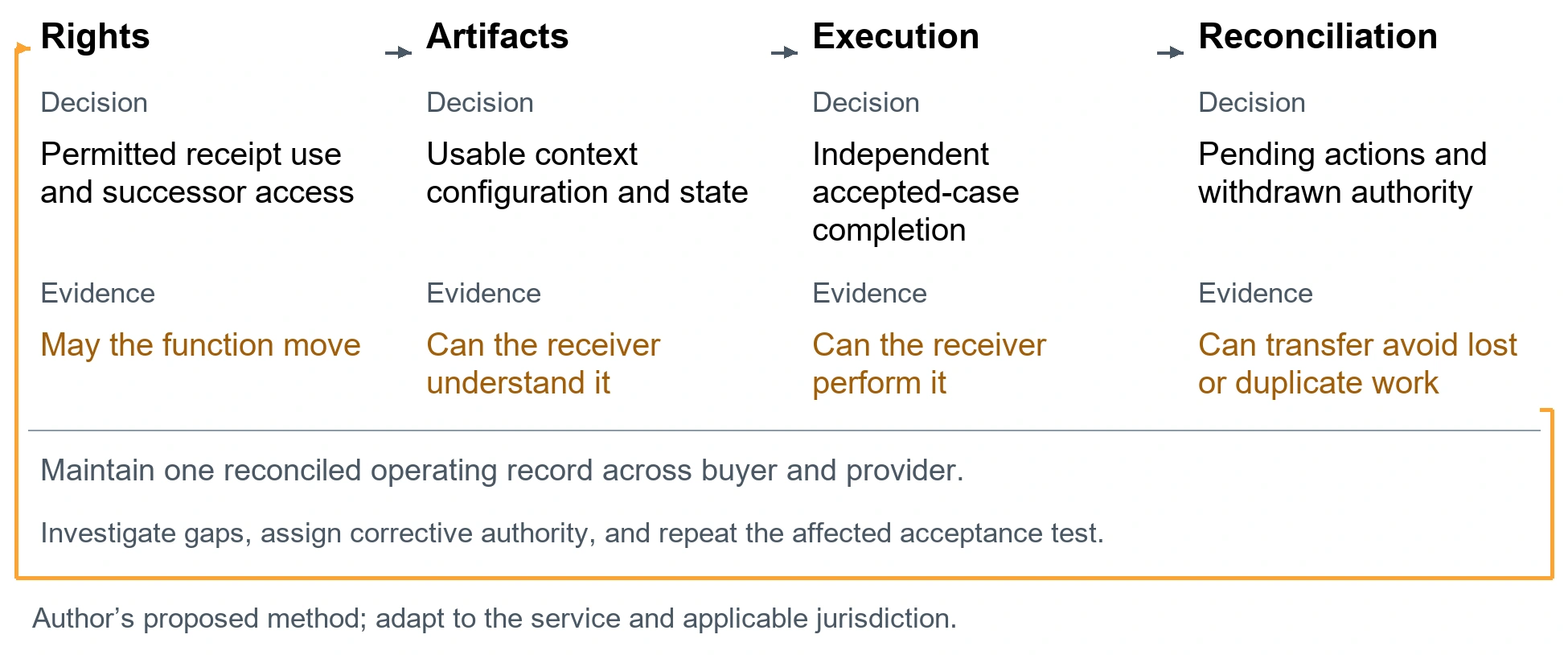
Figure 1 proposes four tests: rights, usable artifacts, independent execution, and pending-case reconciliation. Export representative material into agreed formats with explanatory metadata. Ask the receiving team to complete normal, difficult, and interrupted work without routine incumbent assistance.
Measure elapsed time, accepted outcomes, manual effort, missing knowledge, and dependencies. A successful transfer of a simplified test case should remain evidence within that scope. Record conditions not represented, such as production volume, local access approval, or a wider outage.
BCG’s enterprise-agent platform discussion emphasizes common standards and interoperability.3 Those choices can support portability, but a shared interface standard does not establish that business context, authority, and service state transfer correctly. The manager needs a functional demonstration.
Make Rights and Operating Support Executable
Agree export frequency, retrieval time, formats, licenses, transition assistance, cost, retention, and deletion. Confirm the right to provide relevant artifacts to an authorized successor and reviewer. A right that expires before the handover completes can undermine the continuity plan.
EU, UK, Swiss, US, and other privacy, secrecy, IP, records, and sector requirements can constrain transfer. Qualified specialists should establish the applicable permissions and conditions. Ownership of an artifact should not be assumed to permit every disclosure or reuse.
Preserve identity and authority during transition. Withdraw incumbent access at the appropriate point while ensuring the successor has approved permissions. Reconcile delegated agents, queued work, external actions, and open approvals so that both providers do not execute the same intent.
Maintain Portability as the Service Evolves
A reasonable objection is that a full transfer exercise is costly. Use a proportionate demonstration for the most consequential functions and refresh it after material change. A smaller tested route is more credible than a broad untested claim of effortless exit.
Before relying on portability, require evidence of what moved, what the receiver completed, and which limitations remain. Assign owners and funding for gaps. Revisit the business case if the service requires significant reengineering or retained capability that the sourcing plan omitted.
The manager should classify the service honestly: exportable, reconstructable, or operationally portable at a demonstrated scope. That distinction allows the buyer to manage dependency and negotiate transition support before the need to move becomes urgent.
Evidence and Source Note
The study is a nonrepresentative cross-section of 850 vendor delivery-team respondents on 150 engagements serving Tier 1 financial institutions, collected during January–June 2026. Neither banks nor vendors corroborated the accounts. It establishes reported experience, not causation, legal breach, or market prevalence. Its application here is a mechanism to investigate, not an estimate of conditions in other industries. The author-supplied version 1.8.2 is dated November 1, 2026 and is cited as a forthcoming manuscript consulted October 23, 2026.4
This is an analytical decision paper based on the supplied study and selected primary public sources checked through October 23, 2026. The original contribution is a portability demonstration distinguishing export rights and artifacts from independently operable, reconciled service transfer. The proposed method has not been independently validated. Legal requirements depend on the entity, activity, jurisdiction, and effective provisions; supervisory observations, research, and professional commentary have distinct authority.
Notes
- Doneld Shelkey, “Negotiating AI Provisions in Commercial and Technology Contracts: Where the Market Is Heading,” The Licensing Journal, May 1, 2026, pp. 1–2, intellectual property and transition, https://www.morganlewis.com/-/media/files/publication/outside-publication/article/2026/negotiating-ai-provisions-in-commercial-and-technology-contracts-where-the-market-is-heading-the-licensing-journal.pdf. ↩
- Phil Hatch, Agentic AI Outsourcing at Tier 1 Financial Institutions: Full Study Report, version 1.8.2 (Akholi, forthcoming manuscript dated November 1, 2026), Part 4, “Knowledge at Risk of Departure”, https://doi.org/10.2139/ssrn.7164559; Hatch, Agentic AI Outsourcing, Part 3, Third-Party Ecosystem, sec. 6.1, “Mapping of Third and Fourth Party Dependencies,” indicator C196. ↩
- Daniel Martines et al., “Building Enterprise AI Agents in Regulated Industries,” Boston Consulting Group, July 20, 2026, enterprise platform and identity control sections, https://www.bcg.com/publications/2026/building-enterprise-ai-agents-in-regulated-industries. ↩
- Hatch, Agentic AI Outsourcing, Introduction, “Executive Summary” and “Evidentiary Basis and Its Limits”. ↩
Bibliography
- Hatch, Phil. Agentic AI Outsourcing at Tier 1 Financial Institutions: Full Study Report. Version 1.8.2. Akholi. Forthcoming manuscript dated November 1, 2026. Author-supplied manuscript consulted October 23, 2026. https://doi.org/10.2139/ssrn.7164559.
- Martines, Daniel, Cullen Breithaupt, Drew Ingalls, Sawan Ruparel, and Prithvi Vadlamudi. “Building Enterprise AI Agents in Regulated Industries.” Boston Consulting Group. July 20, 2026. https://www.bcg.com/publications/2026/building-enterprise-ai-agents-in-regulated-industries.
- Shelkey, Doneld. “Negotiating AI Provisions in Commercial and Technology Contracts: Where the Market Is Heading.” The Licensing Journal. May 1, 2026. https://www.morganlewis.com/-/media/files/publication/outside-publication/article/2026/negotiating-ai-provisions-in-commercial-and-technology-contracts-where-the-market-is-heading-the-licensing-journal.pdf.
Explore this subject
Category: Resilience and Exit
Topics: Evidence and Traceability Exit and Portability Service Continuity
Audience: Buy-side Delivery and Vendor Managers
Industry: Cross-industry