
Reprice the Function Rather Than One Input
The executive should identify what changed in the complete service before demanding or accepting a price adjustment. Model consumption is one input. Orchestration, review, correction, evidence, integration, support, and retained buyer work can move differently as the delivery method evolves.
McKinsey’s workflow economics analysis considers the full cost of accepted agentic work.1 The commercial review should follow that functional boundary. A cheaper model can reduce cost while a changed workflow increases total effort, and a higher-priced model can be economical if it reduces consequential rework.
For a hypothetical service, a provider may use a more capable model that costs more per call but completes accepted cases with fewer retries and less review. Compare total cost, quality, timing, and scope. A single input-price index should not determine the whole adjustment.
Preserve the Original Comparison
The study reports manual work and delivery processes not matched to agentic capability.2 It does not establish a universal repricing formula. It identifies costs and dependencies that both firms should make visible before attributing an economic change.
Maintain the original functional baseline, accepted scope, cost inclusions, and benefit assumptions. Record later changes alongside it. Repricing should not erase the ability to determine whether the original value claim was realized or whether the service has become materially different.
Separate provider efficiency, buyer process improvement, changed volume or case mix, technology input cost, and quality change. The contract may allocate gains through a negotiated rule even when causal attribution is imperfect. State that rule rather than present allocation as scientific proof.
Use a Repricing Evidence Record
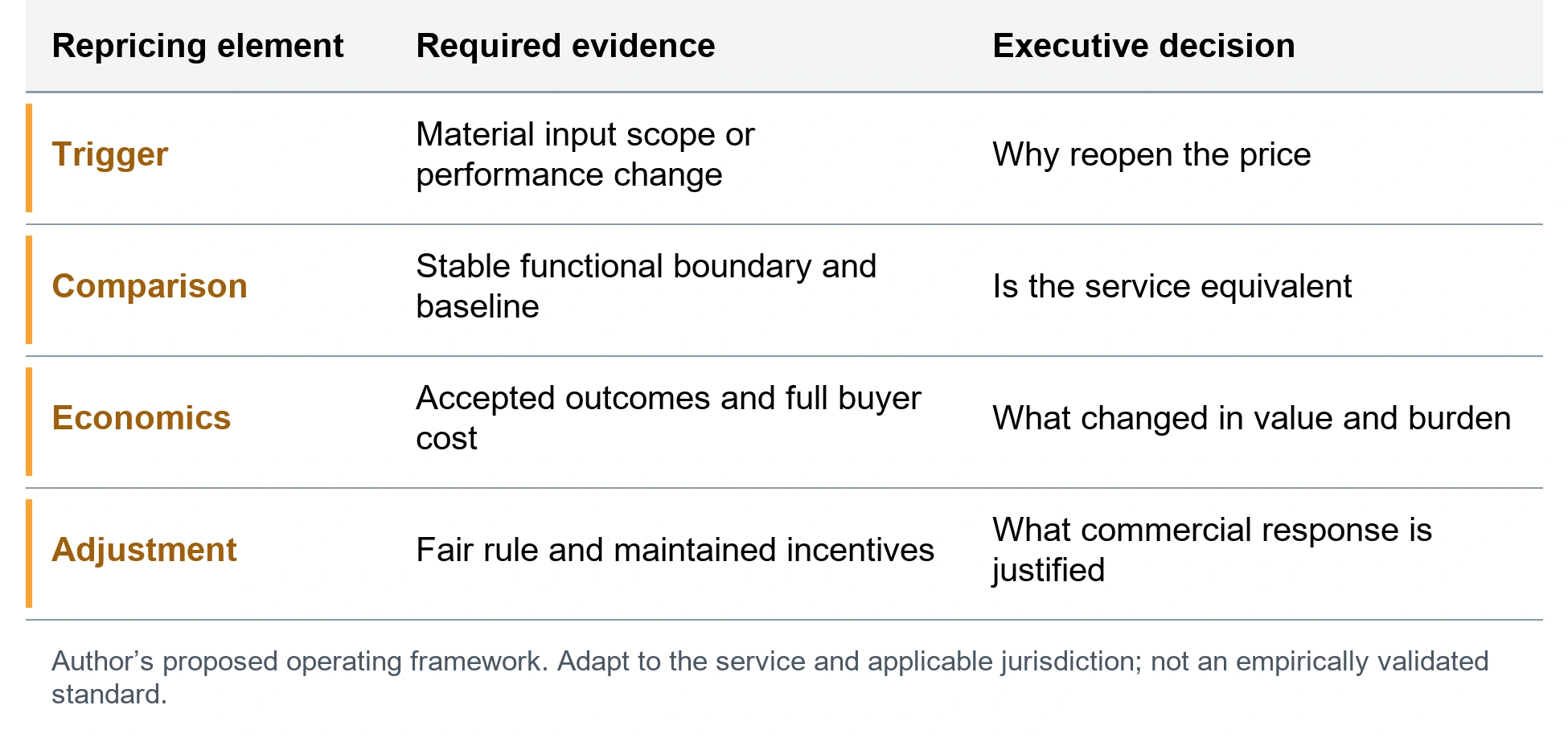
Figure 1 proposes four elements: trigger, comparable service, economic evidence, and adjustment. Define review frequency, materiality, records, notice, and dispute handling. The calculation should be understandable to finance and commercial owners on both sides.
Mayer Brown’s provider-focused contracting analysis describes evolving outcome, activity, consumption, and hybrid pricing.3 These are options with different risks, not a single winning model. Repricing should preserve the chosen unit’s meaning and account for changes in what the provider must deliver.
Include necessary control and recovery capability. Removing an activity can lower cost but change the service’s risk and continuity. The executive should decide whether that is an efficiency or a scope reduction, and adjust acceptance and price consistently.
Keep Incentives and Local Conditions Coherent
A fair mechanism should not reward increased retries, unnecessary agent activity, or hidden transfer of work to the buyer. Nor should it confiscate every provider improvement immediately if that removes the incentive to invest. Compare options such as scheduled review, shared gains, floors, caps, or staged commitments against the service.
EU, UK, Swiss, US, and other legal, tax, labor, sector, and data requirements can affect cost and permissible delivery. Qualified owners should assess relevant changes. A global adjustment should not conceal an uneconomic or nonviable local service.
When economics deteriorate, distinguish temporary transition investment from structural cost. Agree a response that can include redesign, narrower scope, different technology, changed price, or exit. A provider’s commercial difficulty should not be resolved through undisclosed reduction in quality or oversight.
Approve an Adjustment Both Firms Can Apply
A reasonable objection is that detailed cost visibility intrudes on supplier confidentiality. The buyer needs enough evidence to assess its total functional value and apply the agreed mechanism, not necessarily every element of provider margin. Use protected review or agreed observable measures where suitable.
At each review, reconcile accepted outcomes, full charges, retained effort, quality, dependencies, and relevant cost changes. State uncertainty and unresolved disputes separately from urgent operating action. Preserve the basis for the adjustment and the next review trigger.
The executive should approve a commercial model that can evolve without losing comparability or trust. Repricing is a decision about the service now delivered, the value created, and the conditions necessary to sustain it. Model price alone is too narrow a basis.
Evidence and Source Note
The study is a nonrepresentative cross-section of 850 vendor delivery-team respondents on 150 engagements serving Tier 1 financial institutions, collected during January–June 2026. Neither banks nor vendors corroborated the accounts. It establishes reported experience, not causation, legal breach, or market prevalence. Its application here is a mechanism to investigate, not an estimate of conditions in other industries. The author-supplied version 1.8.2 is dated November 1, 2026 and is cited as a forthcoming manuscript consulted October 23, 2026.4
This is an analytical decision paper based on the supplied study and selected primary public sources checked through October 23, 2026. The original contribution is a repricing record separating technology input changes, functional economics, negotiated allocation, and changes in service scope. The proposed method has not been independently validated. Legal requirements depend on the entity, activity, jurisdiction, and effective provisions; supervisory observations, research, and professional commentary have distinct authority.
Notes
- Chandana Asif et al., “Where AI Agents Pay Off: A Practical Guide to the Economics of Agentic Workflows,” McKinsey & Company, August 24, 2026, “What drives the unit economics of AI-based workflows?”, https://www.mckinsey.com/capabilities/quantumblack/our-insights/where-ai-agents-pay-off-a-practical-guide-to-the-economics-of-agentic-workflows. ↩
- Phil Hatch, Agentic AI Outsourcing at Tier 1 Financial Institutions: Full Study Report, version 1.8.2 (Akholi, forthcoming manuscript dated November 1, 2026), Part 5, “The Five Manual Alteration Methods” and “Disclosure of Manual Alteration,” table 5.8, https://doi.org/10.2139/ssrn.7164559; Hatch, Agentic AI Outsourcing, Part 2, “The Shift From Managing People to Managing Agents”; Part 6, “The Executive Action Plan”. ↩
- Scott F. Young and Jon McPherson, “Contracting Opportunities and Challenges for Emerging Agentic AI Companies,” Mayer Brown, October 13, 2026, provider contracting analysis of authority, data, liability, and service terms, https://www.mayerbrown.com/en/insights/publications/2026/10/contracting-opportunities-and-challenges-for-emerging-agentic-ai-companies. ↩
- Hatch, Agentic AI Outsourcing, Introduction, “Executive Summary” and “Evidentiary Basis and Its Limits”. ↩
Bibliography
- Asif, Chandana, Dieter Kiewell, Lari Hämäläinen, Tom Kolaja, and Tunde Olanrewaju. “Where AI Agents Pay Off: A Practical Guide to the Economics of Agentic Workflows.” McKinsey & Company. August 24, 2026. https://www.mckinsey.com/capabilities/quantumblack/our-insights/where-ai-agents-pay-off-a-practical-guide-to-the-economics-of-agentic-workflows.
- Hatch, Phil. Agentic AI Outsourcing at Tier 1 Financial Institutions: Full Study Report. Version 1.8.2. Akholi. Forthcoming manuscript dated November 1, 2026. Author-supplied manuscript consulted October 23, 2026. https://doi.org/10.2139/ssrn.7164559.
- Young, Scott F., and Jon McPherson. “Contracting Opportunities and Challenges for Emerging Agentic AI Companies.” Mayer Brown. October 13, 2026. https://www.mayerbrown.com/en/insights/publications/2026/10/contracting-opportunities-and-challenges-for-emerging-agentic-ai-companies.
Explore this subject
Category: Commercial and Vendor Management
Topics: Contract Design Functional Baselines Outcome Pricing
Audience: Buy-side Boards and Executives
Industry: Cross-industry