
Define the Claims Result Worth Purchasing
The board should ask what an outsourced claims agent is paid to improve. Faster handling, lower expense, accurate decisions, and appropriate settlement are different objectives. A price tied to reduced claims cost can reward an outcome that conflicts with the insurer’s obligations if eligibility, quality, and customer treatment are not defined.
EIOPA’s AI opinion applies a risk-based, proportionate approach within insurance-sector requirements.1 It addresses national supervisors and does not create one global claims-payment formula. The board should establish the applicable duties and ensure the commercial design supports them.
For a hypothetical claims service, a reduction in paid value may reflect better detection of invalid claims, changed case mix, delayed payment, or incorrect rejection. The supplier’s savings claim should distinguish those mechanisms. Lower payment alone is insufficient evidence of a better claims function.
Keep the Complete Claim in View
Follow claims through intake, evidence requests, assessment, decision, payment, challenge, reopening, and correction. Define the population and terminal states. A case should not earn successful-outcome credit merely because the provider stopped handling it or returned it to the insurer.
The study reports manual alteration and completion signals that can differ from actual results.2 These banking accounts do not establish insurance claim harm. They identify why the insurer should verify supplier closure against the actual case and customer outcome.
Separate necessary professional judgment from avoidable rework. Human intervention can protect quality and should remain visible in cost and performance reporting. An incentive that treats every human referral as failure can discourage the escalation that a complex claim needs.
Use a Claims Incentive Safeguard Record
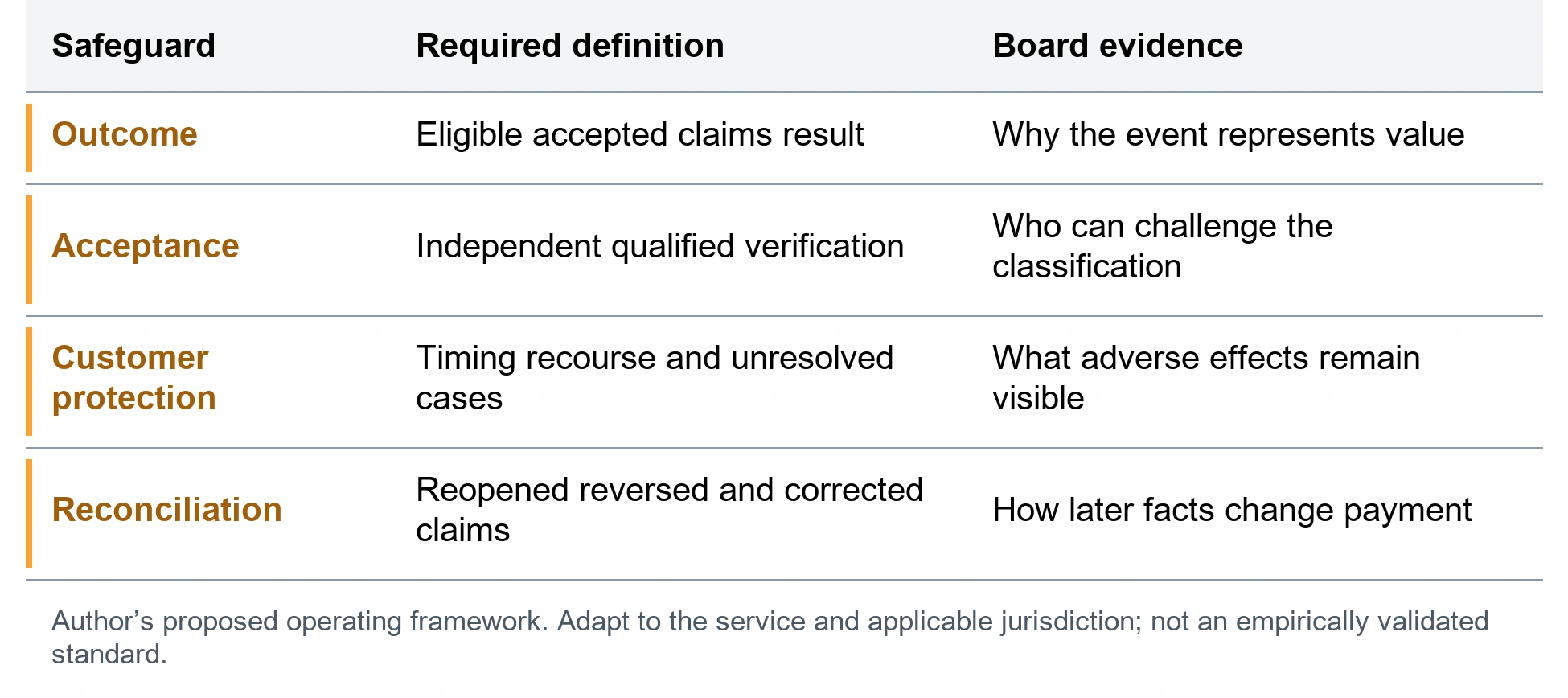
Figure 1 proposes four safeguards: eligible outcome, independent acceptance, customer protection, and later reconciliation. Specify the payable event, evidence, exclusions, and treatment of reopened or reversed decisions. Keep the insurer’s challenge route independent of the team earning the performance payment.
Include timeliness, unresolved cases, complaints, appeals where applicable, corrections, and relevant quality differences. No single measure establishes fairness. Interpret patterns with appropriate case mix and evidence, and obtain qualified review of any material concern.
Mayer Brown’s agentic services analysis connects performance commitments with governance and accountability.3 The contract should support access to the evidence and correction process needed to test the claimed outcome. An invoice dispute should not become the only route for challenging an inappropriate claims decision.
Apply Local Insurance and Customer Duties
EU, UK, Swiss, US, and other insurance markets differ by product, customer, legal entity, and applicable claims rules. Management should obtain local conclusions on coverage, conduct, notices, decision authority, privacy, records, and recourse. A global efficiency target should not determine a local entitlement.
Require the provider to preserve the policy version, evidence, authority, material interventions, and resulting case state. A model-generated explanation should remain connected to the actual basis for the decision. The insurer needs a practical route to obtain and review that basis.
Commercial terms should address changes in case mix and buyer prerequisites fairly. They should not let the supplier redefine eligible claims after seeing results. Preserve the original denominator and the reason for each exclusion so that savings and quality remain interpretable.
Pilot the Incentive Before Scaling the Contract
A reasonable objection is that multiple safeguards make pricing complex. Keep the payable unit clear while preserving the evidence needed to interpret it. If the result cannot be measured fairly or attributed reliably, use another pricing structure until the relevant capability exists.
Run a bounded pilot covering difficult, rejected, appealed, corrected, and unresolved cases. Reconcile provider payment to accepted outcomes and retained insurer work. Examine whether the metric encourages delay, premature closure, or unnecessary escalation, and revise the design before wider use.
The board should approve claims incentives when the supplier’s economic interest supports a defensible insurance result. Commercial success should survive scrutiny of coverage, quality, timing, recourse, and later correction. A lower payout or faster closure is a fact to explain, not a sufficient definition of value.
Evidence and Source Note
The study is a nonrepresentative cross-section of 850 vendor delivery-team respondents on 150 engagements serving Tier 1 financial institutions, collected during January–June 2026. Neither banks nor vendors corroborated the accounts. It establishes reported experience, not causation, legal breach, or market prevalence. The author-supplied version 1.8.2 is dated November 1, 2026 and is cited as a forthcoming manuscript consulted October 23, 2026.4
This is an analytical decision paper based on the supplied study and selected primary public sources checked through October 23, 2026. The original contribution is a claims incentive record connecting supplier payment to defensible outcomes, independent challenge, customer effects, and later reconciliation. The proposed method has not been independently validated. Legal requirements depend on the entity, activity, jurisdiction, and effective provisions; supervisory observations, research, and professional commentary have distinct authority.
Notes
- European Insurance and Occupational Pensions Authority, “Opinion on Artificial Intelligence Governance and Risk Management,” European Insurance and Occupational Pensions Authority, August 6, 2025, description and opinion scope; addressed to national supervisors, https://www.eiopa.europa.eu/publications/opinion-artificial-intelligence-governance-and-risk-management_en. ↩
- Phil Hatch, Agentic AI Outsourcing at Tier 1 Financial Institutions: Full Study Report, version 1.8.2 (Akholi, forthcoming manuscript dated November 1, 2026), Part 5, “The Five Manual Alteration Methods” and “Disclosure of Manual Alteration,” table 5.8, https://doi.org/10.2139/ssrn.7164559; Hatch, Agentic AI Outsourcing, Part 3, AI Technology, sec. 4.1, “Accuracy of the Tools’ Own Success and Failure Reports,” indicator C172. ↩
- Rohith P. George et al., “Contracting for Agentic AI Solutions: Shifting the Model from SaaS to Services,” Mayer Brown, February 17, 2026, secs. 1–6, https://www.mayerbrown.com/en/insights/publications/2026/02/contracting-for-agentic-ai-solutions-shifting-the-model-from-saas-to-services. ↩
- Hatch, Agentic AI Outsourcing, Introduction, “Executive Summary” and “Evidentiary Basis and Its Limits”. ↩
Bibliography
- European Insurance and Occupational Pensions Authority. “Opinion on Artificial Intelligence Governance and Risk Management.” European Insurance and Occupational Pensions Authority. August 6, 2025. https://www.eiopa.europa.eu/publications/opinion-artificial-intelligence-governance-and-risk-management_en.
- George, Rohith P., Joe Pennell, Brad L. Peterson, and Oliver Yaros. “Contracting for Agentic AI Solutions: Shifting the Model from SaaS to Services.” Mayer Brown. February 17, 2026. https://www.mayerbrown.com/en/insights/publications/2026/02/contracting-for-agentic-ai-solutions-shifting-the-model-from-saas-to-services.
- Hatch, Phil. Agentic AI Outsourcing at Tier 1 Financial Institutions: Full Study Report. Version 1.8.2. Akholi. Forthcoming manuscript dated November 1, 2026. Author-supplied manuscript consulted October 23, 2026. https://doi.org/10.2139/ssrn.7164559.
Explore this subject
Category: Commercial and Vendor Management
Topics: Customer Protection Outcome Pricing Outcome Verification
Audience: Buy-side Boards and Executives
Industry: Financial Services Insurance