
Choose the Result the Business Needs
The executive sponsor should define the business outcome before selecting the billing unit. Resolved claims, completed orders, accepted applications, and collected receivables describe different obligations from processed tasks or generated recommendations. A price tied to an event becomes useful only when that event represents the result the buyer intends to purchase.
Bain’s provider analysis identifies the need to connect new commercial models to measurable customer outcomes.1 The buyer’s further task is to determine whether the selected measure rewards the right behavior. A precise metric can still direct the supplier toward an undesirable result.
For a hypothetical service, paying for closed tickets may encourage premature closure while paying for recovered money may ignore the cost or propriety of collection. The executive should identify the intended benefit, affected parties, required quality, and actions that remain prohibited even if they improve the payable metric.
Define Acceptance Before Counting Performance
Specify the unit, eligibility, terminal state, quality standard, timing, evidence source, and treatment of exceptions. State whether the supplier earns payment for attempts, accepted outcomes, or outcomes sustained through an agreed period. Keep these measures distinct rather than use the same word completion for each.
The study’s reported manual repair and completion signals inconsistent with results show why a supplier status field should be tested against actual work.2 Those observations do not establish that outcome pricing fails. They identify a verification requirement for the buyer’s own contract.
A hypothetical automated refund should not earn accepted-outcome payment merely because the agent generated an instruction. The parties should agree which authoritative event establishes the refund, how failed or duplicate attempts are handled, and what later reversal means for the commercial calculation.
Use an Outcome Incentive Design Record
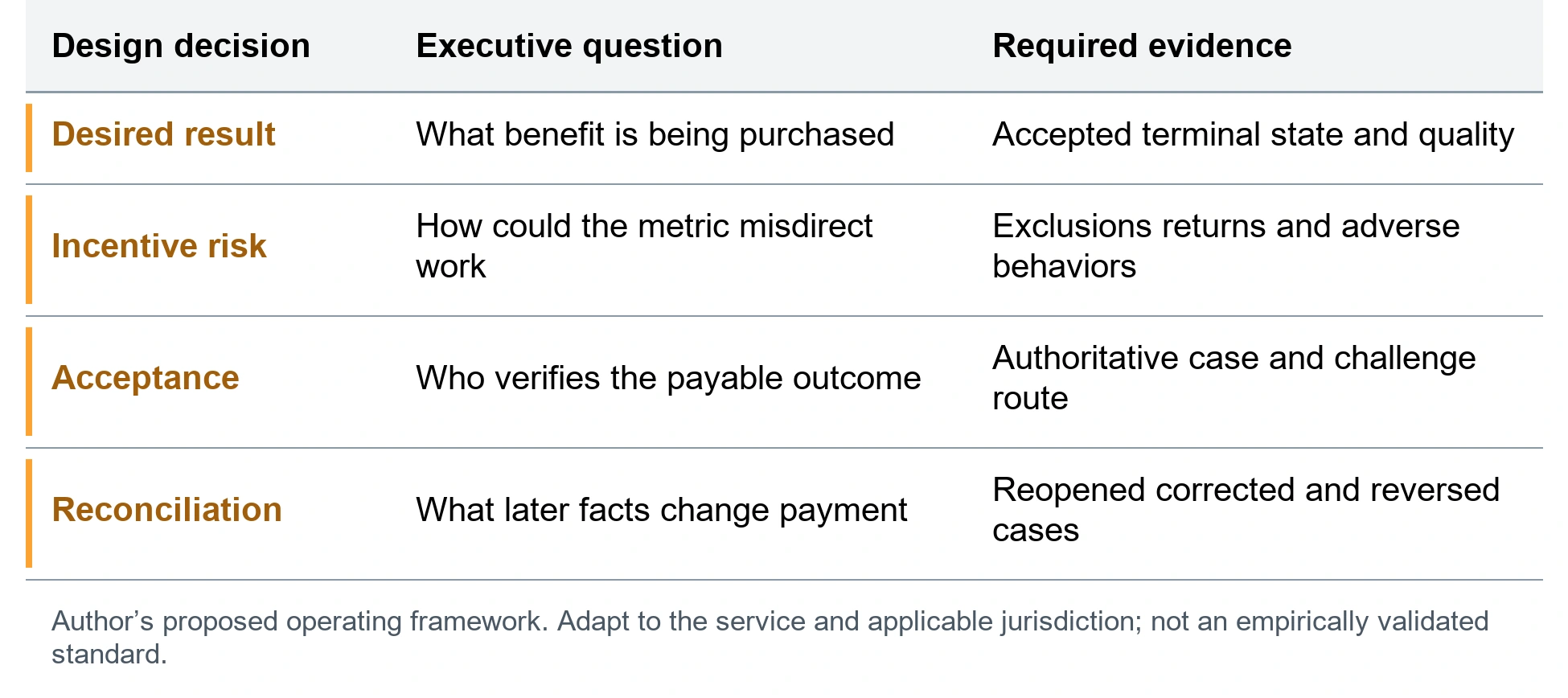
Figure 1 proposes four decisions: define the desired result, identify undesirable incentives, specify independent acceptance evidence, and reconcile later changes. The executive should require management to examine how a supplier could meet the literal metric while defeating the underlying business purpose.
Include work returned to the buyer, excluded cases, reopened cases, and quality failures. A provider should not be able to improve performance by changing the eligible population after the outcome is known. The denominator and exclusion rules should remain stable or change through a controlled agreement.
Morgan Lewis’s contracting discussion addresses performance commitments and explicit allocation of AI-related risks.3 Applied to outcome pricing, the contract should connect payment to evidence and correction rights. The buyer needs an operational route to challenge the classification, not only a right to dispute an invoice after records have disappeared.
Allocate Control and Shared Dependencies Fairly
The supplier may not control all factors determining the business outcome. Buyer approvals, external systems, customer behavior, and market conditions can affect results. Identify the prerequisites, evidence, attribution method, and commercial treatment of shortfalls. A supplier should not guarantee an outcome outside its authority without a defined allocation of that uncertainty.
Conversely, dependencies should not become a blanket exclusion that removes ordinary delivery responsibility. Test which prerequisites are genuinely necessary and who can provide them. A useful commercial model distinguishes provider failure from buyer delay and uncontrollable external events through case evidence.
EU, UK, Swiss, US, and other sectors may impose different conduct, privacy, safety, or professional-duty limits on the actions used to produce an outcome. The payment metric should not override those constraints. A commercially successful act can still be outside the approved service authority.
Pilot the Incentive Before Committing at Scale
A reasonable objection is that a richer acceptance rule makes outcome pricing too complicated. Keep the payable unit simple while preserving the controls needed to interpret it. If the desired result cannot be measured reliably or attributed fairly, another pricing structure may be more suitable for the present service.
Use a bounded period to reconcile cases, invoices, accepted results, exclusions, retained buyer work, and later corrections. Examine difficult cases and incentives at the margin, where closing one more case or avoiding one more exception changes payment. Revise the rule when it rewards an unintended behavior.
The executive should approve outcome pricing when the metric, authority, evidence, and commercial incentives support the same business purpose. A payment linked to an observable event is not automatically aligned with value. The right outcome is the one the buyer can verify, accept, and defend under the conditions of the service.
Evidence and Source Note
The study is a nonrepresentative cross-section of 850 vendor delivery-team respondents on 150 engagements serving Tier 1 financial institutions, collected during January–June 2026. Neither banks nor vendors corroborated the accounts. It establishes reported experience, not causation, legal breach, or market prevalence. Its application here is a mechanism to investigate, not an estimate of conditions in other industries. The author-supplied version 1.8.2 is dated November 1, 2026 and is cited as a forthcoming manuscript consulted October 23, 2026.4
This is an analytical decision paper based on the supplied study and selected primary public sources checked through October 23, 2026. The original contribution is an outcome-pricing design record that tests whether the billing unit, eligibility, authority, acceptance evidence, and later reconciliation reward the buyer’s intended result. The proposed method has not been independently validated. Legal requirements depend on the entity, activity, jurisdiction, and effective provisions; supervisory observations, research, and professional commentary have distinct authority.
Notes
- Megha Chawla et al., “Tech Services: Cracking the Code on AI-led Growth,” Bain & Company, September 29, 2026, “At a Glance” and discussion of commercial models, https://www.bain.com/insights/tech-services-cracking-the-code-on-ai-led-growth-technology-report-2026/. ↩
- Phil Hatch, Agentic AI Outsourcing at Tier 1 Financial Institutions: Full Study Report, version 1.8.2 (Akholi, forthcoming manuscript dated November 1, 2026), Part 5, “The Five Manual Alteration Methods” and “Disclosure of Manual Alteration,” table 5.8, https://doi.org/10.2139/ssrn.7164559; Hatch, Agentic AI Outsourcing, Part 3, AI Technology, sec. 4.1, “Accuracy of the Tools’ Own Success and Failure Reports,” indicator C172. ↩
- Doneld Shelkey, “Negotiating AI Provisions in Commercial and Technology Contracts: Where the Market Is Heading,” The Licensing Journal, May 1, 2026, pp. 1–2, intellectual property and transition, https://www.morganlewis.com/-/media/files/publication/outside-publication/article/2026/negotiating-ai-provisions-in-commercial-and-technology-contracts-where-the-market-is-heading-the-licensing-journal.pdf. ↩
- Hatch, Agentic AI Outsourcing, Introduction, “Executive Summary” and “Evidentiary Basis and Its Limits”. ↩
Bibliography
- Chawla, Megha, Mark Brinda, Sushant Khandelwal, and Sandeep Nayak. “Tech Services: Cracking the Code on AI-led Growth.” Bain & Company. September 29, 2026. https://www.bain.com/insights/tech-services-cracking-the-code-on-ai-led-growth-technology-report-2026/.
- Hatch, Phil. Agentic AI Outsourcing at Tier 1 Financial Institutions: Full Study Report. Version 1.8.2. Akholi. Forthcoming manuscript dated November 1, 2026. Author-supplied manuscript consulted October 23, 2026. https://doi.org/10.2139/ssrn.7164559.
- Shelkey, Doneld. “Negotiating AI Provisions in Commercial and Technology Contracts: Where the Market Is Heading.” The Licensing Journal. May 1, 2026. https://www.morganlewis.com/-/media/files/publication/outside-publication/article/2026/negotiating-ai-provisions-in-commercial-and-technology-contracts-where-the-market-is-heading-the-licensing-journal.pdf.
Explore this subject
Category: Commercial and Vendor Management
Topics: Customer Protection Outcome Pricing Outcome Verification
Audience: Buy-side Boards and Executives
Industry: Cross-industry