
Define the Service That Must Transfer
The executive sponsor should decide what capability the buyer needs to retain when an agentic outsourcing relationship ends. The target may be a successor-run service, an internal operation, or a narrower continuity mode. The exit decision should specify the outcome, timing, authority, and operating conditions to be preserved.
Morgan Lewis’s contracting analysis identifies continued access, configurations, data return, and transition assistance as exit issues.1 Those rights should support a practical transfer test. A contractual promise to deliver files is incomplete if the recipient cannot use them to perform the required work.
Start from the function rather than the provider platform. Identify which business records, case states, instructions, integrations, and skills are necessary. A successor does not necessarily need the same model or orchestration software, but it needs a lawful and workable route to the accepted outcome.
Identify the Context Hidden in the Provider Service
A service can depend on exception histories, customer-specific configurations, retrieval indexes, tool permissions, and informal operating knowledge. Some artifacts may be owned by the provider or licensed from another party. The buyer should distinguish rights to receive material from rights to use it and the practical ability to interpret it.
The study describes operational knowledge held in personal notes and experienced staff.2 It does not establish that a particular provider has trapped the buyer. The finding supports examining whether the buyer’s own transfer plan depends on people or context outside its control.
For a hypothetical order-management service, exported orders may omit pending exceptions and the reasons for prior decisions. A successor could repeat completed actions or abandon unresolved work. The transition package should preserve operational state and governing authority, not only the final documents.
Commission a Transfer Demonstration
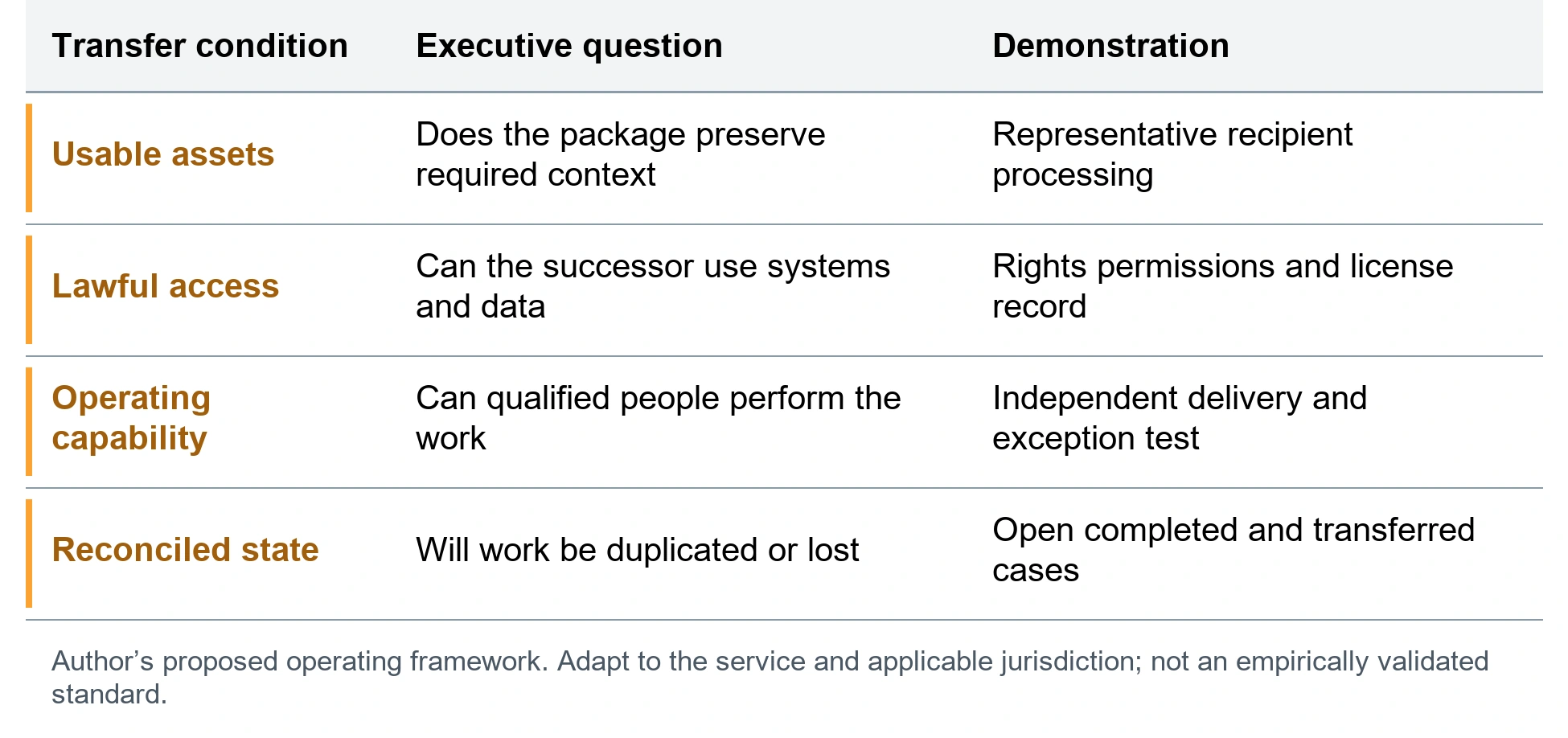
Figure 1 proposes four conditions for transferable delivery: usable assets, lawful access, qualified operation, and reconciled work. Ask a qualified receiving team to process representative cases using the proposed transfer package. Restrict routine assistance from the incumbent during part of the exercise to expose undocumented dependence.
Record missing information, incompatible formats, unavailable licenses, access delays, and judgment gaps. A completed import is a technical milestone, not proof of service continuity. The recipient should demonstrate the required outcome and explain the limitations of the test environment.
California Management Review’s conceptual analysis warns that supplier dependence can weaken buyer challenge and make extraction difficult.3 The proposed response here is an operating demonstration, rather than assuming either that dependence is inevitable or that every proprietary component must be replicated.
Negotiate the Limits Before Exit Becomes Urgent
The agreement should identify transition deliverables, update frequency, formats, assistance, costs, retained rights, deletion duties, and cooperation from material downstream providers. Record what is available independently during a disputed or sudden exit. Planned supplier assistance should not be counted as guaranteed capacity under every failure scenario.
EU, UK, Swiss, US, and other operations may have different privacy, secrecy, retention, licensing, and sector constraints. A transfer must preserve the lawful basis and permissions for the receiving organization. A broad portability clause cannot grant a right held by a third-party data owner or remove a local restriction.
The buyer should also decide what must be deleted or isolated at the incumbent after transfer, subject to applicable retention duties. Confirm how backups, agent memory, shared learning, and derived artifacts are treated. Exit should not leave unexplained copies or destroy evidence the buyer must retain.
Keep Transferability Current
A reasonable concern is that full portability can be costly and technically unrealistic. Prioritize the capability the buyer must preserve and compare transition options. The buyer may accept a proprietary component if a suitable continuity route exists and the residual dependency is explicit. It should not pay for nominal portability that has never been demonstrated.
Repeat affected tests when the service changes materially. A new model, memory design, tool, data license, or operating team can invalidate the transfer package. The executive should receive the latest demonstrated capability, unresolved gaps, estimated transition effort, and contingent assumptions.
Approve the relationship with a usable route to the required successor service. Transferability is established when another qualified party can complete and reconcile the work under lawful authority. The number of files returned is relevant only to the extent that those files support that result.
Evidence and Source Note
The study is a nonrepresentative cross-section of 850 vendor delivery-team respondents on 150 engagements serving Tier 1 financial institutions, collected during January–June 2026. Neither banks nor vendors corroborated the accounts. It establishes reported experience, not causation, legal breach, or market prevalence. Its application here is a mechanism to investigate, not an estimate of conditions in other industries. The author-supplied version 1.8.2 is dated November 1, 2026 and is cited as a forthcoming manuscript consulted October 23, 2026.4
This is an analytical decision paper based on the supplied study and selected primary public sources checked through October 23, 2026. The original contribution is a service transferability decision record that tests usable context, lawful access, receiving-team capability, and reconciliation rather than equating data export with continuity. The proposed method has not been independently validated. Legal requirements depend on the entity, activity, jurisdiction, and effective provisions; supervisory observations, research, and professional commentary have distinct authority.
Notes
- Doneld Shelkey, “Negotiating AI Provisions in Commercial and Technology Contracts: Where the Market Is Heading,” The Licensing Journal, May 1, 2026, pp. 1–2, intellectual property and transition, https://www.morganlewis.com/-/media/files/publication/outside-publication/article/2026/negotiating-ai-provisions-in-commercial-and-technology-contracts-where-the-market-is-heading-the-licensing-journal.pdf. ↩
- Phil Hatch, Agentic AI Outsourcing at Tier 1 Financial Institutions: Full Study Report, version 1.8.2 (Akholi, forthcoming manuscript dated November 1, 2026), Part 4, “Knowledge at Risk of Departure”, https://doi.org/10.2139/ssrn.7164559. ↩
- Shefali Patil et al., “The Hidden Costs of Outsourcing Judgment to AI Suppliers,” California Management Review Insights, March 10, 2026, discussion of supplier entrenchment; conceptual analysis rather than a measured AI failure rate, https://cmr.berkeley.edu/assets/documents/pdf/2026-03-the-hidden-costs-of-outsourcing-judgment-to-ai-suppliers.pdf. ↩
- Hatch, Agentic AI Outsourcing, Introduction, “Executive Summary” and “Evidentiary Basis and Its Limits”. ↩
Bibliography
- Hatch, Phil. Agentic AI Outsourcing at Tier 1 Financial Institutions: Full Study Report. Version 1.8.2. Akholi. Forthcoming manuscript dated November 1, 2026. Author-supplied manuscript consulted October 23, 2026. https://doi.org/10.2139/ssrn.7164559.
- Patil, Shefali, Tinglong Dai, and Christopher G. Myers. “The Hidden Costs of Outsourcing Judgment to AI Suppliers.” California Management Review Insights. March 10, 2026. https://cmr.berkeley.edu/assets/documents/pdf/2026-03-the-hidden-costs-of-outsourcing-judgment-to-ai-suppliers.pdf.
- Shelkey, Doneld. “Negotiating AI Provisions in Commercial and Technology Contracts: Where the Market Is Heading.” The Licensing Journal. May 1, 2026. https://www.morganlewis.com/-/media/files/publication/outside-publication/article/2026/negotiating-ai-provisions-in-commercial-and-technology-contracts-where-the-market-is-heading-the-licensing-journal.pdf.
Explore this subject
Category: Resilience and Exit
Topics: Exit and Portability Intellectual Property and Reuse Retained Capability
Audience: Buy-side Boards and Executives
Industry: Cross-industry