
Govern the Safety Function Across Firms
The board should ask management which organization and person owns each material pharmacovigilance activity, including intake, case validation, follow-up, assessment, submission, and quality review. A prime supplier can coordinate several technical and human dependencies while the responsible company retains important obligations.
EMA’s GVP Module VI addresses case handling, awareness, and documented information exchange with contractors.1 It must be read with applicable current law and updates, not treated as a complete standalone 2017 regime. Management should establish the current requirements for each relevant market.
Define how potential safety information enters the chain and which event starts the applicable clock. A provider’s internal queue or commercial acceptance point should not silently determine legal awareness or reporting time. Qualified pharmacovigilance and legal owners should resolve those questions.
Make Delays and Corrections Visible
The study reports manual alterations, fragmented visibility, and slow cross-firm decisions in banking delivery.2 It does not establish pharmacovigilance failures. The mechanism warrants examination where a supplier’s final artifact can conceal the work and time required to make a safety case usable.
For a hypothetical intake service, an agent may identify a potential case but require human clarification of a key fact. Preserve receipt time, awareness assessment, information available, follow-up, intervention, and ownership. A later transfer to the sponsor should not erase the earlier history.
The board should receive material unresolved cases, aging, reporting exceptions, and recurring correction causes. Avoid interpreting a high processing volume as proof that the safety function is effective. The relevant result is timely, qualified, and properly documented disposition of the required work.
Use a Safety Obligation Chain Record
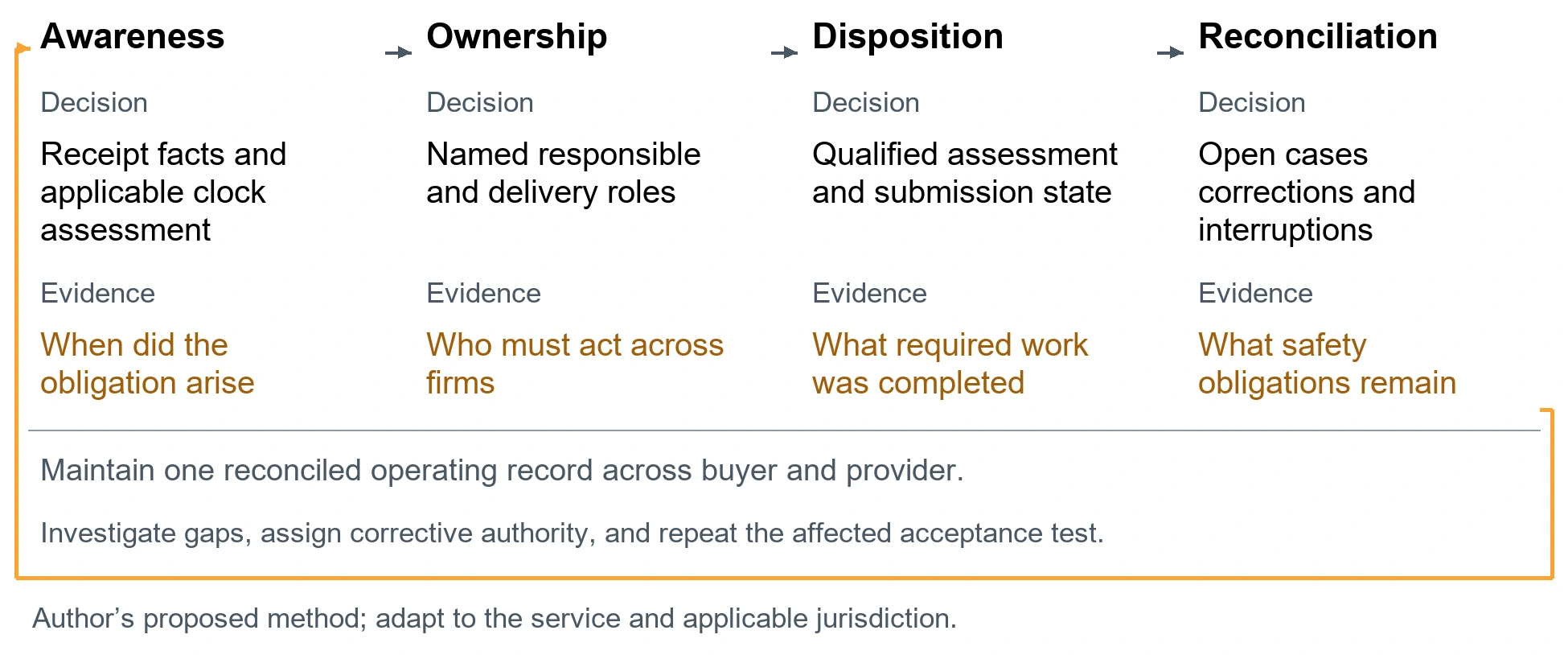
Figure 1 proposes four links: awareness, ownership, qualified disposition, and reconciliation. Identify the authoritative case record and the person who can act when information is incomplete or a dependency fails. Connect the prime supplier’s commitments to relevant downstream cooperation.
EMA’s current GVP page identifies evolving guidance and implementation material.3 Maintain a controlled local obligation map rather than assume the original contract remains aligned indefinitely. Changes should reach provider instructions, tools, trained people, and monitoring.
The proposed record should preserve both automated and human actions. It should distinguish an agent recommendation from a qualified assessment and a prepared report from an accepted submission. Record failures and acknowledgements where relevant so that apparent completion can be reconciled to the required end state.
Test the Chain Under Interruption
EU, UK, Swiss, US, and other pharmacovigilance systems differ by product, case, and responsible role. Specialists should determine reporting, records, privacy, and oversight requirements. A global delivery model should preserve local conclusions and escalation routes where the rules differ.
Test loss of a model, unavailable specialist, failed submission, duplicate case, changed safety information, and an overdue handoff. Establish the minimum service, authority, records, and capacity needed to continue priority work. A continuity document should lead to a demonstrated operating route.
Contract terms should support timely notification, evidence preservation, access, corrective action, and transition. Protect sensitive information while ensuring responsible parties can obtain the facts needed to decide. Commercial dispute resolution should not delay necessary safety action.
Require Demonstrated Safety Oversight
A reasonable objection is that existing pharmacovigilance quality systems already cover the work. Reuse them where effective, but test the new AI and supplier boundaries explicitly. The question is whether the quality system still reaches the actual execution and correction path.
Commission a targeted end-to-end review of representative cases, including late, incomplete, corrected, and interrupted work. Require qualified owners to reconcile timing, responsibility, evidence, and final disposition. Resolve material gaps and retest before expanding the service’s scope.
The board should approve a safety-delivery model that remains explainable across its suppliers. AI can support the function, but speed and volume are useful only when the responsible organization can demonstrate who knew what, who acted, what remained due, and how the obligation was completed.
Evidence and Source Note
The study is a nonrepresentative cross-section of 850 vendor delivery-team respondents on 150 engagements serving Tier 1 financial institutions, collected during January–June 2026. Neither banks nor vendors corroborated the accounts. It establishes reported experience, not causation, legal breach, or market prevalence. Its application here is a mechanism to investigate, not an estimate of conditions in other industries. The author-supplied version 1.8.2 is dated November 1, 2026 and is cited as a forthcoming manuscript consulted October 23, 2026.4
This is an analytical decision paper based on the supplied study and selected primary public sources checked through October 23, 2026. The original contribution is a board-level safety-obligation chain record connecting awareness, outsourced action, qualified disposition, and unresolved reporting work. The proposed method has not been independently validated. Legal requirements depend on the entity, activity, jurisdiction, and effective provisions; supervisory observations, research, and professional commentary have distinct authority.
Notes
- European Medicines Agency and Heads of Medicines Agencies, Guideline on Good Pharmacovigilance Practices (GVP): Module VI—Collection, Management and Submission of Reports of Suspected Adverse Reactions to Medicinal Products, European Medicines Agency and Heads of Medicines Agencies, July 28, 2017, Rev. 2, VI.B.7 and VI.App.2.7–2.9, https://www.ema.europa.eu/en/documents/regulatory-procedural-guideline/guideline-good-pharmacovigilance-practices-gvp-module-vi-collection-management-submission-reports-suspected-adverse-reactions-medicinal-products-rev-2_en.pdf. ↩
- Phil Hatch, Agentic AI Outsourcing at Tier 1 Financial Institutions: Full Study Report, version 1.8.2 (Akholi, forthcoming manuscript dated November 1, 2026), Part 5, “The Five Manual Alteration Methods” and “Disclosure of Manual Alteration,” table 5.8, https://doi.org/10.2139/ssrn.7164559; Hatch, Agentic AI Outsourcing, Part 2, sec. 5.2, “Joint Decision Speed Mismatched to Agent Speed”. ↩
- European Medicines Agency, “Good Pharmacovigilance Practices (GVP),” European Medicines Agency, accessed October 23, 2026, “Planned updates” and current module list, https://www.ema.europa.eu/en/human-regulatory-overview/post-authorisation/pharmacovigilance-post-authorisation/good-pharmacovigilance-practices-gvp. ↩
- Hatch, Agentic AI Outsourcing, Introduction, “Executive Summary” and “Evidentiary Basis and Its Limits”. ↩
Bibliography
- European Medicines Agency. “Good Pharmacovigilance Practices (GVP).” European Medicines Agency. Accessed October 23, 2026. https://www.ema.europa.eu/en/human-regulatory-overview/post-authorisation/pharmacovigilance-post-authorisation/good-pharmacovigilance-practices-gvp.
- European Medicines Agency and Heads of Medicines Agencies. Guideline on Good Pharmacovigilance Practices (GVP): Module VI—Collection, Management and Submission of Reports of Suspected Adverse Reactions to Medicinal Products. European Medicines Agency and Heads of Medicines Agencies. July 28, 2017. https://www.ema.europa.eu/en/documents/regulatory-procedural-guideline/guideline-good-pharmacovigilance-practices-gvp-module-vi-collection-management-submission-reports-suspected-adverse-reactions-medicinal-products-rev-2_en.pdf.
- Hatch, Phil. Agentic AI Outsourcing at Tier 1 Financial Institutions: Full Study Report. Version 1.8.2. Akholi. Forthcoming manuscript dated November 1, 2026. Author-supplied manuscript consulted October 23, 2026. https://doi.org/10.2139/ssrn.7164559.
Explore this subject
Category: Regulation and Compliance
Topics: Outcome Verification Retained Accountability Safety and Validation
Audience: Buy-side Boards and Executives
Industry: Life Sciences Other Regulated Industries