
Define the Plan Change the Customer Authorized
The service manager should distinguish comparing plans, recommending an option, obtaining an instruction, submitting a change, and confirming activation. These are different states. The provider’s agent should not turn a customer’s exploratory question into authority to alter price, service, contract duration, or bundled features.
Ofcom’s September 2026 discussion identifies consent, accountability, and redress questions while finding limited evidence of systemic AI-caused telecom harm to date.1 That evidence should temper broad claims of current failure. The manager should test the actual service rather than assume the banking study measures telecom conditions.
Start with the information the customer receives and the effect the service can create. Identify the relevant account, plan terms, charges, restrictions, eligibility, and effective date. The evidence should establish which proposal the customer accepted and what authority the agent had to carry it out.
Preserve Instruction and Implementation Separately
A customer instruction should remain linked to the specific proposed change. If price, duration, benefits, account, or effective date changes materially, determine whether renewed agreement is required. A general expression of interest should not become reusable approval for later modifications.
The study’s reports of fragmented visibility and completion messages inconsistent with results identify a mechanism to test across supplier and carrier systems.2 They do not establish telecom customer harm. The test is whether the carrier can reconcile the instruction, submitted request, applied account state, and customer confirmation.
For a hypothetical upgrade, the agent may quote one monthly price while the billing system applies another because a promotion is unavailable. The service should detect the mismatch, preserve the original offer, and route the case to authorized resolution. Sending a generic success message would not complete the intended change.
Use a Plan Change Evidence Record
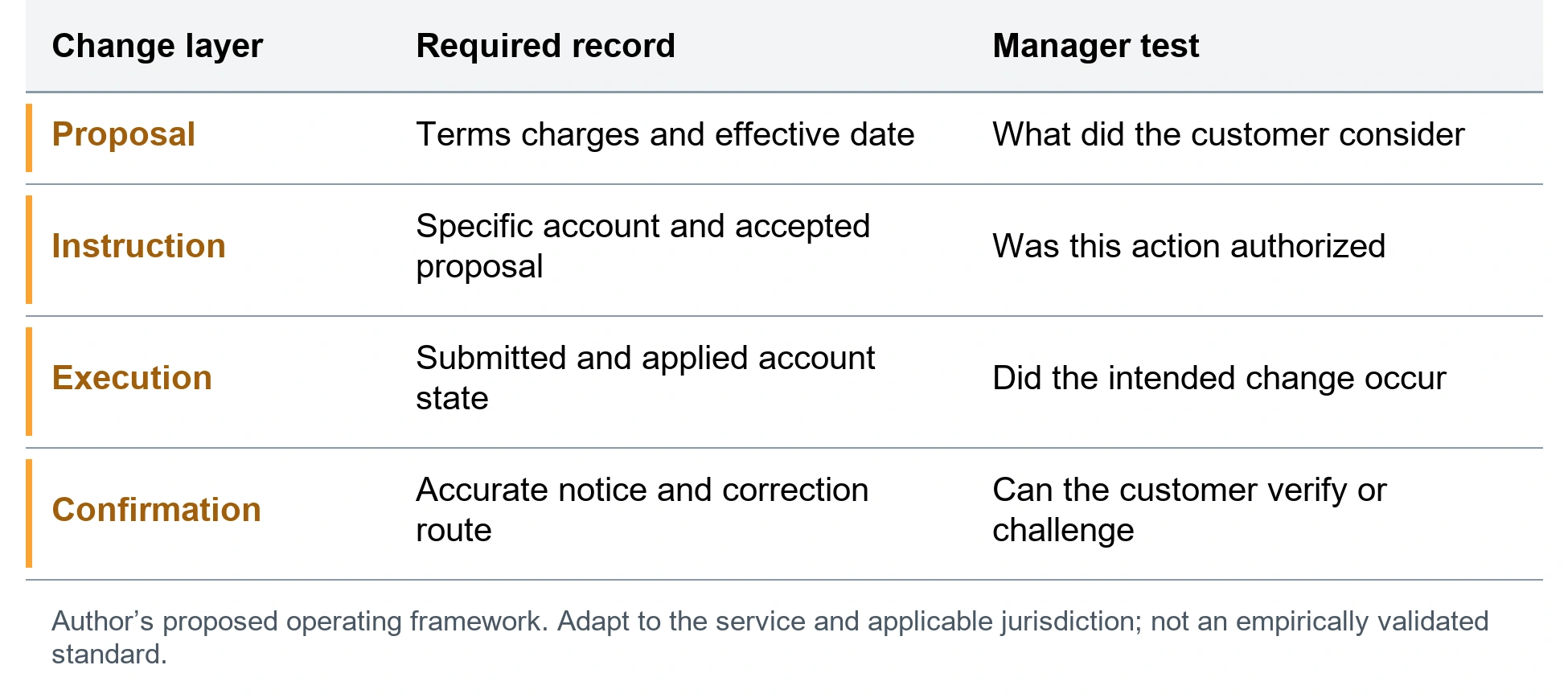
Figure 1 proposes four layers: proposal, instruction, execution, and confirmation. Preserve the governing terms and policy version, the customer’s relevant response, the submitted action, and the authoritative account result. The record should distinguish failed attempts, pending activation, and completed changes.
Include retries, simultaneous requests, shared accounts, ambiguous language, and unavailable promotions in acceptance tests. Verify that the service does not duplicate a change or overwrite an unresolved customer instruction. Use appropriate identity checks and escalation without collecting unnecessary customer information.
CMA guidance addresses accurate information, consent where required, and customer rights when businesses use AI agents.3 The carrier should translate applicable requirements into the workflow and ensure the provider cannot waive them to meet a conversion or handling-time target.
Keep Local Terms and Correction Authority Clear
EU, UK, Swiss, US, and other telecom and consumer rules differ. The manager should obtain the applicable conclusions for contract information, consent, cancellation, billing, accessibility, privacy, and records. One global sales script should not determine the rights attached to every local service.
Identify who can pause a disputed activation, correct billing, restore the prior plan where available, or offer an authorized remedy. Preserve the limits of reversibility; a service change may affect third-party benefits or network provisioning that cannot be restored instantly. The customer should receive an accurate account of the current state.
The provider should supply the evidence needed for complaints and investigation. A transcript alone may omit the tool action or account result, while a system log may omit the terms presented. The manager should require the combination necessary to explain both authority and execution.
Accept the Service Through Reconciled Changes
A reasonable objection is that detailed evidence can lengthen customer interactions. Capture the required records through the workflow where possible and keep explanations proportionate. Removing evidence of a consequential change can create more effort when the customer later disputes the bill or service.
Before launch, reconcile representative successful, failed, corrected, and contested changes across both firms. Monitor mismatches between quoted terms, submitted requests, and applied states. Assign corrective owners and retest affected routes after a model, policy, promotion, or interface change.
The manager should accept agent-made plan changes when the carrier can demonstrate what the customer authorized and what the service applied. Conversation quality can support that result, but it cannot substitute for it. The evidence must connect the customer’s decision to the account state on which the carrier will charge and deliver.
Evidence and Source Note
The study is a nonrepresentative cross-section of 850 vendor delivery-team respondents on 150 engagements serving Tier 1 financial institutions, collected during January–June 2026. Neither banks nor vendors corroborated the accounts. It establishes reported experience, not causation, legal breach, or market prevalence. Its application here is a mechanism to investigate, not an estimate of conditions in other industries. The author-supplied version 1.8.2 is dated November 1, 2026 and is cited as a forthcoming manuscript consulted October 23, 2026.4
This is an analytical decision paper based on the supplied study and selected primary public sources checked through October 23, 2026. The original contribution is a telecom plan-change record reconciling customer-facing terms, specific instruction, submitted action, applied state, and correction authority. The proposed method has not been independently validated. Legal requirements depend on the entity, activity, jurisdiction, and effective provisions; supervisory observations, research, and professional commentary have distinct authority.
Notes
- Ofcom, AI in Telecoms Markets: The Impact on Consumers’ Experiences So Far and How It May Develop, Ofcom, September 25, 2026, secs. 1.16–1.18 and 6; discussion and existing framework, not new rules, https://www.ofcom.org.uk/siteassets/resources/documents/internet-based-services/technology/discussion_the-impact-of-ai-in-telecoms-markets-on-consumers-experiences-so-far-and-how-it-may-develop.pdf?v=425794. ↩
- Phil Hatch, Agentic AI Outsourcing at Tier 1 Financial Institutions: Full Study Report, version 1.8.2 (Akholi, forthcoming manuscript dated November 1, 2026), Part 2, sec. 5.1, “Agent Actions Visible Only Inside Each Firm’s Own Tools”, https://doi.org/10.2139/ssrn.7164559; Hatch, Agentic AI Outsourcing, Part 3, AI Technology, sec. 4.1, “Accuracy of the Tools’ Own Success and Failure Reports,” indicator C172. ↩
- Competition and Markets Authority, “Complying with Consumer Law When Using AI Agents,” Competition and Markets Authority, March 9, 2026, “When it comes to dealing with your customers” and “Monitor how your AI agents are performing”, https://www.gov.uk/government/publications/complying-with-consumer-law-when-using-ai-agents/complying-with-consumer-law-when-using-ai-agents. ↩
- Hatch, Agentic AI Outsourcing, Introduction, “Executive Summary” and “Evidentiary Basis and Its Limits”. ↩
Bibliography
- Competition and Markets Authority. “Complying with Consumer Law When Using AI Agents.” Competition and Markets Authority. March 9, 2026. https://www.gov.uk/government/publications/complying-with-consumer-law-when-using-ai-agents/complying-with-consumer-law-when-using-ai-agents.
- Hatch, Phil. Agentic AI Outsourcing at Tier 1 Financial Institutions: Full Study Report. Version 1.8.2. Akholi. Forthcoming manuscript dated November 1, 2026. Author-supplied manuscript consulted October 23, 2026. https://doi.org/10.2139/ssrn.7164559.
- Ofcom. AI in Telecoms Markets: The Impact on Consumers’ Experiences So Far and How It May Develop. Ofcom. September 25, 2026. https://www.ofcom.org.uk/siteassets/resources/documents/internet-based-services/technology/discussion_the-impact-of-ai-in-telecoms-markets-on-consumers-experiences-so-far-and-how-it-may-develop.pdf?v=425794.
Explore this subject
Category: Data, Technology, and Security
Topics: Agent Identity Customer Protection Evidence and Traceability
Audience: Buy-side Delivery and Vendor Managers
Industry: Other Regulated Industries Telecommunications