
Define the Aviation Function Under Assurance
The board should ask management whether the supplier supports documentation, planning, maintenance administration, operational decision-making, or another function. These uses have different consequences and assurance needs. The actual intended function and authority should determine the assessment.
EASA’s proposed Issue 3 concept paper explores advanced automation and additional AI techniques.1 The June 2026 release was a consultation proposal, not a general certification approval. Management should verify the applicable current certification or approval basis for the specific aviation use.
For a hypothetical maintenance-support service, retrieving approved information differs from changing a maintenance decision or record. A supplier’s successful demonstration of retrieval should not silently authorize a more consequential action. Define the boundary before evaluating the evidence.
Follow Evidence Across Supplier and Operator Roles
The operator, manufacturer, service provider, and further technology suppliers may each hold part of the evidence. Management should identify actual responsibilities and access. A prime contract should not leave the accountable aviation organization unable to inspect material downstream contributions.
The study reports fragmented visibility and knowledge dependency in banking engagements.2 It does not establish aviation safety findings. The transferable question is whether the organization can reconstruct a consequential service action and understand the human work supporting it.
Preserve the relevant configuration, source material, permitted action, operator role, human intervention, and observed result. A fluent explanation should remain linked to authoritative evidence. Where the evidence cannot support the proposed function, state the limitation rather than substitute a general AI maturity score.
Use an Aviation Assurance Coverage Record
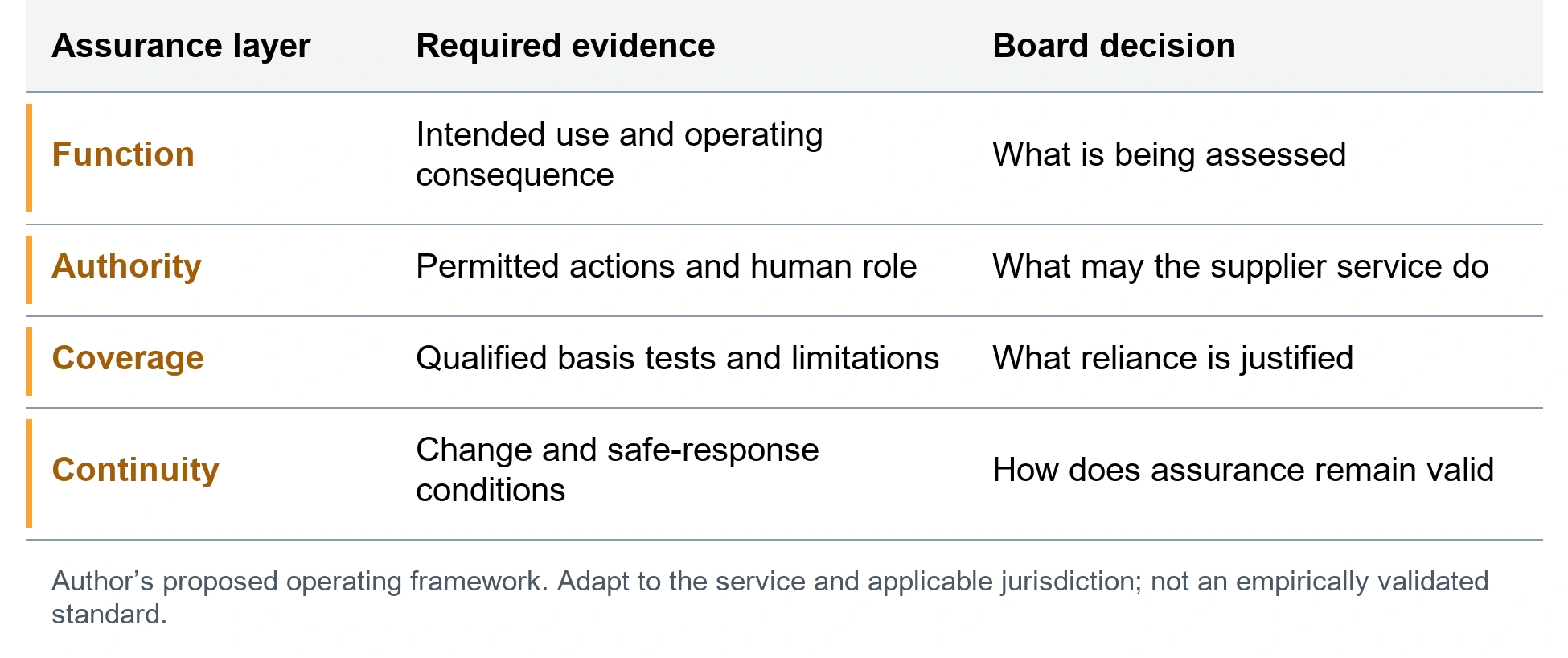
Figure 1 proposes four links: intended function, authority boundary, assurance evidence, and continued operating conditions. Qualified aviation safety, engineering, operational, quality, legal, and technical owners should determine the appropriate assessment and decision route.
Allied guidance on AI in operational technology emphasizes safety-aware integration and fallback mechanisms.3 It is voluntary security guidance, not aviation certification. It supports asking how the service remains bounded and recoverable while the organization separately establishes its aviation-specific assurance requirements.
Test representative operating conditions, difficult cases, human interaction, unavailable information, prohibited action, and failure response. Preserve the scope and limitations of simulation. A test in a simplified environment should not be described as proof of all live operating conditions.
Preserve Change and Recovery Assurance
EU, UK, Swiss, US, and other aviation requirements differ by activity, product, operation, and approval basis. Management should obtain the relevant conclusions from qualified specialists. A concept paper or internal acceptance cannot replace a required authorization or demonstrate compliance by itself.
A provider update to models, instructions, data, tools, or human review can affect accepted evidence. Define notice, impact assessment, focused retest, and release authority. Preserve the historical configuration so that prior work remains explainable.
Establish the safe response when the supplier is unavailable or unreliable. The organization should know which tasks can continue, which require qualified intervention, and which must stop. A commercial termination or software rollback does not necessarily establish a safe operational state.
Approve the Scope the Evidence Can Support
A reasonable objection is that emerging AI methods do not fit established assurance practice neatly. That uncertainty should shape a bounded use and evidence plan. It should not become permission to represent unassessed functionality as accepted merely because the technology is novel.
Before material reliance, require a concise assurance conclusion, identified basis, evidence coverage, unresolved limitations, and operating conditions. Commission additional work where a consequential claim is unsupported. Keep commercial scope aligned with the function the qualified assessment can justify.
The board should approve aviation AI through the same seriousness applied to its intended consequence. Supplier capability can be valuable, but the organization needs evidence for the actual function, authority, human role, change process, and safe response it intends to operate.
Evidence and Source Note
The study is a nonrepresentative cross-section of 850 vendor delivery-team respondents on 150 engagements serving Tier 1 financial institutions, collected during January–June 2026. Neither banks nor vendors corroborated the accounts. It establishes reported experience, not causation, legal breach, or market prevalence. Its application here is a mechanism to investigate, not an estimate of conditions in other industries. The author-supplied version 1.8.2 is dated November 1, 2026 and is cited as a forthcoming manuscript consulted October 23, 2026.4
This is an analytical decision paper based on the supplied study and selected primary public sources checked through October 23, 2026. The original contribution is an aviation assurance-coverage record distinguishing general AI evidence, concept-paper status, and function-specific operating acceptance. The proposed method has not been independently validated. Legal requirements depend on the entity, activity, jurisdiction, and effective provisions; supervisory observations, research, and professional commentary have distinct authority.
Notes
- European Union Aviation Safety Agency, “EASA Releases Latest Issue of Its Concept Paper on Artificial Intelligence for Comment,” European Union Aviation Safety Agency, June 3, 2026, proposed Issue 03 scope and consultation status, https://www.easa.europa.eu/en/newsroom-and-events/news/easa-releases-latest-issue-its-concept-paper-artificial-intelligence. ↩
- Phil Hatch, Agentic AI Outsourcing at Tier 1 Financial Institutions: Full Study Report, version 1.8.2 (Akholi, forthcoming manuscript dated November 1, 2026), Part 2, sec. 5.1, “Agent Actions Visible Only Inside Each Firm’s Own Tools”, https://doi.org/10.2139/ssrn.7164559; Hatch, Agentic AI Outsourcing, Part 4, “Knowledge at Risk of Departure”. ↩
- Cybersecurity and Infrastructure Security Agency and Australian Signals Directorate et al., “Principles for the Secure Integration of Artificial Intelligence in Operational Technology,” Cybersecurity and Infrastructure Security Agency and Australian Signals Directorate et al., December 4, 2025, secs. 2.4 and 4.2, “Embed Safety and Failsafe Mechanisms”, https://www.cyber.gov.au/publication/principles-for-the-secure-integration-of-artificial-intelligence-in-operational-technology. ↩
- Hatch, Agentic AI Outsourcing, Introduction, “Executive Summary” and “Evidentiary Basis and Its Limits”. ↩
Bibliography
- Cybersecurity and Infrastructure Security Agency and Australian Signals Directorate et al.. “Principles for the Secure Integration of Artificial Intelligence in Operational Technology.” Cybersecurity and Infrastructure Security Agency and Australian Signals Directorate et al.. December 4, 2025. https://www.cyber.gov.au/publication/principles-for-the-secure-integration-of-artificial-intelligence-in-operational-technology.
- European Union Aviation Safety Agency. “EASA Releases Latest Issue of Its Concept Paper on Artificial Intelligence for Comment.” European Union Aviation Safety Agency. June 3, 2026. https://www.easa.europa.eu/en/newsroom-and-events/news/easa-releases-latest-issue-its-concept-paper-artificial-intelligence.
- Hatch, Phil. Agentic AI Outsourcing at Tier 1 Financial Institutions: Full Study Report. Version 1.8.2. Akholi. Forthcoming manuscript dated November 1, 2026. Author-supplied manuscript consulted October 23, 2026. https://doi.org/10.2139/ssrn.7164559.
Explore this subject
Category: Regulation and Compliance
Topics: Contract Design Evidence and Traceability Safety and Validation
Audience: Buy-side Boards and Executives