
Define the Operational Effect of the Change
The carrier’s service manager should ask what changes for frontline staff, back-office teams, customers, and the provider’s operators. A model or tool update can alter plan explanations, account actions, exception patterns, or the information needed to resolve a complaint.
Ofcom’s AI discussion considers consumer experience, accountability, and redress in telecoms.1 It is not a finding that every supplier update causes harm. The manager should test the particular change and its effect on the customer journey rather than infer quality from a release announcement.
For a hypothetical billing-support update, the agent may begin applying a new promotion rule while staff still use an older explanation. Customers can receive contradictory information even if the software behaves as designed. The change record should include the people and source material governing the service.
Map the People and Artifacts That Must Change
Identify affected scripts, policy sources, tool permissions, training, knowledge articles, monitoring, case forms, and escalation. Assign an owner for each. A distribution email should not count as implementation evidence if the receiving team cannot explain or use the revised method.
The study reports process and knowledge gaps in banking agentic delivery.2 These accounts do not establish telecom failure rates. They identify why a technical change should be assessed against the operating knowledge and human intervention that sustain the service.
The provider should disclose the expected effect, known limitations, and material dependencies. The carrier should identify its local customer and operational requirements. Resolve contradictions jointly before the change reaches a consequential action.
Use an Operational Change Receipt
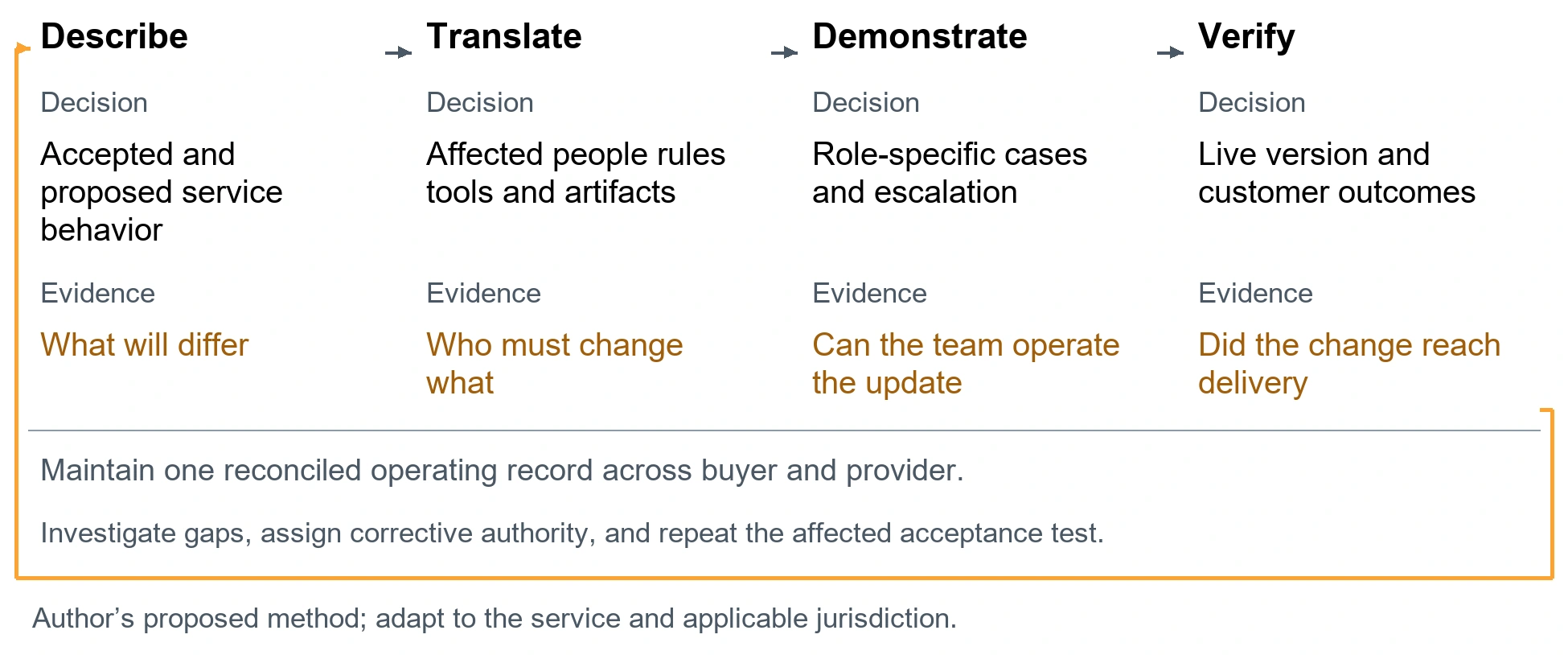
Figure 1 proposes four stages: describe, translate, demonstrate, and verify. The receipt should establish what changed, which teams and artifacts were affected, what they must do differently, and how readiness was demonstrated. It is an operating acceptance record, not a claim of regulatory certification.
The UK Software Security Code addresses lifecycle maintenance and communication.3 It is voluntary guidance. The proposed receipt extends the communication question to the actual telecom workflow so that receiving teams can act on the change rather than merely acknowledge it.
Use representative customer cases and exceptions. Ask the live operating team to explain the changed rule, inspect the relevant account state, and route an unresolved case. Record gaps in authority, access, information, or training before approving wider deployment.
Preserve Local Terms and a Corrective Route
EU, UK, Swiss, US, and other telecom, consumer, privacy, accessibility, and contract requirements differ. Qualified owners should establish local conclusions for affected offers and customers. A global software change should not silently standardize rights or terms that remain local.
Identify how customers receive accurate information and how staff can correct an inappropriate action or explanation. Preserve the accepted terms and account history. A rollback should consider actions already taken, including billing and service changes that software restoration alone does not reverse.
For urgent security changes, use a defined exception route with appropriate authority, temporary restrictions, evidence, and follow-up. Urgency should not become a permanent bypass for routine feature deployment or an excuse for leaving operators unaware of changed behavior.
Close the Change Through Live Operating Evidence
A reasonable objection is that repeated training can overwhelm staff. Use role-specific updates focused on changed decisions and practical cases. Do not require everyone to repeat generic AI instruction when only a defined service behavior has changed.
After deployment, verify the actual version, operator understanding, customer information, escalation, and relevant outcomes. Inspect a sample of changed and corrected cases. Resolve discrepancies and update the receipt before declaring the operating transition complete.
The manager should close the change when the technology and people operate under the same current instructions. A supplier release becomes a reliable service improvement only when those responsible for delivery understand its effect and can apply, challenge, and correct it.
Evidence and Source Note
The study is a nonrepresentative cross-section of 850 vendor delivery-team respondents on 150 engagements serving Tier 1 financial institutions, collected during January–June 2026. Neither banks nor vendors corroborated the accounts. It establishes reported experience, not causation, legal breach, or market prevalence. Its application here is a mechanism to investigate, not an estimate of conditions in other industries. The author-supplied version 1.8.2 is dated November 1, 2026 and is cited as a forthcoming manuscript consulted October 23, 2026.4
This is an analytical decision paper based on the supplied study and selected primary public sources checked through October 23, 2026. The original contribution is an operational change receipt testing whether supplier updates reach the people and artifacts needed for correct telecom delivery. The proposed method has not been independently validated. Legal requirements depend on the entity, activity, jurisdiction, and effective provisions; supervisory observations, research, and professional commentary have distinct authority.
Notes
- Ofcom, AI in Telecoms Markets: The Impact on Consumers’ Experiences So Far and How It May Develop, Ofcom, September 25, 2026, secs. 1.16–1.18 and 6; discussion and existing framework, not new rules, https://www.ofcom.org.uk/siteassets/resources/documents/internet-based-services/technology/discussion_the-impact-of-ai-in-telecoms-markets-on-consumers-experiences-so-far-and-how-it-may-develop.pdf?v=425794. ↩
- Phil Hatch, Agentic AI Outsourcing at Tier 1 Financial Institutions: Full Study Report, version 1.8.2 (Akholi, forthcoming manuscript dated November 1, 2026), Part 2, “The Shift From Managing People to Managing Agents”; Part 6, “The Executive Action Plan”, https://doi.org/10.2139/ssrn.7164559; Hatch, Agentic AI Outsourcing, Part 4, “Knowledge at Risk of Departure”. ↩
- UK Department for Science Innovation and Technology, “Software Security Code of Practice,” UK Department for Science Innovation and Technology, updated January 15, 2026, voluntary scope and software security and resilience principles, https://www.gov.uk/government/publications/software-security-code-of-practice/software-security-code-of-practice. ↩
- Hatch, Agentic AI Outsourcing, Introduction, “Executive Summary” and “Evidentiary Basis and Its Limits”. ↩
Bibliography
- Hatch, Phil. Agentic AI Outsourcing at Tier 1 Financial Institutions: Full Study Report. Version 1.8.2. Akholi. Forthcoming manuscript dated November 1, 2026. Author-supplied manuscript consulted October 23, 2026. https://doi.org/10.2139/ssrn.7164559.
- Ofcom. AI in Telecoms Markets: The Impact on Consumers’ Experiences So Far and How It May Develop. Ofcom. September 25, 2026. https://www.ofcom.org.uk/siteassets/resources/documents/internet-based-services/technology/discussion_the-impact-of-ai-in-telecoms-markets-on-consumers-experiences-so-far-and-how-it-may-develop.pdf?v=425794.
- UK Department for Science Innovation and Technology. “Software Security Code of Practice.” UK Department for Science Innovation and Technology. Updated January 15, 2026. https://www.gov.uk/government/publications/software-security-code-of-practice/software-security-code-of-practice.
Explore this subject
Category: Delivery and Operations
Topics: Architecture and Dependencies Change Control Service Continuity
Audience: Buy-side Delivery and Vendor Managers
Industry: Other Regulated Industries Telecommunications