
Identify the Judgment the Banking Function Requires
The executive should ask which decisions depend on banking expertise rather than general language or technical capability. Account status, product terms, transaction meaning, customer circumstances, and policy exceptions can require context that is absent from a prompt or benchmark.
Cambridge’s financial-services research identifies talent and data constraints alongside AI adoption.1 Its surveys do not establish the competence of a particular provider team. Management should identify and test the domain judgment needed for the contracted service.
For a hypothetical account-review service, the agent may recognize a transaction pattern while misunderstanding the product or customer context that determines its significance. The buyer should identify which conclusions the provider may prepare and which require qualified bank interpretation.
Find the Human Judgment Behind Apparent Autonomy
The study describes operational knowledge in experienced staff and manual work used in delivery.2 It does not establish that human intervention is always a defect. The executive should determine whether essential judgment is designed, qualified, visible, and sustainable.
Require the provider to identify specialists who resolve ambiguous cases, their access to bank context, and the authority they hold. An experienced operator may know when to escalate without being authorized to make the banking decision. Preserve that distinction in the workflow and contract.
Do not treat every confident model answer as a settled interpretation. The service should identify uncertainty, conflicting sources, missing facts, and conditions requiring clarification. Its performance should include the quality of escalation rather than reward completion regardless of evidential support.
Use a Domain Judgment Allocation Record
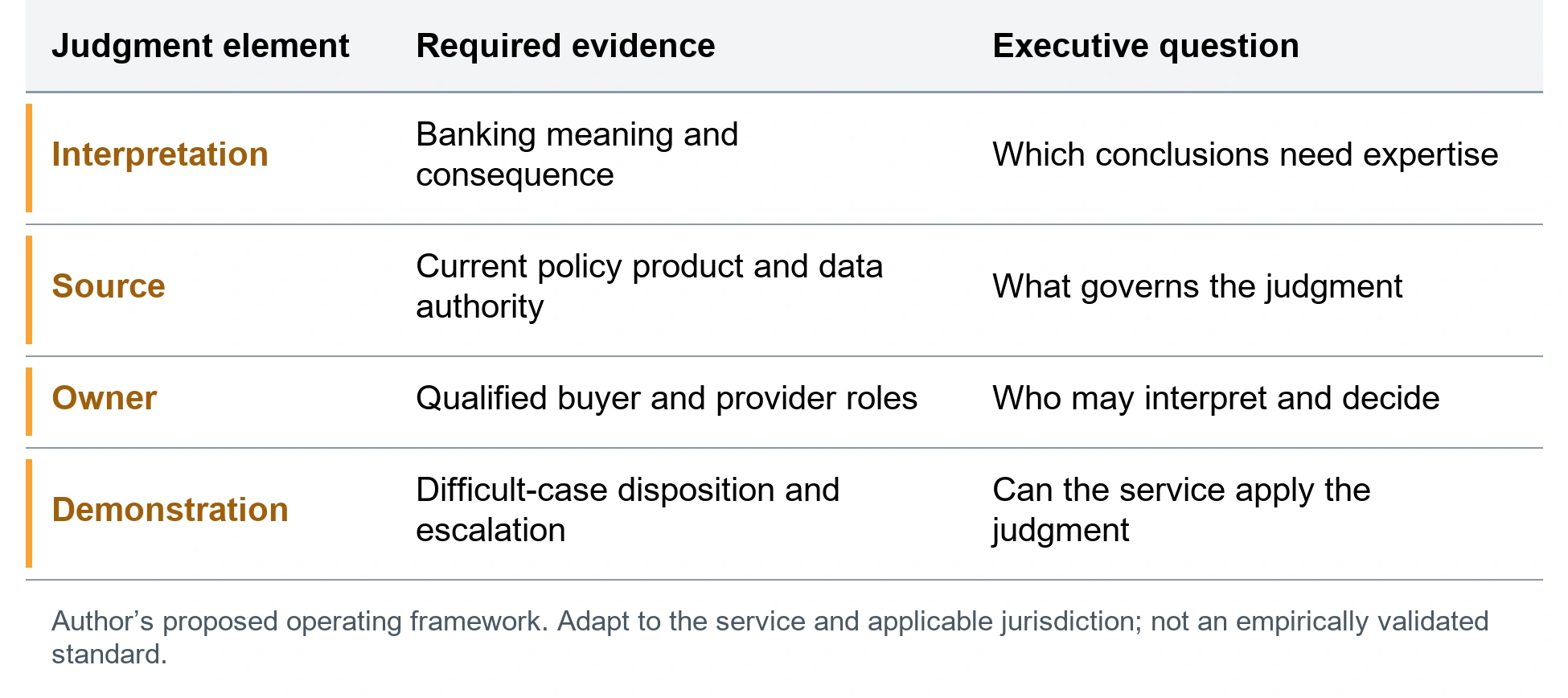
Figure 1 proposes four elements: required interpretation, authoritative source, qualified owner, and demonstrated case decision. Assign buyer and provider roles at the level of the actual judgment. A broad statement that the supplier understands banking is insufficient.
FINMA’s AI guidance includes knowledge, documentation, and control concerns for supervised firms.3 It is Swiss supervisory material, not a universal qualification standard. The bank should establish relevant local obligations and the expertise necessary to implement them.
Test representative difficult cases with the people and configuration intended for production. Ask reviewers to explain the evidence, applicable policy, uncertainty, and action boundary. Compare the resulting business disposition, not merely the fluency or familiarity of the language used.
Sustain Expertise as the Service Changes
Bank policy, products, data definitions, market practices, and local requirements change. Identify who maintains authoritative context and how it reaches provider staff and agents. A competent team can become dependent on obsolete material if the knowledge route is not maintained.
EU, UK, Swiss, US, and other banking activities can require different professional, conduct, privacy, and decision responsibilities. Qualified specialists should establish the applicable conclusions. A global provider training programme should preserve local distinctions that affect the action.
Include succession and retained buyer capability in the operating plan. If expertise resides in one individual or outside the bank’s practical access, test absence and transition. The bank must retain enough judgment to challenge the service rather than depend entirely on the supplier’s explanation.
Approve the Judgment Model Alongside the Technology
A reasonable objection is that requiring experts for every case removes the value of automation. The bank should reserve qualified judgment for decisions that need it and use bounded automation elsewhere. The boundary should be based on consequence, uncertainty, and applicable obligations rather than a target automation percentage.
Before expanding authority, require evidence of reliable normal-case delivery and appropriate handling of ambiguity. Fund the specialist capacity and decision response the workflow needs. Restrict unsupported conclusions while the team improves sources, training, or design.
The executive should approve a service that combines useful agent capability with sustained banking judgment. Technology can increase the amount of work performed. The bank still needs a defensible account of who interprets the facts, who may decide, and how the resulting action is justified.
Evidence and Source Note
The study is a nonrepresentative cross-section of 850 vendor delivery-team respondents on 150 engagements serving Tier 1 financial institutions, collected during January–June 2026. Neither banks nor vendors corroborated the accounts. It establishes reported experience, not causation, legal breach, or market prevalence. The author-supplied version 1.8.2 is dated November 1, 2026 and is cited as a forthcoming manuscript consulted October 23, 2026.4
This is an analytical decision paper based on the supplied study and selected primary public sources checked through October 23, 2026. The original contribution is a domain-judgment allocation record connecting bank-specific interpretation, qualified authority, and practical case tests. The proposed method has not been independently validated. Legal requirements depend on the entity, activity, jurisdiction, and effective provisions; supervisory observations, research, and professional commentary have distinct authority.
Notes
- Cambridge Centre for Alternative Finance, University of Cambridge, The 2026 Global AI in Financial Services Report: Adoption, Impact and Risks (Cambridge Centre for Alternative Finance, University of Cambridge, April 2026), survey limitations and pp. 74–77, 93–96, and 128, https://www.jbs.cam.ac.uk/wp-content/uploads/2026/05/ccaf-2026-04-28-global-ai-in-financial-services-report-2.pdf. ↩
- Phil Hatch, Agentic AI Outsourcing at Tier 1 Financial Institutions: Full Study Report, version 1.8.2 (Akholi, forthcoming manuscript dated November 1, 2026), Part 4, “Knowledge at Risk of Departure”, https://doi.org/10.2139/ssrn.7164559; Hatch, Agentic AI Outsourcing, Part 5, “The Five Manual Alteration Methods” and “Disclosure of Manual Alteration,” table 5.8. ↩
- Swiss Financial Market Supervisory Authority, Governance and Risk Management When Using Artificial Intelligence (Swiss Financial Market Supervisory Authority, December 18, 2024), FINMA Guidance 08/2024, secs. 2.1–2.7, https://www.finma.ch/~/media/finma/dokumente/dokumentencenter/myfinma/4dokumentation/finma-aufsichtsmitteilungen/20241218-finma-aufsichtsmitteilung-08-2024.pdf?hash=60E2745D7AC1D7F4E06CE43474539F68&sc_lang=en. ↩
- Hatch, Agentic AI Outsourcing, Introduction, “Executive Summary” and “Evidentiary Basis and Its Limits”. ↩
Bibliography
- Cambridge Centre for Alternative Finance, University of Cambridge. The 2026 Global AI in Financial Services Report: Adoption, Impact and Risks. Cambridge Centre for Alternative Finance, University of Cambridge, April 2026. https://www.jbs.cam.ac.uk/wp-content/uploads/2026/05/ccaf-2026-04-28-global-ai-in-financial-services-report-2.pdf.
- Hatch, Phil. Agentic AI Outsourcing at Tier 1 Financial Institutions: Full Study Report. Version 1.8.2. Akholi. Forthcoming manuscript dated November 1, 2026. Author-supplied manuscript consulted October 23, 2026. https://doi.org/10.2139/ssrn.7164559.
- Swiss Financial Market Supervisory Authority. Governance and Risk Management When Using Artificial Intelligence. Swiss Financial Market Supervisory Authority, December 18, 2024. https://www.finma.ch/~/media/finma/dokumente/dokumentencenter/myfinma/4dokumentation/finma-aufsichtsmitteilungen/20241218-finma-aufsichtsmitteilung-08-2024.pdf?hash=60E2745D7AC1D7F4E06CE43474539F68&sc_lang=en.
Explore this subject
Category: People and Capability
Topics: Domain Judgment Human Oversight Joint Training
Audience: Buy-side Boards and Executives
Industry: Banking Financial Services