

Define the Population Before the Result
The sourcing manager should require an explicit definition of the work eligible for the promised outcome. A provider can accurately calculate a percentage that answers the wrong commercial question if difficult cases, returned work, or failures are removed from the denominator.
Bain’s provider analysis emphasizes measurable customer outcomes in new commercial models.1 Measurement begins with a stable unit and population. The manager should define whether one unit is a customer request, business case, transaction attempt, accepted result, or another observable event.
For an illustrative service receiving 1,000 eligible cases, 800 accepted results imply 80% completion on that population. Reporting 800 successes among only 850 cases retained by the provider yields about 94.1%. Neither calculation is meaningful without explaining the 150 cases removed. These figures are hypothetical, not study findings.
Account for Every Eligible Case
Define mutually understandable states for accepted, failed, pending, returned, excluded, corrected, and reversed work. Reconcile totals across the buyer and provider. A case may move between states, but its history and original eligibility should remain available.
The study’s reported manual work and completion-evidence problems support testing this reconciliation.2 They do not establish a universal inflation rate. The manager should inspect the actual service population rather than infer misreporting from a difference in terminology alone.
Separate attempts from business intent. Repeated retries can inflate activity counts without creating additional outcomes. Conversely, one case may legitimately contain several payable units if the agreement defines them. The parties should settle that rule before comparing performance or issuing invoices.
Use an Outcome Population Record
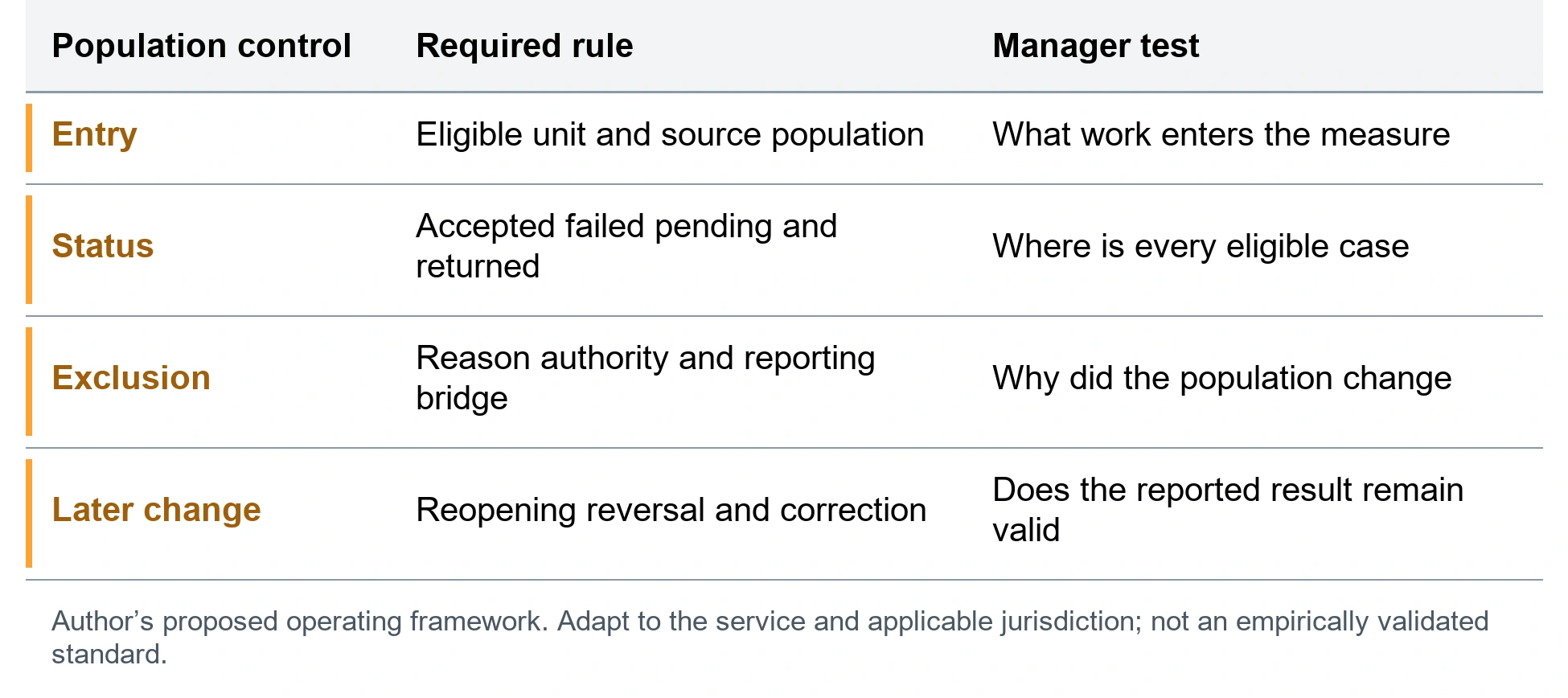
Figure 1 proposes four controls: entry, status, exclusion, and later change. Record the eligibility rule, source system, time window, case identifier, and owner for disputed classification. Preserve the approved version of the rule for each reporting period.
Every exclusion should have a reason and appropriate authority. A change in scope can be valid, but it should not retrospectively erase performance. Report the original population and the adjusted view together where necessary, with a bridge explaining the difference.
Morgan Lewis’s commercial-contract discussion addresses performance commitments and allocation of AI-related responsibilities.3 Translate the chosen outcome into testable billing and reporting rules. A term such as successful resolution needs an operational definition that both firms can apply to the same cases.
Handle Timing and Quality Explicitly
A result accepted after the reporting cutoff should not appear as timely completion for the earlier period without a stated rule. Track aging and unresolved cases. Otherwise, a provider can improve the current rate by moving difficult work into a future period while the buyer retains the backlog.
Define the treatment of quality failure, reopening, reversal, and customer correction. A result can be initially accepted and later invalidated. Preserve both events and specify whether the later fact affects payment, performance, remediation, or all three.
EU, UK, Swiss, US, and other services may have local definitions of completion, retention, conduct, or required recourse. Qualified owners should determine relevant constraints. A contractual denominator should not redefine a statutory duty or remove an affected case from required oversight.
Reconcile the Rate Before Using It
A reasonable objection is that population reconciliation adds administrative work. Reuse authoritative case records and automate joins where possible. Concentrate manual challenge on ambiguous and consequential categories. The objective is a common account of the service, not a second disconnected reporting system.
Before relying on the metric, sample each status and reconstruct cases against receiving systems. Reconcile the invoice population to performance reporting and operational queues. Resolve differences before using the rate to claim savings, accept the service, or expand authority.
The manager should be able to explain what entered the denominator, what left it, and what happened afterward. Precision in a percentage cannot compensate for an unstable population. An honest denominator makes outcome pricing interpretable and gives both firms a fair basis for judging delivery.
Evidence and Source Note
The study is a nonrepresentative cross-section of 850 vendor delivery-team respondents on 150 engagements serving Tier 1 financial institutions, collected during January–June 2026. Neither banks nor vendors corroborated the accounts. It establishes reported experience, not causation, legal breach, or market prevalence. Its application here is a mechanism to investigate, not an estimate of conditions in other industries. The author-supplied version 1.8.2 is dated November 1, 2026 and is cited as a forthcoming manuscript consulted October 23, 2026.4
This is an analytical decision paper based on the supplied study and selected primary public sources checked through October 23, 2026. The original contribution is an outcome-population record connecting eligibility, status reconciliation, exclusions, and later changes to commercial interpretation. The proposed method has not been independently validated. Legal requirements depend on the entity, activity, jurisdiction, and effective provisions; supervisory observations, research, and professional commentary have distinct authority.
Notes
- Megha Chawla et al., “Tech Services: Cracking the Code on AI-led Growth,” Bain & Company, September 29, 2026, “At a Glance” and discussion of commercial models, https://www.bain.com/insights/tech-services-cracking-the-code-on-ai-led-growth-technology-report-2026/. ↩
- Phil Hatch, Agentic AI Outsourcing at Tier 1 Financial Institutions: Full Study Report, version 1.8.2 (Akholi, forthcoming manuscript dated November 1, 2026), Part 5, “The Five Manual Alteration Methods” and “Disclosure of Manual Alteration,” table 5.8, https://doi.org/10.2139/ssrn.7164559; Hatch, Agentic AI Outsourcing, Part 3, AI Technology, sec. 4.1, “Accuracy of the Tools’ Own Success and Failure Reports,” indicator C172. ↩
- Doneld Shelkey, “Negotiating AI Provisions in Commercial and Technology Contracts: Where the Market Is Heading,” The Licensing Journal, May 1, 2026, pp. 1–2, intellectual property and transition, https://www.morganlewis.com/-/media/files/publication/outside-publication/article/2026/negotiating-ai-provisions-in-commercial-and-technology-contracts-where-the-market-is-heading-the-licensing-journal.pdf. ↩
- Hatch, Agentic AI Outsourcing, Introduction, “Executive Summary” and “Evidentiary Basis and Its Limits”. ↩
Bibliography
- Chawla, Megha, Mark Brinda, Sushant Khandelwal, and Sandeep Nayak. “Tech Services: Cracking the Code on AI-led Growth.” Bain & Company. September 29, 2026. https://www.bain.com/insights/tech-services-cracking-the-code-on-ai-led-growth-technology-report-2026/.
- Hatch, Phil. Agentic AI Outsourcing at Tier 1 Financial Institutions: Full Study Report. Version 1.8.2. Akholi. Forthcoming manuscript dated November 1, 2026. Author-supplied manuscript consulted October 23, 2026. https://doi.org/10.2139/ssrn.7164559.
- Shelkey, Doneld. “Negotiating AI Provisions in Commercial and Technology Contracts: Where the Market Is Heading.” The Licensing Journal. May 1, 2026. https://www.morganlewis.com/-/media/files/publication/outside-publication/article/2026/negotiating-ai-provisions-in-commercial-and-technology-contracts-where-the-market-is-heading-the-licensing-journal.pdf.
Explore this subject
Category: Commercial and Vendor Management
Topics: Functional Baselines Hidden Human Work Outcome Pricing
Audience: Buy-side Delivery and Vendor Managers
Industry: Cross-industry