
Follow the Alert Beyond the Provider Boundary
The manager should define the full alert journey before assessing provider productivity. Intake, enrichment, triage, investigation support, review, decision, and required reporting can sit in different firms. Faster provider processing does not establish a lower total burden if the bank receives more incomplete or ambiguous cases.
FATF’s technology analysis supports informed, risk-based oversight of new AML/CFT tools.1 It does not validate a particular agentic workflow or automation rate. The manager should assess whether the service improves the relevant function while preserving the quality and responsibilities that matter.
Identify the eligible alert population, case types, required evidence, decision authority, and terminal states. Distinguish work closed under an approved rule from work deferred, returned, excluded, or awaiting a bank decision. These categories should not disappear inside one completed-work percentage.
Measure Returned Work as Part of Delivery
The study reports manual intervention, review pressure, and completion signals not always matching outcomes.2 It does not quantify financial-crime effectiveness. The transferable issue is whether the reported service performance excludes the effort needed to make a case decision-ready.
For a hypothetical investigation-support service, an agent may return a concise summary but omit source evidence needed by the bank reviewer. The provider’s handling time improves while the reviewer repeats research. Record that work and its cause rather than treating the handoff as a completed investigation.
Separate necessary bank judgment from avoidable provider rework. Both consume retained capacity, but the remedies differ. One may require staffing and authority; the other may require better inputs, retrieval, evidence packaging, or a corrected workflow. A combined cost figure should preserve that distinction.
Use a Joint Alert Journey Record
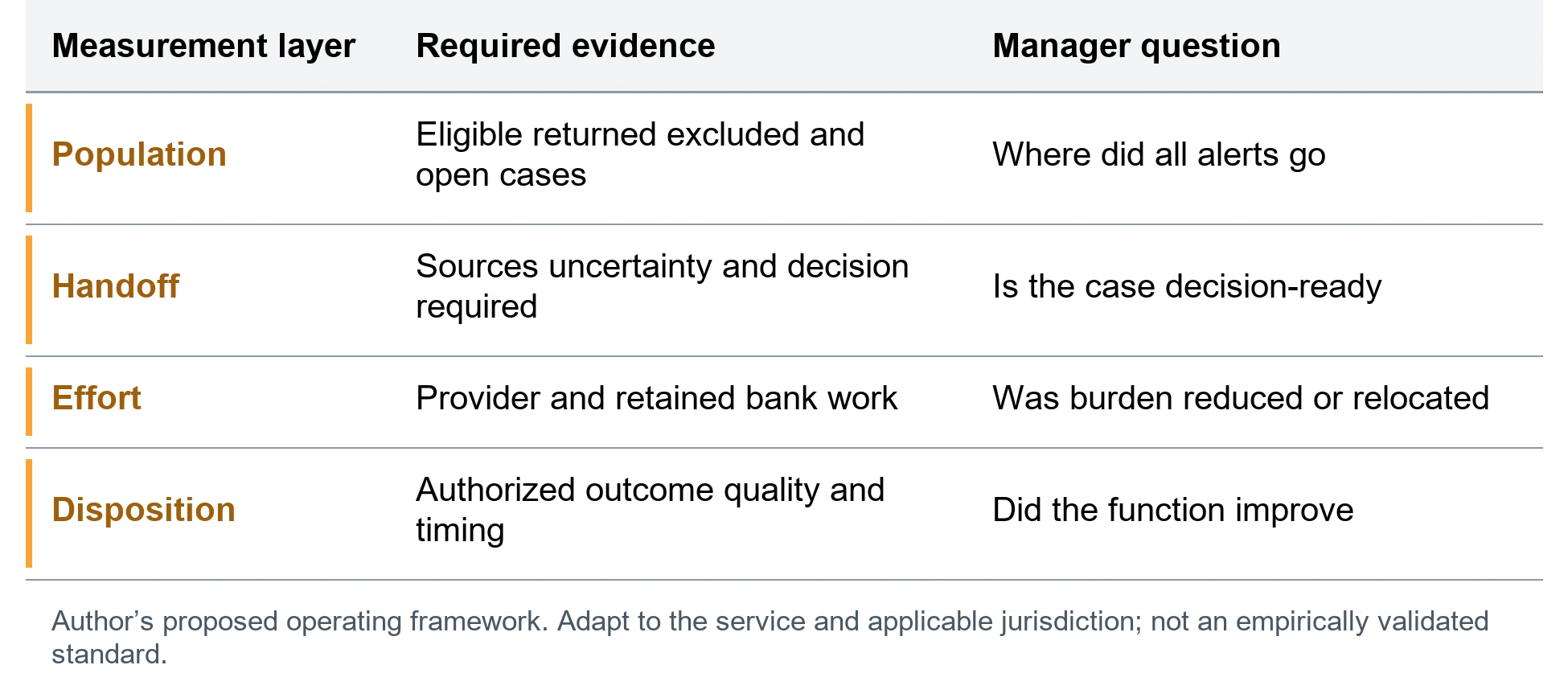
Figure 1 proposes a record of population, handoff quality, retained effort, and accepted disposition. Reconcile cases across the two firms and include unresolved work. Measure relevant elapsed time and aging alongside effort so that a low-cost process does not conceal delayed action.
Assess whether a reviewer receives the facts, source links, uncertainty, attempted actions, and specific decision needed. A polished narrative can be less useful than a structured evidence pack if it obscures missing information. Test whether another qualified reviewer can substantiate the conclusion.
McKinsey’s agentic economics discussion includes repeated work and coordination costs beyond model charges.3 Apply that complete-cost perspective to the alert journey. Do not infer financial-crime effectiveness from productivity alone; quality and risk outcomes require their own evidence.
Preserve the Relevant Legal and Confidentiality Boundaries
EU, UK, Swiss, US, and other AML/CFT regimes differ in reporting, secrecy, privacy, recordkeeping, and responsible roles. Qualified specialists should determine which activities may be delegated and which decisions remain with the bank. A provider recommendation should not silently become an authorized report or closure.
Ensure evidence exchange respects sensitive information and applicable restrictions. The manager should still obtain sufficient information to oversee the service and investigate deficiencies. Agree controlled access and escalation before a time-critical case requires it.
Review the incentive model. A price based only on alert closure or reduced referrals can reward the wrong behavior. Keep population rules stable, examine excluded cases, and connect payment to the accepted scope and quality rather than a raw reduction in work reaching the bank.
Improve the Function Rather Than the Handoff Metric
A reasonable objection is that retained effort is difficult to measure precisely. Use proportionate case sampling, workflow records, and stated allocation assumptions. Distinguish observed effort from estimates and record uncertainty. An imperfect complete view is more useful than a precise measure that excludes a major part of the work.
Before expanding the service, compare representative journeys against the functional baseline. Identify whether value comes from less research, better evidence, faster qualified decisions, or another mechanism. Correct the largest avoidable burden and verify that the change improves accepted work without weakening quality.
The manager should report the full result: what the provider completed, what the bank still did, what remained unresolved, and whether the required decision improved. Agentic delivery creates value when the complete financial-crime function improves, not when effort merely crosses the contractual boundary.
Evidence and Source Note
The study is a nonrepresentative cross-section of 850 vendor delivery-team respondents on 150 engagements serving Tier 1 financial institutions, collected during January–June 2026. Neither banks nor vendors corroborated the accounts. It establishes reported experience, not causation, legal breach, or market prevalence. The author-supplied version 1.8.2 is dated November 1, 2026 and is cited as a forthcoming manuscript consulted October 23, 2026.4
This is an analytical decision paper based on the supplied study and selected primary public sources checked through October 23, 2026. The original contribution is a joint alert-journey record separating bank judgment, avoidable rework, population treatment, and complete functional economics. The proposed method has not been independently validated. Legal requirements depend on the entity, activity, jurisdiction, and effective provisions; supervisory observations, research, and professional commentary have distinct authority.
Notes
- Financial Action Task Force, “Opportunities and Challenges of New Technologies for AML/CFT,” Financial Action Task Force, July 2021, public report summary and suggested actions on informed oversight, https://www.fatf-gafi.org/en/publications/Digitaltransformation/Opportunities-challenges-new-technologies-for-aml-cft.html. ↩
- Phil Hatch, Agentic AI Outsourcing at Tier 1 Financial Institutions: Full Study Report, version 1.8.2 (Akholi, forthcoming manuscript dated November 1, 2026), Part 5, “The Five Manual Alteration Methods” and “Disclosure of Manual Alteration,” table 5.8, https://doi.org/10.2139/ssrn.7164559; Hatch, Agentic AI Outsourcing, Part 3, AI Technology, sec. 4.1, “Accuracy of the Tools’ Own Success and Failure Reports,” indicator C172. ↩
- Lari Hämäläinen et al., “Is That AI Agent Worth It? Agentic Economics and the Modern Operating Model,” McKinsey & Company, July 13, 2026, “Why the operating expenditure bill keeps rising” and “The implications for competitive dynamics”, https://www.mckinsey.com/capabilities/quantumblack/our-insights/is-that-ai-agent-worth-it-agentic-economics-and-the-modern-operating-model. ↩
- Hatch, Agentic AI Outsourcing, Introduction, “Executive Summary” and “Evidentiary Basis and Its Limits”. ↩
Bibliography
- Financial Action Task Force. “Opportunities and Challenges of New Technologies for AML/CFT.” Financial Action Task Force. July 2021. https://www.fatf-gafi.org/en/publications/Digitaltransformation/Opportunities-challenges-new-technologies-for-aml-cft.html.
- Hatch, Phil. Agentic AI Outsourcing at Tier 1 Financial Institutions: Full Study Report. Version 1.8.2. Akholi. Forthcoming manuscript dated November 1, 2026. Author-supplied manuscript consulted October 23, 2026. https://doi.org/10.2139/ssrn.7164559.
- Hämäläinen, Lari, Mark Patel, Sven Blumberg, Tanguy Catlin, and Wasim Lala. “Is That AI Agent Worth It? Agentic Economics and the Modern Operating Model.” McKinsey & Company. July 13, 2026. https://www.mckinsey.com/capabilities/quantumblack/our-insights/is-that-ai-agent-worth-it-agentic-economics-and-the-modern-operating-model.
Explore this subject
Category: Economics and Value
Topics: Financial Crime Hidden Human Work Outcome Verification
Audience: Buy-side Delivery and Vendor Managers
Industry: Banking Financial Services