
Offer a Service the Buyer Can Accept
The provider leader should define the outcome, authority, configuration, volume, quality, and operating conditions offered for production. A demonstration of agent capability is not a handover of a complete service. The buyer needs to understand what it is accepting and what it must continue to provide.
Bain’s technology-services analysis describes the commercial shift toward measurable outcomes.1 The provider’s acceptance method should make those outcomes observable. A contract promise becomes stronger when both firms can demonstrate the workflow and evidence on which it depends.
Identify buyer data, tools, decisions, approvals, and retained specialists required for delivery. Explain the effect of each missing prerequisite. A provider should not promise autonomous completion while relying on customer intervention that has not been disclosed, funded, or tested.
Disclose the Human Work in the Service
The study reports manual alterations across its sampled engagements.2 It does not prove that all intervention is improper. For a provider, the commercial lesson is to distinguish designed human review from repair, exception handling, and work returned to the customer.
For a hypothetical service, an agent may prepare most cases while specialists finish difficult ones. That can be a sound delivery model if the staffing, qualification, authority, cost, and evidence are explicit. Describing the whole service as unattended automation can undermine both pricing and acceptance.
Record which actions the provider can perform, which require buyer approval, and which remain prohibited. Test how staff and agents behave when the buyer is unavailable or instructions conflict. The service should restrict or escalate the affected work rather than improvise permission to meet a completion target.
Use a Joint Acceptance Record
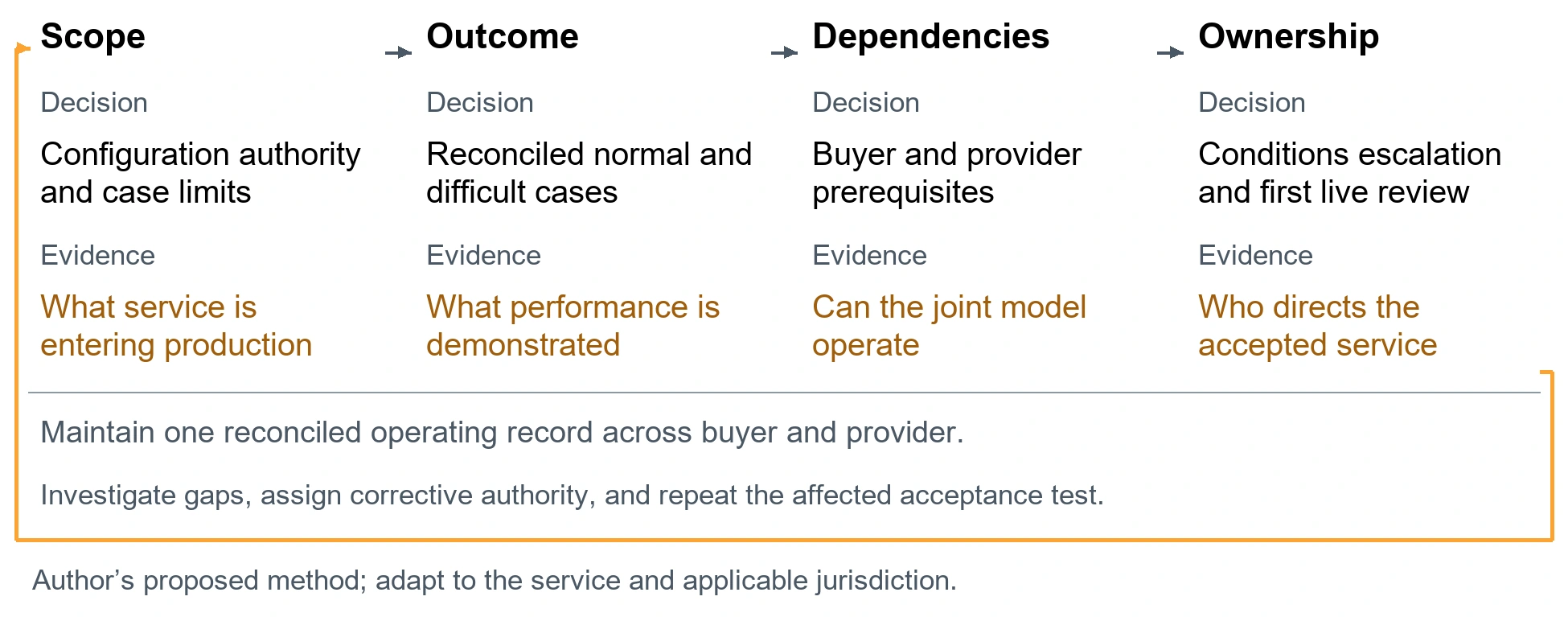
Figure 1 proposes four elements: accepted scope, demonstrated outcome, dependency readiness, and live ownership. Agree objective criteria and representative cases before the final acceptance exercise. Include unsuccessful, corrected, and interrupted work so that the test is not limited to a polished demonstration.
Preserve the configuration, inputs, results, intervention history, and buyer decision. Distinguish a passed test from a limitation accepted under conditions. Each condition should have an owner, operating restriction, expiry or review trigger, and evidence needed to remove it.
Morgan Lewis’s AI outsourcing overview emphasizes contract, pricing, and governance alignment.3 Acceptance should connect those elements. If the actual service requires more human work, different authority, or a narrower scope than proposed, resolve the operating and commercial implications before handover.
Plan the First Live Period Together
The provider should identify who monitors outcomes, receives exceptions, approves changes, and directs an interruption during early production. Agree the cadence and evidence for reviewing the initial live cases. A signed acceptance certificate should not end joint attention while real operating conditions are first encountered.
Applicable EU, UK, Swiss, US, and other obligations depend on the buyer, service, and provider role. Obtain the customer’s approved requirements and document responsibility for implementation. Commercial acceptance is not a substitute for regulatory, clinical, safety, or other required authorization.
Secure practical rights and access for both firms to investigate the service. Protect proprietary and sensitive information while supplying the evidence needed to substantiate outcomes and controls. A limitation that prevents material assurance should be disclosed and addressed in the acceptance decision.
Use Acceptance to Protect Sustainable Delivery
A reasonable objection is that detailed acceptance encourages the customer to delay payment. Define a bounded process, agreed evidence, decision deadlines, and fair treatment of buyer-caused delays. A clear test protects the provider as well as the buyer by distinguishing unmet requirements from expanding expectations.
Conduct the joint exercise with the people who will operate the service. Resolve material failures or restrict the offered scope. Obtain explicit agreement on remaining conditions and the first live review. Avoid relying on a demonstration team whose knowledge and access will disappear after signature.
Production acceptance should leave both firms with the same account of what is live, what has been demonstrated, what remains conditional, and who must act. That shared operating commitment is more valuable than a ceremonial handover and provides a defensible basis for delivery, payment, and later change.
Evidence and Source Note
The study is a nonrepresentative cross-section of 850 vendor delivery-team respondents on 150 engagements serving Tier 1 financial institutions, collected during January–June 2026. Neither banks nor vendors corroborated the accounts. It establishes reported experience, not causation, legal breach, or market prevalence. Its application here is a mechanism to investigate, not an estimate of conditions in other industries. The author-supplied version 1.8.2 is dated November 1, 2026 and is cited as a forthcoming manuscript consulted October 23, 2026.4
This is an analytical decision paper based on the supplied study and selected primary public sources checked through October 23, 2026. The original contribution is a provider-led joint acceptance record connecting commercial commitments, visible human work, buyer prerequisites, and early live ownership. The proposed method has not been independently validated. Legal requirements depend on the entity, activity, jurisdiction, and effective provisions; supervisory observations, research, and professional commentary have distinct authority.
Notes
- Megha Chawla et al., “Tech Services: Cracking the Code on AI-led Growth,” Bain & Company, September 29, 2026, “At a Glance” and discussion of commercial models, https://www.bain.com/insights/tech-services-cracking-the-code-on-ai-led-growth-technology-report-2026/. ↩
- Phil Hatch, Agentic AI Outsourcing at Tier 1 Financial Institutions: Full Study Report, version 1.8.2 (Akholi, forthcoming manuscript dated November 1, 2026), Part 5, “The Five Manual Alteration Methods” and “Disclosure of Manual Alteration,” table 5.8, https://doi.org/10.2139/ssrn.7164559. ↩
- Barbara Murphy Melby et al., “AI-Enabled Outsourcing: Key Contract, Pricing, and Governance Considerations,” Morgan Lewis, July 2026, public report overview and key takeaways, https://www.morganlewis.com/pubs/2026/07/ai-enabled-outsourcing-key-contract-pricing-and-governance-considerations. ↩
- Hatch, Agentic AI Outsourcing, Introduction, “Executive Summary” and “Evidentiary Basis and Its Limits”. ↩
Bibliography
- Chawla, Megha, Mark Brinda, Sushant Khandelwal, and Sandeep Nayak. “Tech Services: Cracking the Code on AI-led Growth.” Bain & Company. September 29, 2026. https://www.bain.com/insights/tech-services-cracking-the-code-on-ai-led-growth-technology-report-2026/.
- Hatch, Phil. Agentic AI Outsourcing at Tier 1 Financial Institutions: Full Study Report. Version 1.8.2. Akholi. Forthcoming manuscript dated November 1, 2026. Author-supplied manuscript consulted October 23, 2026. https://doi.org/10.2139/ssrn.7164559.
- Melby, Barbara Murphy, Marina G. Aronchik, and C. Kari Krusmark. “AI-Enabled Outsourcing: Key Contract, Pricing, and Governance Considerations.” Morgan Lewis. July 2026. https://www.morganlewis.com/pubs/2026/07/ai-enabled-outsourcing-key-contract-pricing-and-governance-considerations.
Explore this subject
Category: Delivery and Operations
Topics: Joint Operating Model Production Acceptance Service Continuity
Audience: Service Providers
Industry: Cross-industry