
Approve the Quality of Resolution
The board should ask management what a closed AML case means in the outsourced service. A case can be administratively closed while the underlying evidence is incomplete, a required escalation is missing, or the rationale cannot be supported. The performance measure must reflect the bank’s risk-based obligations and the actual disposition of the case.
FATF’s technology report supports informed oversight and responsible, risk-based use of new tools.1 It does not certify a particular agent or replace local AML requirements. The bank should assess whether the supplier’s method preserves the evidence and judgment needed for its own financial-crime decisions.
Start with the decisions the provider may prepare, recommend, or make. Distinguish assembling information, resolving an alert, conducting further inquiry, escalating a concern, and making a report. A broad statement that the supplier manages cases should not silently delegate every consequential decision in that chain.
Distinguish a Narrative from Its Evidence
An agent can produce a plausible case summary without establishing that the cited transactions, customer facts, or external sources support its conclusion. The bank should require traceable references, relevant data dates, unresolved contradictions, and the basis for material judgments. An explanation that merely restates the conclusion is not sufficient evidence.
The study reports manual changes and tool completion claims inconsistent with observed work.2 Those accounts do not prove AML failures in any bank. They identify reasons to examine whether human repair and incomplete execution are visible in the case record used to support closure.
For a hypothetical alert, an agent may classify a transaction pattern as consistent with expected activity while relying on an outdated customer profile. The bank should be able to identify the profile version, contradictory evidence, reviewer decision, and final action. The relevant weakness is not grammar in the summary; it is an unsupported inference affecting case disposition.
Require a Case Resolution Evidence Profile
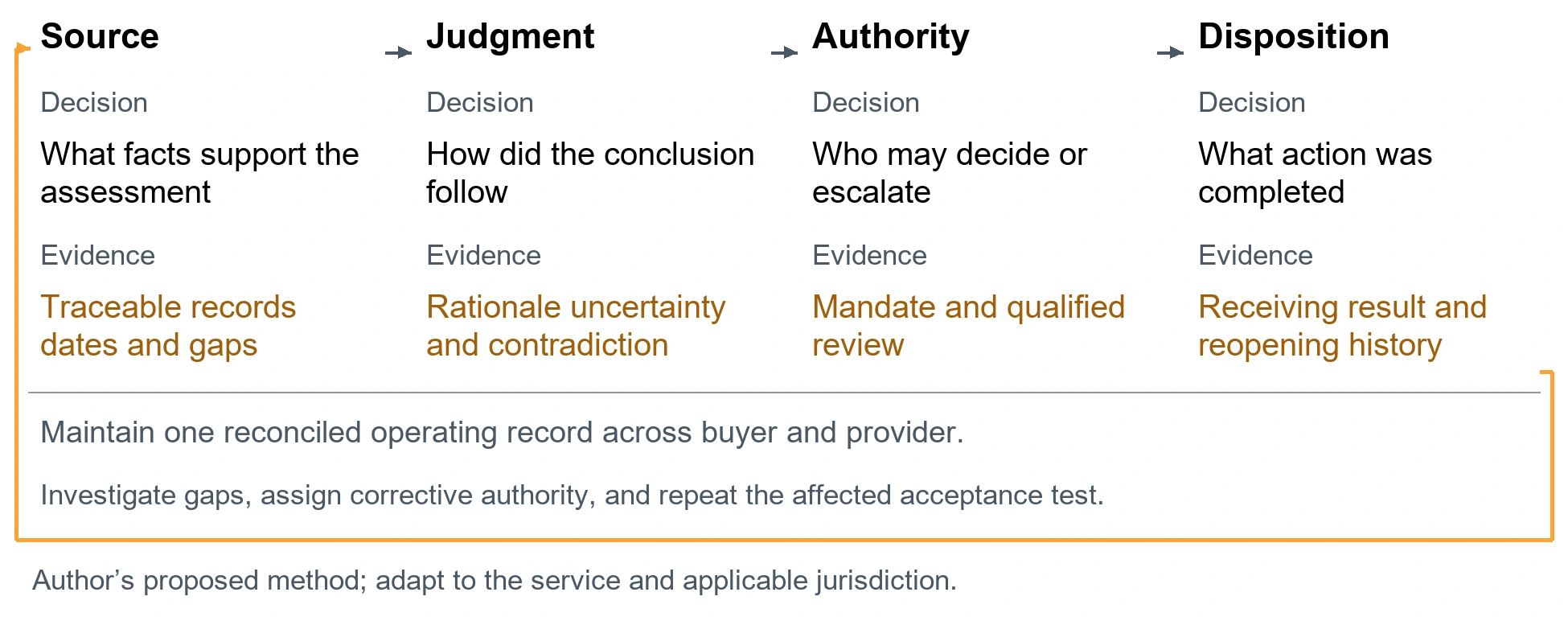
Figure 1 proposes four executive questions: what evidence was used, how the conclusion followed, who had authority, and what action was completed. The profile should preserve uncertainty and material omissions. The provider should not improve closure speed by converting unresolved cases into unsupported low-risk conclusions.
Independent assurance should examine representative resolved, escalated, corrected, and reopened cases. Include difficult cases and cases the supplier describes as unattended successes. Sampling should be designed by the relevant assurance specialists; a few reconstructed cases can identify mechanisms but cannot establish portfolio-wide compliance.
Track work returned to the bank, additional inquiries, reviewer overrides, missing records, and later reopenings alongside closure volume. These measures can reveal effort and unresolved risk that a single productivity rate conceals. Interpret differences with case mix and data quality visible rather than assume every override reflects an agent defect.
Preserve Bank Judgment and Local Obligations
FINMA’s AI guidance identifies governance, documentation, and independent review as supervisory concerns.3 The bank should connect those disciplines to its financial-crime service while obtaining the specific AML applicability conclusions for each entity and activity.
EU, UK, Swiss, and US reporting, secrecy, privacy, customer-due-diligence, and record duties differ. The supplier’s global workflow should implement the relevant local instructions and preserve a route to qualified bank judgment. A case should not be routed to whichever standard produces the fastest closure.
Contract terms should secure evidence access, timely escalation, correction support, and cooperation from material downstream parties. The bank should identify who can restrict the service if evidence quality deteriorates. A contractual remedy payable later does not complete an overdue investigation or restore missing source material.
Make Expansion Depend on Supported Cases
A legitimate objection is that demanding detailed evidence can recreate the manual burden automation was intended to reduce. Use structured references and system records rather than duplicative narrative. The requirement is reconstructible judgment and action, not longer case notes. An efficient record can be concise while remaining supported.
The committee should receive assurance findings, unresolved evidence gaps, authority exceptions, returned work, and the effect on the business case. Require management to close material deficiencies before expanding autonomy. Where the supplier cannot preserve the necessary support, narrow its role to preparation or assistance until the gap is resolved.
The board should approve an AML service on the quality of its supported resolutions. Speed can be valuable after the bank establishes that the right evidence, judgment, and action remain visible. A closed status is an operating event; a defensible resolution is the result the bank needs.
Evidence and Source Note
The study is a nonrepresentative cross-section of 850 vendor delivery-team respondents on 150 engagements serving Tier 1 financial institutions, collected during January–June 2026. Neither banks nor vendors corroborated the accounts. It establishes reported experience, not causation, legal breach, or market prevalence. The author-supplied version 1.8.2 is dated November 1, 2026 and is cited as a forthcoming manuscript consulted October 23, 2026.4
This is an analytical decision paper based on the supplied study and selected primary public sources checked through October 23, 2026. The original contribution is an AML case-resolution evidence profile linking source support, judgment, authority, and completed disposition rather than treating closure volume as assurance. The proposed method has not been independently validated. Legal requirements depend on the entity, activity, jurisdiction, and effective provisions; supervisory observations, research, and professional commentary have distinct authority.
Notes
- Financial Action Task Force, “Opportunities and Challenges of New Technologies for AML/CFT,” Financial Action Task Force, July 2021, public report summary and suggested actions on informed oversight, https://www.fatf-gafi.org/en/publications/Digitaltransformation/Opportunities-challenges-new-technologies-for-aml-cft.html. ↩
- Phil Hatch, Agentic AI Outsourcing at Tier 1 Financial Institutions: Full Study Report, version 1.8.2 (Akholi, forthcoming manuscript dated November 1, 2026), Part 5, “The Five Manual Alteration Methods” and “Disclosure of Manual Alteration,” table 5.8, https://doi.org/10.2139/ssrn.7164559; Hatch, Agentic AI Outsourcing, Part 3, AI Technology, sec. 4.1, “Accuracy of the Tools’ Own Success and Failure Reports,” indicator C172. ↩
- Swiss Financial Market Supervisory Authority, Governance and Risk Management When Using Artificial Intelligence (Swiss Financial Market Supervisory Authority, December 18, 2024), FINMA Guidance 08/2024, secs. 2.1–2.7, https://www.finma.ch/~/media/finma/dokumente/dokumentencenter/myfinma/4dokumentation/finma-aufsichtsmitteilungen/20241218-finma-aufsichtsmitteilung-08-2024.pdf?hash=60E2745D7AC1D7F4E06CE43474539F68&sc_lang=en. ↩
- Hatch, Agentic AI Outsourcing, Introduction, “Executive Summary” and “Evidentiary Basis and Its Limits”. ↩
Bibliography
- Financial Action Task Force. “Opportunities and Challenges of New Technologies for AML/CFT.” Financial Action Task Force. July 2021. https://www.fatf-gafi.org/en/publications/Digitaltransformation/Opportunities-challenges-new-technologies-for-aml-cft.html.
- Hatch, Phil. Agentic AI Outsourcing at Tier 1 Financial Institutions: Full Study Report. Version 1.8.2. Akholi. Forthcoming manuscript dated November 1, 2026. Author-supplied manuscript consulted October 23, 2026. https://doi.org/10.2139/ssrn.7164559.
- Swiss Financial Market Supervisory Authority. Governance and Risk Management When Using Artificial Intelligence. Swiss Financial Market Supervisory Authority, December 18, 2024. https://www.finma.ch/~/media/finma/dokumente/dokumentencenter/myfinma/4dokumentation/finma-aufsichtsmitteilungen/20241218-finma-aufsichtsmitteilung-08-2024.pdf?hash=60E2745D7AC1D7F4E06CE43474539F68&sc_lang=en.
Explore this subject
Category: Assurance and Audit
Topics: Financial Crime Human Oversight Outcome Verification
Audience: Buy-side Boards and Executives
Industry: Banking Financial Services