
Retain Accountability for the Public Function
The agency executive should identify which public function the supplier’s agent will support and which decisions remain with the public authority. The purpose is to preserve lawful authority and a usable route to explanation and correction. A supplier’s technical capability does not confer the authority to make a public decision.
GSA’s 2026 directive connects AI acquisition, monitoring, and lifecycle accountability within its stated agency scope.1 It is an example of institutional responsibility, not a global public-sector rule. Each buyer must identify its own legal powers, administrative duties, records requirements, and limits on delegation.
Start with the effect on a person or organization. A case-routing agent, an information service, and an eligibility-decision service create different consequences. The executive approval should describe the actual function and the authority the supplier receives, rather than rely on a generic label such as administrative automation.
Follow the Decision Beyond the Supplier Dashboard
The study’s reported visibility gaps across buyer and provider systems identify a mechanism relevant to public-service outsourcing.2 They do not establish failures in government services. The agency should test whether it can reconstruct what its own supplier did, which instruction governed the action, and what effect reached the public.
A hypothetical benefits-support agent may classify an application as incomplete and send a message that causes the applicant to abandon it. Even if the final eligibility decision remains with a public official, the administrative action can affect access to the service. The agency should assess that effect rather than treat all upstream work as inconsequential.
Preserve the original information, applicable policy, agent action, human correction, notice, and final case state where needed. Evidence access should not depend entirely on a provider summary prepared after a complaint. The public authority needs a timely route to the underlying records appropriate to its duties.
Approve an Accountability Evidence Schedule
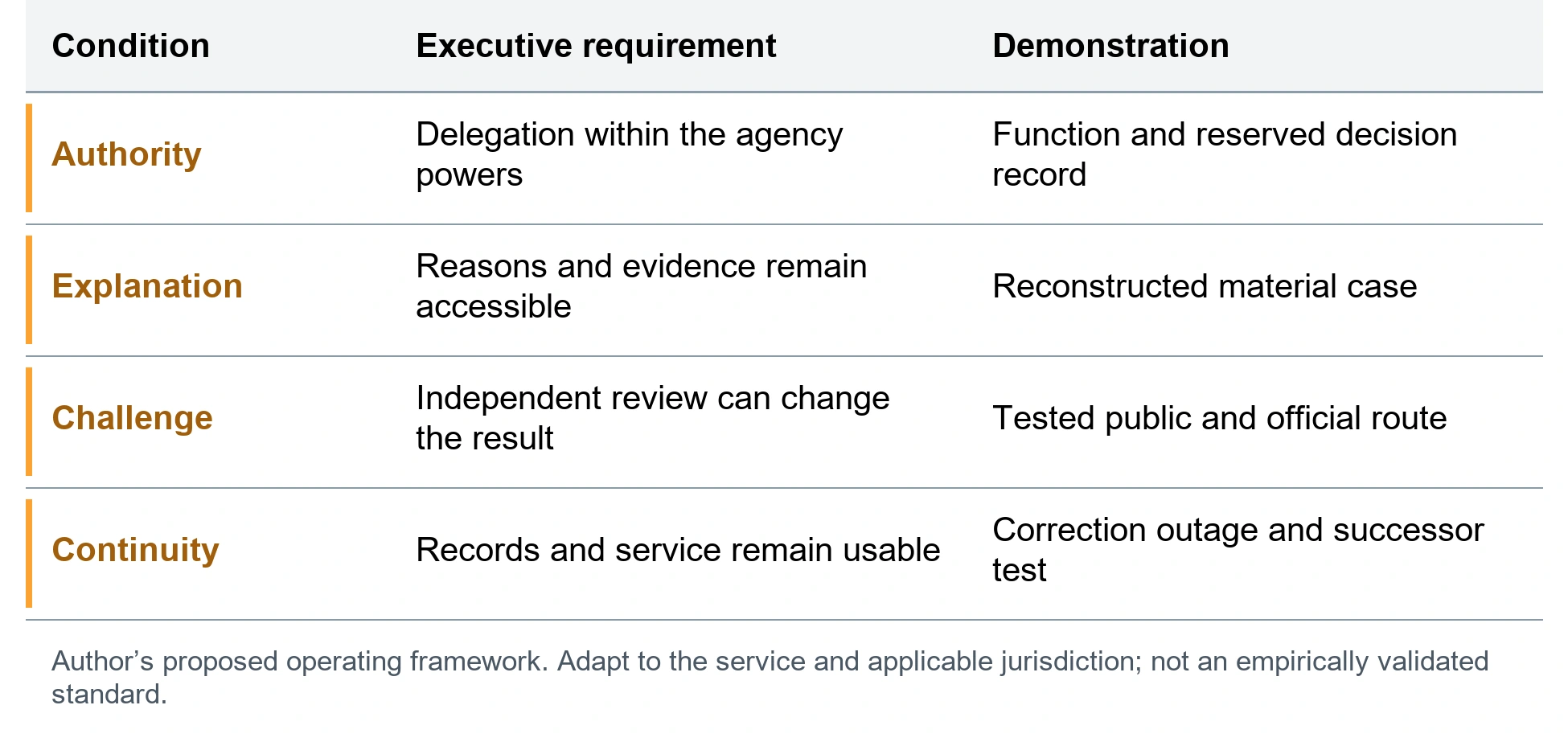
Figure 1 proposes four executive conditions: lawful authority, accessible reasons, independent challenge, and correction capacity. Management should connect each to contract rights, operating owners, and a demonstrated route. A broad audit clause is incomplete if the agency cannot obtain the record needed for a specific disputed case.
The supplier should identify which parts of its system or subcontracting chain limit explanation, portability, or access. The agency should assess those limits before award and decide whether the function can be delivered within them. An unresolved proprietary-system limitation should not become a surprise only when the public seeks a reason.
A person should have an appropriate route to challenge a material action and reach an official able to resolve it. The route must preserve relevant deadlines and evidence. Sending the person repeatedly through the same automated process does not establish meaningful review when the disputed mechanism remains unchanged.
Keep Local Duties and Data Rights Explicit
EU, UK, Swiss, US, and other public authorities operate under different administrative, privacy, procurement, transparency, and records regimes. The agency should obtain an activity-specific applicability assessment. A contract schedule can implement the required evidence and cooperation, but it cannot expand the agency’s legal powers or remove an individual’s rights.
Morgan Lewis’s outsourcing report identifies data, intellectual-property, governance, and dependency questions that persist throughout AI-enabled services.3 For public work, the buyer should secure the rights needed to retain service records, investigate outcomes, support oversight, and continue the function with a successor where required.
Separate public explanation from disclosure of protected information. The agency may need to protect personal data, security details, or legitimately confidential material while still explaining a decision. That balance requires a deliberate legal and operating method, rather than a blanket supplier-confidentiality response.
Authorize Only the Function the Agency Can Govern
A reasonable objection is that extensive conditions may reduce supplier participation. Prioritize the rights necessary for the actual public function and make them clear in procurement. Suppliers can then propose evidence methods and narrower scopes. Lower competition does not justify accepting a service whose material actions the agency cannot explain or correct.
Before expansion, test a normal case, an erroneous administrative action, a contested result, and a supplier outage. The executive should receive the authority assessment, evidence-access results, challenge-route test, and unresolved limitations. Where a condition fails, change the function or restrict the supplier mandate before public exposure grows.
Public accountability should remain operational across the supplier boundary. The agency should approve the service when it can establish who acted, under what authority, on which evidence, with what effect, and through which route an error can be corrected. Those capabilities are part of the purchased service, not optional additions to the technology.
Evidence and Source Note
The study is a nonrepresentative cross-section of 850 vendor delivery-team respondents on 150 engagements serving Tier 1 financial institutions, collected during January–June 2026. Neither banks nor vendors corroborated the accounts. It establishes reported experience, not causation, legal breach, or market prevalence. Its application here is a mechanism to investigate, not an estimate of conditions in other industries. The author-supplied version 1.8.2 is dated November 1, 2026 and is cited as a forthcoming manuscript consulted October 23, 2026.4
This is an analytical decision paper based on the supplied study and selected primary public sources checked through October 23, 2026. The original contribution is a public-service accountability evidence schedule connecting lawful delegation, accessible reasons, independent challenge, and practical correction across the supplier boundary. The proposed method has not been independently validated. Legal requirements depend on the entity, activity, jurisdiction, and effective provisions; supervisory observations, research, and professional commentary have distinct authority.
Notes
- US General Services Administration, “Accelerating Responsible Use of Artificial Intelligence at GSA,” US General Services Administration, March 11, 2026, CIO 2185.1C, purpose and applicability, https://www.gsa.gov/directives-library/accelerating-responsible-use-of-artificial-intelligence-at-gsa. ↩
- Phil Hatch, Agentic AI Outsourcing at Tier 1 Financial Institutions: Full Study Report, version 1.8.2 (Akholi, forthcoming manuscript dated November 1, 2026), Part 2, sec. 5.1, “Agent Actions Visible Only Inside Each Firm’s Own Tools”, https://doi.org/10.2139/ssrn.7164559. ↩
- Barbara Murphy Melby et al., “AI-Enabled Outsourcing: Key Contract, Pricing, and Governance Considerations,” Morgan Lewis, July 2026, public report overview and key takeaways, https://www.morganlewis.com/pubs/2026/07/ai-enabled-outsourcing-key-contract-pricing-and-governance-considerations. ↩
- Hatch, Agentic AI Outsourcing, Introduction, “Executive Summary” and “Evidentiary Basis and Its Limits”. ↩
Bibliography
- Hatch, Phil. Agentic AI Outsourcing at Tier 1 Financial Institutions: Full Study Report. Version 1.8.2. Akholi. Forthcoming manuscript dated November 1, 2026. Author-supplied manuscript consulted October 23, 2026. https://doi.org/10.2139/ssrn.7164559.
- Melby, Barbara Murphy, Marina G. Aronchik, and C. Kari Krusmark. “AI-Enabled Outsourcing: Key Contract, Pricing, and Governance Considerations.” Morgan Lewis. July 2026. https://www.morganlewis.com/pubs/2026/07/ai-enabled-outsourcing-key-contract-pricing-and-governance-considerations.
- US General Services Administration. “Accelerating Responsible Use of Artificial Intelligence at GSA.” US General Services Administration. March 11, 2026. https://www.gsa.gov/directives-library/accelerating-responsible-use-of-artificial-intelligence-at-gsa.
Explore this subject
Category: Governance and Accountability
Topics: Customer Protection Delegated Authority Retained Accountability
Audience: Buy-side Boards and Executives
Industry: Government and Public Services Other Regulated Industries