
Specify the Function Before the Technology
The sourcing manager should define the outcome, workload, quality, timing, authority, and relevant constraints the organization needs. Describe representative cases and material exceptions. Avoid prescribing an agent architecture before determining whether it is necessary for the function.
McKinsey’s scaling blueprint warns against premature build-versus-buy decisions before work is understood.1 The RFP should therefore expose the operating problem and invite suitable methods. Providers can propose agents, conventional automation, human work, or a combination, with a clear explanation of their choice.
State the buyer prerequisites available now and those requiring mobilization. Bidders should identify additional data, tools, decisions, and expertise they need. This prevents an attractive price from relying on access or retained capacity the buyer has not approved.
Ask for Demonstration Rather Than Adjectives
Require a structured response describing what the service can prepare, recommend, approve, execute, and verify. Ask how it behaves when authority is missing, information conflicts, a tool fails, or a human must intervene. Separate current capability from roadmap commitments.
The study reports manual work and apparent completion without corresponding results.2 It does not establish that every bid is overstated. It identifies why evaluation should observe the accepted outcome and the work required to achieve it.
For a hypothetical invoice service, use the same normal and difficult cases across bidders, with predefined acceptance rules. Preserve case mix, quality requirements, and evidence conditions. A bidder should not improve its score by silently excluding cases or using unreported demonstration staff.
Use an RFP Evidence Schedule
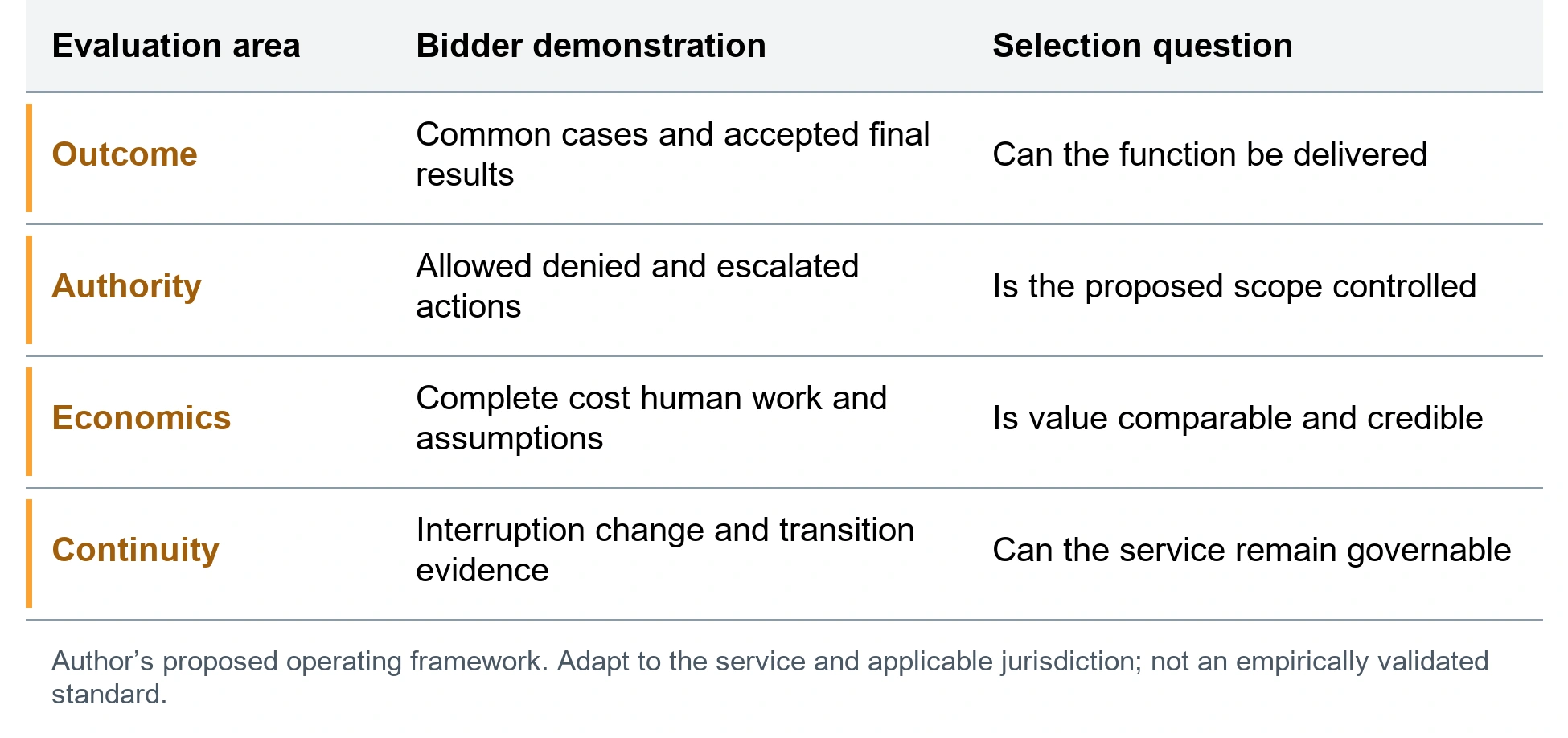
Figure 1 proposes four schedules: outcome demonstration, authority and control, complete economics, and continuity. Each should identify the required evidence, evaluation method, limitations, and relevant contract commitment. Keep requirements proportionate to the service’s consequences.
Require visibility of human review, repair, returned work, exclusions, and buyer effort. Ask bidders to show the calculation supporting price and benefit claims without necessarily disclosing every proprietary cost. The buyer needs a comparable functional cost, not unrestricted access to supplier margins.
BCG’s services research reports a gap between buyer expectations and provider commitments.3 Its surveys and forecasts do not establish the result of this procurement. They reinforce the value of aligning the proposed outcome, evidence, price, and conditions before selection.
Evaluate the Two Firm Operating Model
Include buyer readiness, decision response, training, change governance, incident cooperation, records, downstream dependencies, and transition. The provider should demonstrate what it controls and state what it cannot guarantee. An explicit limitation can be preferable to an untestable universal assurance.
EU, UK, Swiss, US, and other services can have different sector, privacy, conduct, safety, procurement, and records requirements. Qualified owners should establish local conclusions. Use those conclusions to define relevant evidence rather than ask every bidder for unrelated certifications.
Protect confidential and sensitive information through controlled evaluation access and suitable test data. Avoid unnecessary disclosure of personal or proprietary material. The evaluation should still permit meaningful challenge of material claims and preserve a record of why the selected service is suitable.
Carry Evaluation Evidence into the Contract
A reasonable objection is that extensive demonstrations increase procurement cost. Focus on claims capable of changing selection or creating material exposure. Use staged evaluation and reserve deeper tests for shortlisted offers. A concise evidence schedule can reduce repetitive narrative responses.
Before award, reconcile the winning proposal, test limitations, buyer dependencies, production conditions, and contract. Identify which claims remain forecasts and what must be demonstrated before live authority expands. Do not let a successful presentation replace the agreed acceptance criteria.
The manager should award against a service the buyer can understand, test, and govern. An evidence-based RFP creates a common comparison across different delivery methods and leaves a usable basis for mobilization, acceptance, pricing, and later review.
Evidence and Source Note
The study is a nonrepresentative cross-section of 850 vendor delivery-team respondents on 150 engagements serving Tier 1 financial institutions, collected during January–June 2026. Neither banks nor vendors corroborated the accounts. It establishes reported experience, not causation, legal breach, or market prevalence. Its application here is a mechanism to investigate, not an estimate of conditions in other industries. The author-supplied version 1.8.2 is dated November 1, 2026 and is cited as a forthcoming manuscript consulted October 23, 2026.4
This is an analytical decision paper based on the supplied study and selected primary public sources checked through October 23, 2026. The original contribution is an RFP evidence schedule linking comparable case demonstrations to authority, full economics, and contractual acceptance. The proposed method has not been independently validated. Legal requirements depend on the entity, activity, jurisdiction, and effective provisions; supervisory observations, research, and professional commentary have distinct authority.
Notes
- McKinsey & Company, “Stacking the Odds: A Blueprint for Successfully Scaling Agentic AI,” McKinsey & Company, September 14, 2026, workflow redesign, technical foundation, and operating-model blueprint, https://www.mckinsey.com/capabilities/operations/our-insights/stacking-the-odds-a-blueprint-for-successfully-scaling-agentic-ai. ↩
- Phil Hatch, Agentic AI Outsourcing at Tier 1 Financial Institutions: Full Study Report, version 1.8.2 (Akholi, forthcoming manuscript dated November 1, 2026), Part 5, “The Five Manual Alteration Methods” and “Disclosure of Manual Alteration,” table 5.8, https://doi.org/10.2139/ssrn.7164559; Hatch, Agentic AI Outsourcing, Part 3, AI Technology, sec. 4.1, “Accuracy of the Tools’ Own Success and Failure Reports,” indicator C172. ↩
- Vikash Jain et al., “The $200 Billion Agentic AI Opportunity for Tech Service Providers,” Boston Consulting Group, February 20, 2026, demand and supply survey methodology; expectation and commitment gaps, https://www.bcg.com/publications/2026/the-200-billion-dollar-ai-opportunity-in-tech-services. ↩
- Hatch, Agentic AI Outsourcing, Introduction, “Executive Summary” and “Evidentiary Basis and Its Limits”. ↩
Bibliography
- Hatch, Phil. Agentic AI Outsourcing at Tier 1 Financial Institutions: Full Study Report. Version 1.8.2. Akholi. Forthcoming manuscript dated November 1, 2026. Author-supplied manuscript consulted October 23, 2026. https://doi.org/10.2139/ssrn.7164559.
- Jain, Vikash, Sudhanshu Chawla, Saurav Mohanty, Hiren Mittal, Anoop Gopal Singh, Sahib Katyal, and Shailee Raychaudhuri. “The $200 Billion Agentic AI Opportunity for Tech Service Providers.” Boston Consulting Group. February 20, 2026. https://www.bcg.com/publications/2026/the-200-billion-dollar-ai-opportunity-in-tech-services.
- McKinsey & Company. “Stacking the Odds: A Blueprint for Successfully Scaling Agentic AI.” McKinsey & Company. September 14, 2026. https://www.mckinsey.com/capabilities/operations/our-insights/stacking-the-odds-a-blueprint-for-successfully-scaling-agentic-ai.
Explore this subject
Category: Commercial and Vendor Management
Topics: Hidden Human Work Production Acceptance Supplier Selection
Audience: Buy-side Delivery and Vendor Managers
Industry: Cross-industry