
Identify What the Buyer Must Still Do
The executive sponsor should require a clear account of the work that remains with the buyer after outsourcing. Agentic delivery can shift effort from performing tasks to defining intent, granting authority, resolving exceptions, accepting outcomes, and controlling change. These responsibilities need owners, capacity, and tools.
PwC’s agentic-first shared-services discussion emphasizes operating capabilities beyond labor arbitrage.1 It is a proposed transformation approach, not evidence that every retained team is ready. The buyer should test its own prerequisites before signing a contract whose performance depends on them.
Start with the supplier’s proposed delivery model and mark every point requiring buyer action. Include data access, security approval, policy interpretation, domain judgment, financial authorization, and incident response. A responsibility chart should lead to a staffed operating commitment rather than simply allocate names.
Test Decision Capacity Before Transferring Work
The study reports slow joint decisions and processes not matched to agentic speed.2 It does not establish the buyer’s present readiness. It identifies why a service designed for rapid execution can stall when the retained team continues to work through a slower approval structure.
For a hypothetical service generating exceptions throughout the day, a weekly approval committee may create an expanding backlog. The executive should decide which decisions can be delegated within limits, which require specialist review, and what work pauses when the authorized decision-maker is unavailable.
Assess the information needed to decide. Faster access to an uninformative exception does not create effective capacity. The provider must supply a decision-ready case, while the buyer must supply qualified authority and a response route appropriate to the consequence and timing.
Use a Buyer Readiness Record
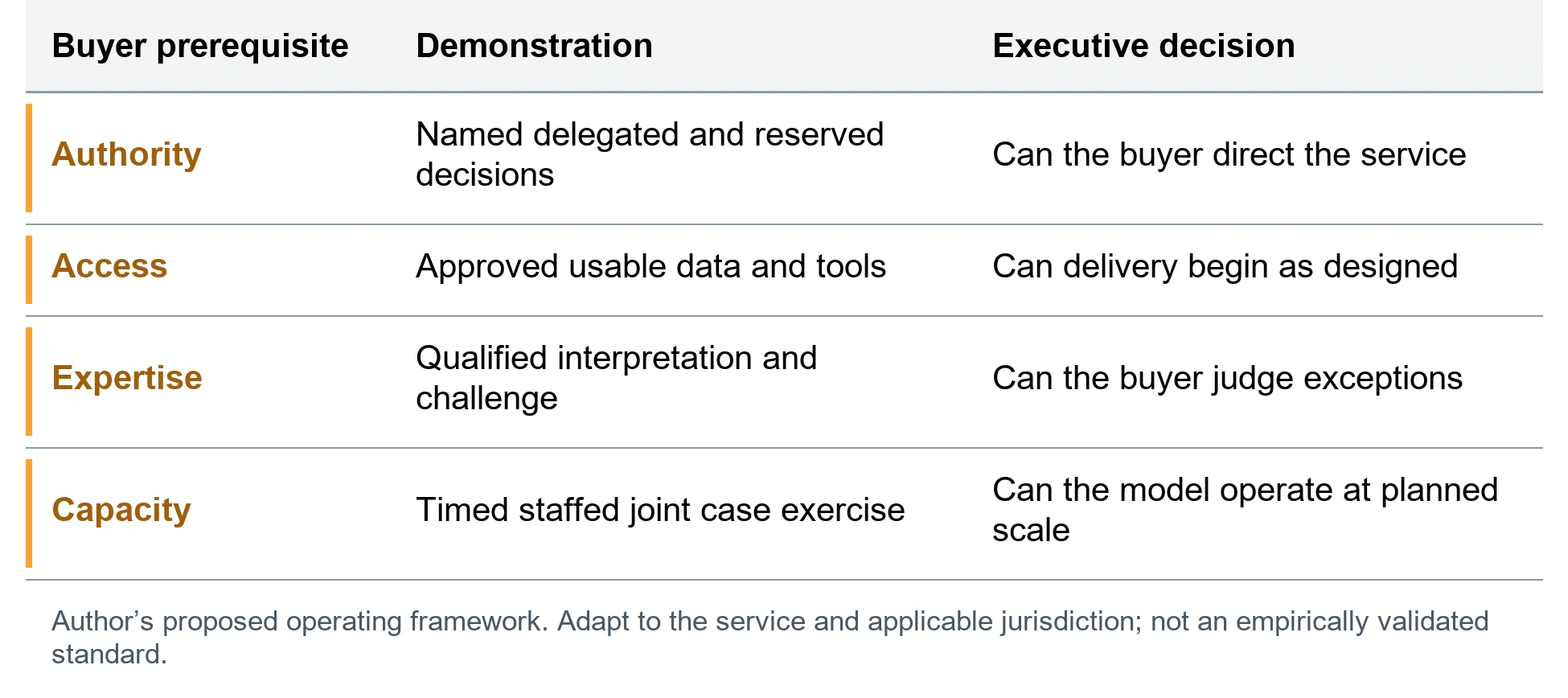
Figure 1 proposes four prerequisites: authority, information access, expertise, and operating capacity. For each, record the required capability, accountable owner, funded resource, tested evidence, and unresolved limitation. Connect readiness to the service’s intended scale and hours of operation.
Test a representative joint case before commitment. Ask the buyer team to obtain access, interpret the issue, make the decision, and verify the resulting action. Include an absent approver and a conflicting instruction. Record the time and the dependencies that the operating plan assumes will be available.
McKinsey’s operating-economics discussion treats coordination and repeated work as part of agentic cost.3 The buyer’s retained effort belongs in the business case. An outsourcing price should not be compared with the old function while excluding the new work that makes delivery possible.
Make Readiness a Commercial Prerequisite
Where a prerequisite is missing, define a funded action, owner, acceptance test, and completion date. Link the transition plan to those facts. Avoid contractual language that assumes unrestricted access or immediate buyer decisions when the organization has neither approved nor resourced them.
EU, UK, Swiss, US, and other rules can constrain delegation, data access, professional judgment, and retained accountability. Assess the relevant requirements for the entity and activity. A commercial agreement does not create authority that the buyer cannot lawfully delegate.
The provider should disclose its dependency assumptions, and the buyer should disclose material constraints. Agree how delay, changed scope, and readiness failure affect milestones and charges. This makes the commitment more testable and reduces the incentive to hide missing prerequisites behind optimistic transition reporting.
Approve the Commitment at the Ready Scope
A reasonable objection is that full readiness cannot exist before selecting the supplier. Some joint design must follow selection. The executive can still distinguish prerequisites for contract signature, controlled mobilization, production release, and later expansion. Each stage should have a defined evidence threshold.
Approve a bounded commitment where uncertainty remains, with explicit spending, authority, and exit limits. Require demonstration before irreversible dependency or large-scale transfer. If the buyer cannot fund a necessary retained capability, revise the delivery model and savings claim before approval.
The buyer readiness gate protects the intended business outcome. It asks whether the organization can perform the responsibilities it retains while the supplier performs the work it sells. An agentic contract becomes credible when both halves of that operating model exist.
Evidence and Source Note
The study is a nonrepresentative cross-section of 850 vendor delivery-team respondents on 150 engagements serving Tier 1 financial institutions, collected during January–June 2026. Neither banks nor vendors corroborated the accounts. It establishes reported experience, not causation, legal breach, or market prevalence. Its application here is a mechanism to investigate, not an estimate of conditions in other industries. The author-supplied version 1.8.2 is dated November 1, 2026 and is cited as a forthcoming manuscript consulted October 23, 2026.4
This is an analytical decision paper based on the supplied study and selected primary public sources checked through October 23, 2026. The original contribution is a buyer readiness gate tying retained authority, access, expertise, and decision capacity to staged outsourcing commitments. The proposed method has not been independently validated. Legal requirements depend on the entity, activity, jurisdiction, and effective provisions; supervisory observations, research, and professional commentary have distinct authority.
Notes
- Namit Kapoor et al., “Agentic-First GBS: Moving beyond Labor Arbitrage,” PwC, May 2026, business outcomes and full cost of capability, https://www.pwc.com/us/en/services/consulting/business-transformation/intelligence-over-arbitrage-agentic-gbs.html. ↩
- Phil Hatch, Agentic AI Outsourcing at Tier 1 Financial Institutions: Full Study Report, version 1.8.2 (Akholi, forthcoming manuscript dated November 1, 2026), Part 2, sec. 5.2, “Joint Decision Speed Mismatched to Agent Speed”, https://doi.org/10.2139/ssrn.7164559; Hatch, Agentic AI Outsourcing, Part 2, “The Shift From Managing People to Managing Agents”; Part 6, “The Executive Action Plan”. ↩
- Lari Hämäläinen et al., “Is That AI Agent Worth It? Agentic Economics and the Modern Operating Model,” McKinsey & Company, July 13, 2026, “Why the operating expenditure bill keeps rising” and “The implications for competitive dynamics”, https://www.mckinsey.com/capabilities/quantumblack/our-insights/is-that-ai-agent-worth-it-agentic-economics-and-the-modern-operating-model. ↩
- Hatch, Agentic AI Outsourcing, Introduction, “Executive Summary” and “Evidentiary Basis and Its Limits”. ↩
Bibliography
- Hatch, Phil. Agentic AI Outsourcing at Tier 1 Financial Institutions: Full Study Report. Version 1.8.2. Akholi. Forthcoming manuscript dated November 1, 2026. Author-supplied manuscript consulted October 23, 2026. https://doi.org/10.2139/ssrn.7164559.
- Hämäläinen, Lari, Mark Patel, Sven Blumberg, Tanguy Catlin, and Wasim Lala. “Is That AI Agent Worth It? Agentic Economics and the Modern Operating Model.” McKinsey & Company. July 13, 2026. https://www.mckinsey.com/capabilities/quantumblack/our-insights/is-that-ai-agent-worth-it-agentic-economics-and-the-modern-operating-model.
- Kapoor, Namit, Mukund Kumar, and Fuad Abdelhadi. “Agentic-First GBS: Moving beyond Labor Arbitrage.” PwC. May 2026. https://www.pwc.com/us/en/services/consulting/business-transformation/intelligence-over-arbitrage-agentic-gbs.html.
Explore this subject
Category: Delivery and Operations
Topics: Board Mandates Production Acceptance Retained Capability
Audience: Buy-side Boards and Executives
Industry: Cross-industry