
Choose the Capability Boundary Before the Location
The executive should define which capabilities the organization must control directly and which it can obtain through a provider or global capability center. Location and labor cost remain relevant, but they should follow the functional design rather than determine it before the work is understood.
McKinsey’s discussion of global business services emphasizes changing workflows, talent, and operating models.1 It includes practitioner expectations, not a universal forecast for every center. The sourcing decision should compare feasible arrangements for the organization’s own function.
Identify business intent, policy interpretation, data meaning, consequential authority, routine execution, exception judgment, technology operations, and recovery. These capabilities may be combined differently across retained teams, captive centers, and external providers. Avoid assuming one organizational form is best for all of them.
Assess the Boundary Costs Agentic Work Introduces
The study reports slow joint decisions, knowledge dependency, and processes poorly matched to agentic delivery.2 It does not compare captive and external models causally. It identifies coordination and knowledge costs that a location-based labor comparison can miss.
For a hypothetical service, low-cost execution in one location may require repeated interpretation from a scarce retained specialist elsewhere. A different boundary that keeps interpretation close to execution may improve the function even if its nominal staffing cost is higher.
Include the cost of access, data movement, evidence exchange, qualified oversight, training, transition, and recovery. Compare accepted outcomes at common quality and timing. A lower cost per process phase is not necessarily comparable after the delivery method changes the phases themselves.
Use a Capability Boundary Record
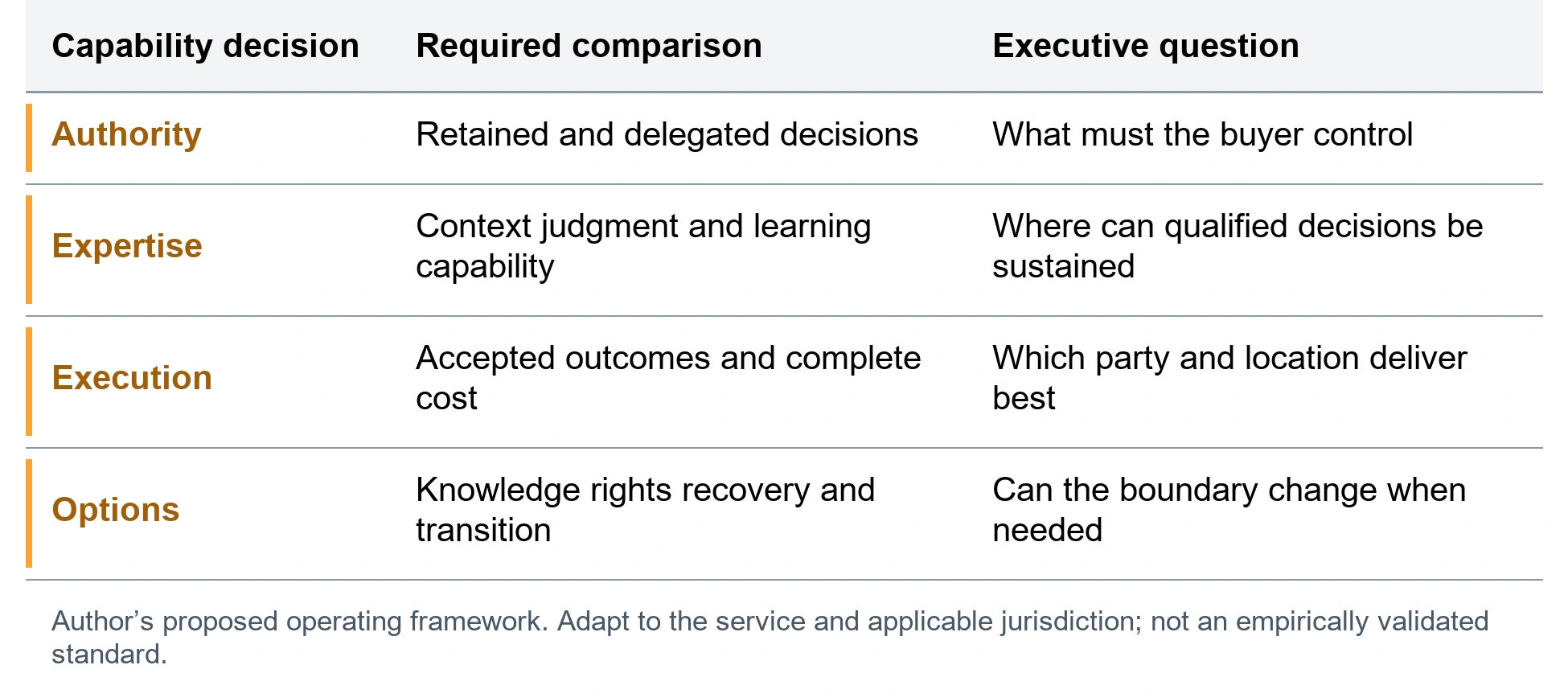
Figure 1 proposes four decisions: retain authority, place expertise, source execution, and preserve options. For each capability, identify the required evidence, accountable owner, data and system access, and conditions under which the proposed location or party can perform it.
PwC’s agentic shared-services discussion argues for value beyond labor arbitrage.3 The proposed record tests that proposition in a sourcing choice. Captive ownership does not automatically establish expertise or control, and an external provider can offer strong capability where rights and operating evidence support reliance.
Evaluate realistic alternatives against the same function. Include a combined model where the buyer retains consequential judgment, a center maintains context and reusable assets, and a provider supplies execution capability. The arrangement should minimize unnecessary handoffs without hiding necessary accountability.
Apply Local Constraints and Portfolio Dependencies
EU, UK, Swiss, US, and other privacy, secrecy, professional, labor, tax, transfer, and sector requirements can affect the feasible design. Qualified specialists should assess the actual entity, activity, data, and location. A global sourcing principle should preserve local constraints where they matter.
Map shared technology, workforce, identity, and recovery dependencies across captive and external arrangements. Moving work between legal entities does not necessarily diversify a common cloud or model exposure. The portfolio should be assessed by operational dependencies as well as contract count.
Preserve the buyer’s ability to challenge, change, and transition the function. Agree knowledge rights and practical transfer assets. A center or provider that becomes the only holder of critical context can create dependency regardless of whether the buyer owns the legal entity.
Commit Through Demonstrated Capability
A reasonable objection is that a detailed boundary review slows sourcing decisions. Focus first on consequential functions and irreversible commitments. Use a bounded operating test to establish where knowledge, authority, and coordination work best before scaling the chosen model.
Require evidence of accepted outcomes, total functional cost, decision timing, retained expertise, and recovery. State uncertainty and the investment needed to close important gaps. A strategic sourcing label should not replace the demonstration that the chosen parties can perform the function together.
The executive should place capability where it can deliver the required result under credible control and economics. Agentic sourcing is a decision about the organization’s ability to direct and sustain work. Geography and ownership are important design choices within that decision, rather than sufficient answers to it.
Evidence and Source Note
The study is a nonrepresentative cross-section of 850 vendor delivery-team respondents on 150 engagements serving Tier 1 financial institutions, collected during January–June 2026. Neither banks nor vendors corroborated the accounts. It establishes reported experience, not causation, legal breach, or market prevalence. Its application here is a mechanism to investigate, not an estimate of conditions in other industries. The author-supplied version 1.8.2 is dated November 1, 2026 and is cited as a forthcoming manuscript consulted October 23, 2026.4
This is an analytical decision paper based on the supplied study and selected primary public sources checked through October 23, 2026. The original contribution is a capability-boundary record comparing retained, captive, external, and combined agentic delivery models at the complete functional level. The proposed method has not been independently validated. Legal requirements depend on the entity, activity, jurisdiction, and effective provisions; supervisory observations, research, and professional commentary have distinct authority.
Notes
- McKinsey & Company, “Agentic AI and the Future of Global Business Services,” McKinsey & Company, August 11, 2026, edited podcast transcript with Christian Johnson, Heiko Heimes, and Josh Peters, https://www.mckinsey.com/capabilities/operations/our-insights/agentic-ai-and-the-future-of-global-business-services. ↩
- Phil Hatch, Agentic AI Outsourcing at Tier 1 Financial Institutions: Full Study Report, version 1.8.2 (Akholi, forthcoming manuscript dated November 1, 2026), Part 2, sec. 5.2, “Joint Decision Speed Mismatched to Agent Speed”, https://doi.org/10.2139/ssrn.7164559; Hatch, Agentic AI Outsourcing, Part 4, “Knowledge at Risk of Departure”. ↩
- Namit Kapoor et al., “Agentic-First GBS: Moving beyond Labor Arbitrage,” PwC, May 2026, business outcomes and full cost of capability, https://www.pwc.com/us/en/services/consulting/business-transformation/intelligence-over-arbitrage-agentic-gbs.html. ↩
- Hatch, Agentic AI Outsourcing, Introduction, “Executive Summary” and “Evidentiary Basis and Its Limits”. ↩
Bibliography
- Hatch, Phil. Agentic AI Outsourcing at Tier 1 Financial Institutions: Full Study Report. Version 1.8.2. Akholi. Forthcoming manuscript dated November 1, 2026. Author-supplied manuscript consulted October 23, 2026. https://doi.org/10.2139/ssrn.7164559.
- Kapoor, Namit, Mukund Kumar, and Fuad Abdelhadi. “Agentic-First GBS: Moving beyond Labor Arbitrage.” PwC. May 2026. https://www.pwc.com/us/en/services/consulting/business-transformation/intelligence-over-arbitrage-agentic-gbs.html.
- McKinsey & Company. “Agentic AI and the Future of Global Business Services.” McKinsey & Company. August 11, 2026. https://www.mckinsey.com/capabilities/operations/our-insights/agentic-ai-and-the-future-of-global-business-services.
Explore this subject
Category: Commercial and Vendor Management
Topics: Retained Capability Return on Investment Sourcing Strategy
Audience: Buy-side Boards and Executives
Industry: Cross-industry