
Align the Operating Model with the Sold Outcome
The provider executive should examine how account leaders, delivery managers, and technical teams are rewarded before approving an agentic outcome offer. A commercial team may promise lower effort while internal performance measures still favor billable hours, staffing growth, and high utilization. That contradiction can undermine both delivery improvement and margin.
Bain’s 2026 tech-services analysis identifies changing delivery, pricing, and talent models as central to provider adaptation.1 The practical decision is not to abolish effort measurement. It is to distinguish effort as an operating cost from effort as the result the customer purchases.
Start with one proposed outcome service. Define the accepted result, scope, quality, timing, and customer prerequisites. Then inspect the internal measures attached to the people responsible for delivering it. If those measures reward work that the commercial model expects to remove, leadership should resolve the conflict before signature.
Keep Cost Visibility While Changing the Target
Hours remain useful for understanding cost, capacity, exception work, and transition investment. The provider should preserve that information even when it stops billing by the hour. Removing time records can make an outcome offer less auditable and conceal the human effort needed to sustain the service.
The study’s manual-alteration accounts show why agentic delivery can include substantial human work that an autonomy claim does not reveal.2 These reports are not a provider cost benchmark. They support requiring each account to measure the actual work behind its accepted outcomes, including correction, assurance, and recovery readiness.
Separate necessary professional judgment from avoidable repair. The objective should be to eliminate defects and unnecessary handling while retaining the human contribution the service needs. A target that penalizes all human involvement can encourage the team to relabel effort or underprovide oversight rather than improve the delivery method.
Build an Account Performance Model Around Accepted Work
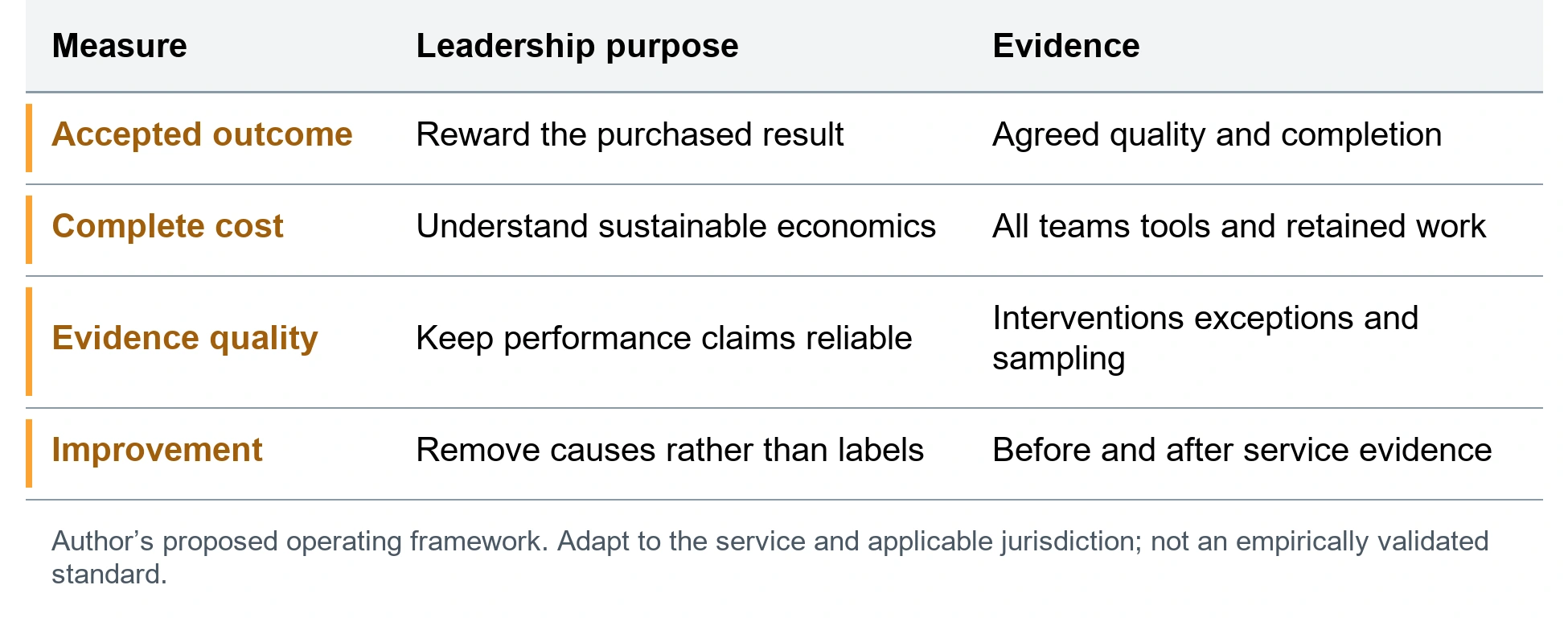
Figure 1 proposes four measures for the internal transition: accepted outcomes, complete delivery cost, evidence quality, and verified improvement. Leadership should decide how these measures affect account and individual evaluations. A single automation percentage is too weak to reconcile customer value, service quality, and provider economics.
For a hypothetical service, an engineering team may reduce processing hours while the operations team receives more exceptions. The account should evaluate the combined cost and accepted result. Rewarding only the engineering reduction would recognize an improvement that the delivery system has not achieved.
The provider should also distinguish current margin from investment in a reusable capability. Training, integration, and evidence infrastructure may reduce short-term utilization while supporting future service economics. Leadership should fund those choices explicitly and test their expected benefit, rather than force teams to hide investment inside billable delivery.
Protect Quality and Disclosure During the Transition
Mayer Brown’s agentic-services analysis connects performance commitments with governance and appropriate incentives.3 The provider should require accurate intervention reporting and preserve the customer’s agreed acceptance evidence. An account must not improve its apparent outcome rate by excluding difficult work or redefining completion after the fact.
Use independent sampling to check accepted cases, failed attempts, manual support, and work returned to the buyer. Review whether staff can escalate defects without being penalized for revealing them. Incentives should support timely correction and useful evidence while retaining accountability for avoidable errors and misconduct.
Global accounts need a common economic view with local labor, employment, privacy, and regulated-service conditions respected. A staffing change in one country may carry different costs and obligations from the same change elsewhere. EU, UK, Swiss, and US delivery economics should not be collapsed into a single assumed labor saving.
Stage the Commercial Transition
A reasonable objection is that mixed effort and outcome measures can confuse managers. Use a defined transition period with a small number of measures and clear ownership. Preserve the old cost evidence while testing the new acceptance and pricing logic. Do not declare the transformation complete because the invoice format changed.
Require the account to demonstrate accepted unit economics under representative volume and exception conditions. State which buyer prerequisites affect performance and how shortfalls are attributed. Leadership should approve the offer only when the delivery team can explain how the promised outcome, operating cost, and internal incentives fit together.
The provider should sell the result it can deliver and manage the work required to achieve it. Replacing billable-effort targets is therefore an operating decision as well as a pricing decision. The commercial model becomes credible when people are rewarded for accepted value, truthful evidence, and demonstrated improvement across the whole service.
Evidence and Source Note
The study is a nonrepresentative cross-section of 850 vendor delivery-team respondents on 150 engagements serving Tier 1 financial institutions, collected during January–June 2026. Neither banks nor vendors corroborated the accounts. It establishes reported experience, not causation, legal breach, or market prevalence. Its application here is a mechanism to investigate, not an estimate of conditions in other industries. The author-supplied version 1.8.2 is dated November 1, 2026 and is cited as a forthcoming manuscript consulted October 23, 2026.4
This is an analytical decision paper based on the supplied study and selected primary public sources checked through October 23, 2026. The original contribution is a provider account performance model that reconciles outcome pricing with internal incentives, complete cost visibility, truthful intervention reporting, and verified improvement. The proposed method has not been independently validated. Legal requirements depend on the entity, activity, jurisdiction, and effective provisions; supervisory observations, research, and professional commentary have distinct authority.
Notes
- Megha Chawla et al., “Tech Services: Cracking the Code on AI-led Growth,” Bain & Company, September 29, 2026, “At a Glance” and discussion of commercial models, https://www.bain.com/insights/tech-services-cracking-the-code-on-ai-led-growth-technology-report-2026/. ↩
- Phil Hatch, Agentic AI Outsourcing at Tier 1 Financial Institutions: Full Study Report, version 1.8.2 (Akholi, forthcoming manuscript dated November 1, 2026), Part 5, “The Five Manual Alteration Methods” and “Disclosure of Manual Alteration,” table 5.8, https://doi.org/10.2139/ssrn.7164559. ↩
- Rohith P. George et al., “Contracting for Agentic AI Solutions: Shifting the Model from SaaS to Services,” Mayer Brown, February 17, 2026, secs. 1–6, https://www.mayerbrown.com/en/insights/publications/2026/02/contracting-for-agentic-ai-solutions-shifting-the-model-from-saas-to-services. ↩
- Hatch, Agentic AI Outsourcing, Introduction, “Executive Summary” and “Evidentiary Basis and Its Limits”. ↩
Bibliography
- Chawla, Megha, Mark Brinda, Sushant Khandelwal, and Sandeep Nayak. “Tech Services: Cracking the Code on AI-led Growth.” Bain & Company. September 29, 2026. https://www.bain.com/insights/tech-services-cracking-the-code-on-ai-led-growth-technology-report-2026/.
- George, Rohith P., Joe Pennell, Brad L. Peterson, and Oliver Yaros. “Contracting for Agentic AI Solutions: Shifting the Model from SaaS to Services.” Mayer Brown. February 17, 2026. https://www.mayerbrown.com/en/insights/publications/2026/02/contracting-for-agentic-ai-solutions-shifting-the-model-from-saas-to-services.
- Hatch, Phil. Agentic AI Outsourcing at Tier 1 Financial Institutions: Full Study Report. Version 1.8.2. Akholi. Forthcoming manuscript dated November 1, 2026. Author-supplied manuscript consulted October 23, 2026. https://doi.org/10.2139/ssrn.7164559.
Explore this subject
Category: Commercial and Vendor Management
Topics: Hidden Human Work Outcome Pricing Workforce Continuity
Audience: Service Providers
Industry: Cross-industry