
Identify the Knowledge the Engagement Produces
The manager should map the information and artifacts created as the service runs: case histories, corrections, instructions, configurations, retrieval materials, memory, and operational improvements. These can combine buyer information, provider methods, and third-party content. One general ownership clause may not resolve the resulting uses.
The UK copyright-and-AI report examines licensing and evolving policy questions.1 It does not establish a universal ownership rule for all generated artifacts. Qualified counsel should assess the actual material, contribution, jurisdiction, and intended use.
For a hypothetical service, human corrections may improve a buyer-specific workflow while also revealing confidential policy or customer context. Permission to use the correction to finish the case should not silently become permission to incorporate it into a shared product.
Separate Each Learning Purpose
Define whether material may be used only to perform the service, improve a dedicated configuration, develop a shared capability, or train a broader model. Include analytics, testing, support, and derived learning where relevant. A no-foundation-model-training clause can leave other reuse unresolved.
The study reports important knowledge outside formal systems and manual work supporting delivery.2 It does not determine ownership of agent memory. The transferable concern is whether the buyer understands the knowledge created by its service and the rights needed to use or protect it.
Distinguish reusable general methods from buyer-specific information. The provider may legitimately retain background technology and experience while the buyer restricts confidential or regulated material. The objective is a workable allocation, not an unsupported assumption that everything belongs exclusively to one party.
Use a Learning Rights Record
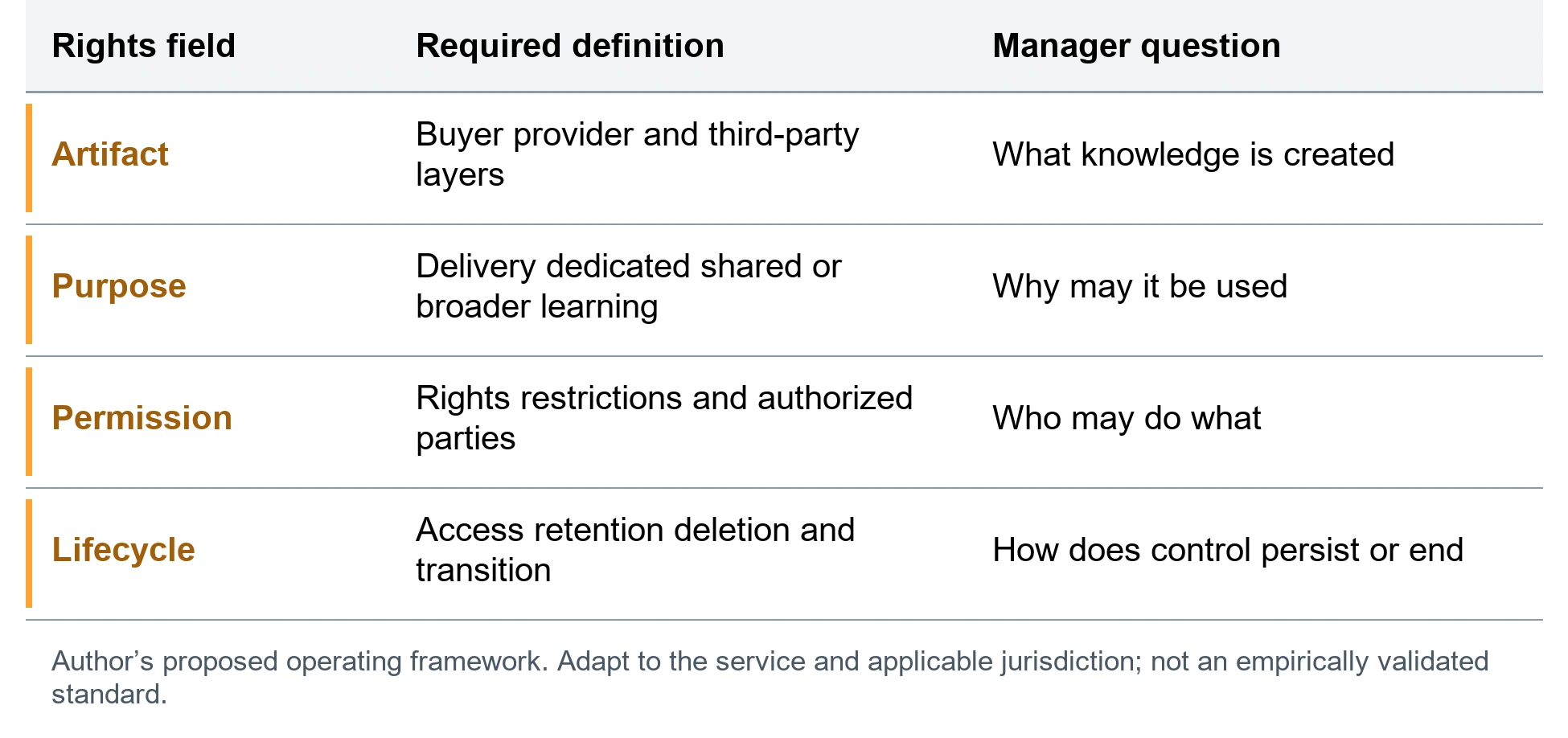
Figure 1 proposes four fields: artifact, purpose, permission, and lifecycle. Identify relevant source rights, confidentiality, privacy, access, retention, deletion, and transfer. Record uncertainty and the owner who can resolve it before the disputed use occurs.
Morgan Lewis’s contracting discussion addresses output and training-use terms.3 The proposed record makes those distinctions operational. A commercial permission should be connected to the systems and downstream parties that store or use the material.
Test whether the provider can distinguish dedicated and shared environments, implement restrictions, retrieve relevant records, and apply required deletion or isolation. A statement that data is not used for training should be evaluated against actual logging, memory, support, and improvement practices.
Preserve Local Rights and Practical Access
EU, UK, Swiss, US, and other IP, privacy, secrecy, employment, contract, and sector requirements differ. Qualified specialists should establish applicable conclusions. Ownership does not by itself permit processing personal information or reuse of licensed third-party content.
The buyer should retain the rights and usable context needed to investigate, correct, continue, and transition the service. The provider should disclose material limits imposed by its own platform or downstream agreements. A right to receive outputs may be insufficient if the operating knowledge needed for continuity remains inaccessible.
Update the record when a new memory feature, tool, recipient, or improvement purpose is introduced. Material new uses should receive the agreed review and authorization. Do not allow a routine platform update to expand the supplier’s reuse rights without an explicit decision.
Agree Learning Rights Before Context Becomes Indispensable
A reasonable objection is that future learning cannot be predicted artifact by artifact. Use clear categories, default permissions, prohibited uses, and a change route for new material purposes. Avoid unnecessary ownership disputes where a suitable license and protection meet both parties’ needs.
Before expanding the service, review representative artifacts and trace their actual storage, use, and downstream access. Test a restriction and transition request. Resolve gaps between the rights schedule and operating behavior before more valuable context accumulates.
The manager should establish a service that can learn usefully within deliberate boundaries. Knowledge created during delivery is part of the commercial relationship. Its permitted use, protection, access, and treatment at exit should be governed as intentionally as the initial data supplied.
Evidence and Source Note
The study is a nonrepresentative cross-section of 850 vendor delivery-team respondents on 150 engagements serving Tier 1 financial institutions, collected during January–June 2026. Neither banks nor vendors corroborated the accounts. It establishes reported experience, not causation, legal breach, or market prevalence. Its application here is a mechanism to investigate, not an estimate of conditions in other industries. The author-supplied version 1.8.2 is dated November 1, 2026 and is cited as a forthcoming manuscript consulted October 23, 2026.4
This is an analytical decision paper based on the supplied study and selected primary public sources checked through October 23, 2026. The original contribution is a learning-rights record separating service use, dedicated improvement, shared reuse, and broader training across the agentic supply chain. The proposed method has not been independently validated. Legal requirements depend on the entity, activity, jurisdiction, and effective provisions; supervisory observations, research, and professional commentary have distinct authority.
Notes
- UK Department for Science Innovation and Technology Department for Culture Media and Sport and Intellectual Property Office, “Report on Copyright and Artificial Intelligence,” UK Department for Science Innovation and Technology Department for Culture Media and Sport and Intellectual Property Office, March 18, 2026, sections A and G; policy report, not a new ownership rule, https://www.gov.uk/government/publications/report-and-impact-assessment-on-copyright-and-artificial-intelligence/report-on-copyright-and-artificial-intelligence. ↩
- Phil Hatch, Agentic AI Outsourcing at Tier 1 Financial Institutions: Full Study Report, version 1.8.2 (Akholi, forthcoming manuscript dated November 1, 2026), Part 4, “Knowledge at Risk of Departure”, https://doi.org/10.2139/ssrn.7164559; Hatch, Agentic AI Outsourcing, Part 5, “The Five Manual Alteration Methods” and “Disclosure of Manual Alteration,” table 5.8. ↩
- Doneld Shelkey, “Negotiating AI Provisions in Commercial and Technology Contracts: Where the Market Is Heading,” The Licensing Journal, May 1, 2026, pp. 1–2, intellectual property and transition, https://www.morganlewis.com/-/media/files/publication/outside-publication/article/2026/negotiating-ai-provisions-in-commercial-and-technology-contracts-where-the-market-is-heading-the-licensing-journal.pdf. ↩
- Hatch, Agentic AI Outsourcing, Introduction, “Executive Summary” and “Evidentiary Basis and Its Limits”. ↩
Bibliography
- Hatch, Phil. Agentic AI Outsourcing at Tier 1 Financial Institutions: Full Study Report. Version 1.8.2. Akholi. Forthcoming manuscript dated November 1, 2026. Author-supplied manuscript consulted October 23, 2026. https://doi.org/10.2139/ssrn.7164559.
- Shelkey, Doneld. “Negotiating AI Provisions in Commercial and Technology Contracts: Where the Market Is Heading.” The Licensing Journal. May 1, 2026. https://www.morganlewis.com/-/media/files/publication/outside-publication/article/2026/negotiating-ai-provisions-in-commercial-and-technology-contracts-where-the-market-is-heading-the-licensing-journal.pdf.
- UK Department for Science Innovation and Technology Department for Culture Media and Sport and Intellectual Property Office. “Report on Copyright and Artificial Intelligence.” UK Department for Science Innovation and Technology Department for Culture Media and Sport and Intellectual Property Office. March 18, 2026. https://www.gov.uk/government/publications/report-and-impact-assessment-on-copyright-and-artificial-intelligence/report-on-copyright-and-artificial-intelligence.
Explore this subject
Category: Commercial and Vendor Management
Topics: Contract Design Intellectual Property and Reuse Privacy and Data Rights
Audience: Buy-side Delivery and Vendor Managers
Industry: Cross-industry