
Ask What the Assurance Conclusion Covers
The audit committee should begin with the material service and the conclusion management asks it to accept. A provider may present cybersecurity certification, model evaluations, service-level reports, and internal reviews. Each can be useful while leaving the bank’s consequential workflow outside its scope.
EY’s governance survey reports that formal assurance reviews can surface issues and lead organizations to modify or stop systems.1 It covers US executive reports, not independently verified bank engagement outcomes. Its relevance is the difference between obtaining an assurance document and using assurance to change a decision.
Ask management to state the legal entity, service configuration, period, data population, subcontractors, and control objectives covered. Then identify exclusions. The committee should understand whether a favorable conclusion applies to the service operating today or to a narrower process tested before a material change.
Make Unreported Intervention an Assurance Question
In the supplied study, all 150 sampled engagements had a reported manual alteration across the five methods. Thirteen of 1,004 pooled valid disclosure-question answers indicated informing the customer, approximately 1.29%.2 These denominators differ; the answers may repeat respondents and do not establish bank knowledge.
The committee should therefore ask whether the assurance process can detect and classify human intervention, including legitimate review and corrective work. The finding is not proof that every provider concealed a breach. It is a reason to test whether management’s evidence depends on supplier reporting that omits the work sustaining the service.
A hypothetical clean performance report could exclude cases completed manually. The committee needs the inclusion rule and reconciled case history before interpreting the automation claim. Where the population cannot be reconciled, the assurance conclusion should disclose that limitation rather than imply comprehensive coverage.
Use an Assurance Coverage Record
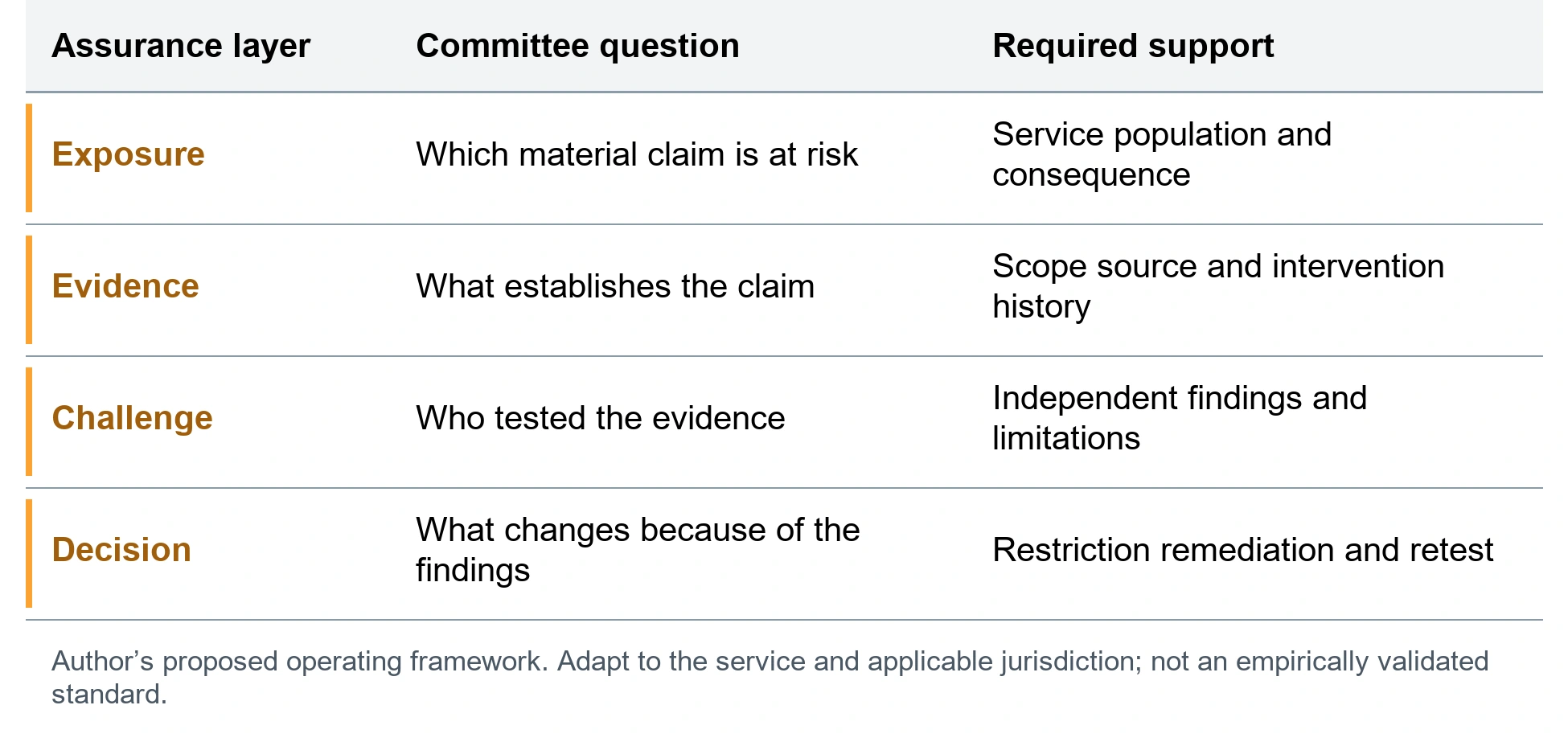
Figure 1 proposes a record connecting material exposure, evidence, independent challenge, and corrective decision. Management should identify the source of each important claim and the person who tested it. Distinguish provider assertion, bank observation, and independent assurance.
The record should include material exceptions, missing evidence, changed configurations, and overdue remediation. A risk rating without the underlying limitation can be misleading. The committee should see what could not be established and whether the gap affects continued reliance, service scope, or reporting to another responsible body.
The Basel third-party principles retain board and senior management responsibilities across the relationship lifecycle.3 An external report can support those responsibilities; it cannot discharge them merely by existing. The bank must connect assurance scope to the particular service and its own controls.
Keep Legal and Assurance Conclusions Distinct
A departure from a planned governance function is not automatically a legal violation. Counsel and relevant control functions should assess the facts against applicable requirements. Likewise, absence of a reported incident does not demonstrate effective control if the monitoring process could not detect one.
EU, UK, Swiss, US, and other banking and audit regimes differ. The committee should require management to identify the relevant statutory, supervisory, accounting, and contractual conclusions and who is qualified to make each. Do not combine them into an undefined statement that the service is compliant.
Secure access to the records necessary for bank and auditor challenge, including relevant downstream evidence. Protect confidential information through proportionate access controls. If a supplier restriction prevents a material conclusion, the limitation belongs in the committee decision rather than in an undisclosed operational footnote.
Commission Work That Can Change Reliance
A reasonable objection is that the committee cannot inspect operational detail for every agent. It should not. Management should prioritize material services and bring concise conclusions with a traceable evidence route. The committee’s role is to challenge coverage, unresolved exposure, independence, and the adequacy of the response.
Commission a targeted review where a material claim lacks evidence. Give it access, a defined question, an accountable owner, and a decision date. Require a clear recommendation on continued use, restricted scope, remediation, or replacement. Track closure through demonstrated correction rather than administrative completion.
The committee should leave the review able to explain why reliance is justified and where it remains conditional. The strongest assurance pack is not the largest. It is the one that connects material outsourced activity to credible evidence, explicit limitations, and a decision management can execute.
Evidence and Source Note
The study is a nonrepresentative cross-section of 850 vendor delivery-team respondents on 150 engagements serving Tier 1 financial institutions, collected during January–June 2026. Neither banks nor vendors corroborated the accounts. It establishes reported experience, not causation, legal breach, or market prevalence. The author-supplied version 1.8.2 is dated November 1, 2026 and is cited as a forthcoming manuscript consulted October 23, 2026.4
This is an analytical decision paper based on the supplied study and selected primary public sources checked through October 23, 2026. The original contribution is an audit-committee coverage record connecting material agent-service claims to evidence provenance, assurance limitations, and decisions about continued reliance. The proposed method has not been independently validated. Legal requirements depend on the entity, activity, jurisdiction, and effective provisions; supervisory observations, research, and professional commentary have distinct authority.
Notes
- Richard Jackson and John McLain, “AI Governance Has Entered Its Next Phase: Closing the Confidence Gap,” EY, September 15, 2026, US survey population and chapters 4–5, https://www.ey.com/en_us/insights/assurance/ai-governance-has-entered-its-next-phase-closing-the-confidence-gap. ↩
- Phil Hatch, Agentic AI Outsourcing at Tier 1 Financial Institutions: Full Study Report, version 1.8.2 (Akholi, forthcoming manuscript dated November 1, 2026), Part 5, “The Five Manual Alteration Methods” and “Disclosure of Manual Alteration,” table 5.8, https://doi.org/10.2139/ssrn.7164559. ↩
- Bank for International Settlements, Financial Stability Institute, “Sound Management of Third-Party Risk—Executive Summary,” Bank for International Settlements, Financial Stability Institute, March 25, 2026, principles 1–9 and intended application, https://www.bis.org/publications/fsi-summary-sound-management-third-party-risk-executive-summary. ↩
- Hatch, Agentic AI Outsourcing, Introduction, “Executive Summary” and “Evidentiary Basis and Its Limits”. ↩
Bibliography
- Bank for International Settlements, Financial Stability Institute. “Sound Management of Third-Party Risk—Executive Summary.” Bank for International Settlements, Financial Stability Institute. March 25, 2026. https://www.bis.org/publications/fsi-summary-sound-management-third-party-risk-executive-summary.
- Hatch, Phil. Agentic AI Outsourcing at Tier 1 Financial Institutions: Full Study Report. Version 1.8.2. Akholi. Forthcoming manuscript dated November 1, 2026. Author-supplied manuscript consulted October 23, 2026. https://doi.org/10.2139/ssrn.7164559.
- Jackson, Richard, and John McLain. “AI Governance Has Entered Its Next Phase: Closing the Confidence Gap.” EY. September 15, 2026. https://www.ey.com/en_us/insights/assurance/ai-governance-has-entered-its-next-phase-closing-the-confidence-gap.
Explore this subject
Category: Assurance and Audit
Topics: Board Mandates Evidence and Traceability Independent Audit
Audience: Buy-side Boards and Executives
Industry: Banking Financial Services