
Approve the Financial Mandate
A bank should authorize a provider agent to perform a defined financial action, rather than approve an account and assume its permissions describe the business mandate. The board risk committee needs assurance that management can connect every consequential action to a current instruction, a represented principal, an approved purpose, and an enforceable limit.
Consider a hypothetical wealth-service agent that can read an account and submit a transfer. Its access may be technically valid while the proposed transfer exceeds the customer instruction, uses an expired mandate, or sends funds to an unapproved destination. Successful authentication answers who accessed the system. It does not settle whether this particular use of the account was authorized.
NIST’s August 2026 identity analysis distinguishes agent identity, delegated entitlements, and the accountability problems created by shared credentials.1 The bank’s further task is to connect those controls to the financial instruction and the product rules governing execution.
Separate Instruction from Permission
The business owner should define which acts the provider may prepare, recommend, approve, submit, cancel, or confirm. These verbs describe different authority. Permission to assemble a payment should not silently include permission to release it; permission to submit should not imply authority to declare settlement final.
The proposed mandate record should identify the customer or bank principal, the source of authority, permitted instruments and destinations, transaction and aggregate limits, effective period, and required approvals. It should also identify actions reserved to the bank and the conditions requiring renewed instructions. Technical teams can then show where each boundary is enforced.
The study’s accounts of divided visibility and slow joint decisions explain why the record must cross the firm boundary. They do not determine the validity of any customer mandate. The bank should require the provider to preserve the instruction reference and actual action together, so a later investigator can reconstruct their relationship.2
Test the Mandate at Execution
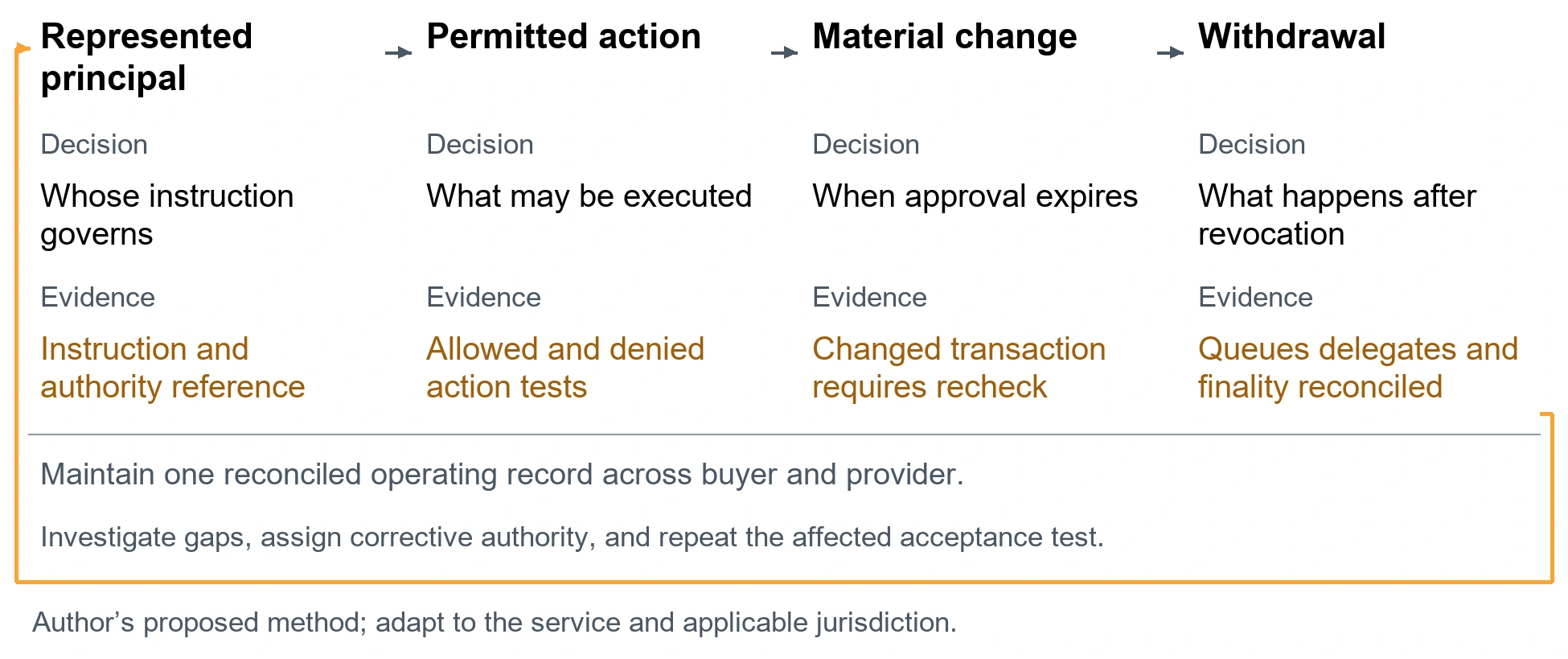
Figure 1 proposes four executive acceptance questions. Management should demonstrate a permitted transaction and attempts outside each material boundary. The purpose is to establish that a valid identity cannot substitute for a missing instruction, and that an instruction cannot override a restriction imposed on the service.
A material change should invalidate the earlier approval where appropriate. If the destination, amount, instrument, customer circumstance, or approval condition changes between preparation and execution, the service should recheck authority. A human approval of one proposed transaction must not become reusable permission for a different transaction.
Limits should address accumulated activity as well as individual actions. A series of individually permitted transfers can create exposure beyond the approved aggregate. The bank should decide the relevant aggregation window and related-party treatment, require evidence of enforcement, and investigate retries that could duplicate a submitted instruction.
Preserve Withdrawal and Local Product Duties
Revocation should reach queued instructions, delegated agents, active sessions, and outstanding approvals. A cancellation request cannot be treated as completed merely because the provider removed the agent from its directory. Management needs a defined treatment of instructions already submitted to an external rail, including any point beyond which cancellation is unavailable.
Swiss supervisory AI guidance emphasizes governance and control responsibilities; it is not a universal transaction-authorization rule.3 For each Swiss, UK, EU, or US entity, counsel and the product owner should identify the mandate, conduct, payment, investment, and record requirements that apply to the actual activity. One group policy should not erase those differences.
The operating agreement should assign who restricts the agent when instructions conflict, who contacts the customer, and who determines whether a correction can proceed. A provider must be able to pause an unsafe action without inventing a replacement financial instruction. Disputes over contractual responsibility should not delay containment.
Require Evidence Before Expanding Execution
The commercial objection is that repeated checks may remove the speed advantage of agentic delivery. The answer is to approve narrow classes of action with enforceable conditions and reserve fresh approval for material changes. Management should measure the resulting delay against the business deadline, rather than remove the authorization boundary to improve a processing metric.
Before expanding execution authority, the committee should receive the mandate profile, negative-test results, revocation rehearsal, unresolved exceptions, and the executive’s acceptance decision. Sample completed actions should reconcile the original instruction, permissions at execution, actual submission, and final disposition. The sample is an investigative starting point, not statistical proof of universal compliance.
The bank should release only the authority it can explain and demonstrate. A provider agent may act quickly, but the instruction it represents must remain specific, current, and recoverable from evidence. The mandate, rather than the breadth of the technical account, should determine what the service is permitted to do.
Evidence and Source Note
The study is a nonrepresentative cross-section of 850 vendor delivery-team respondents on 150 engagements serving Tier 1 financial institutions, collected during January–June 2026. Neither banks nor vendors corroborated the accounts. It establishes reported experience, not causation, legal breach, or market prevalence. The author-supplied version 1.8.2 is dated November 1, 2026 and is cited as a forthcoming manuscript consulted October 23, 2026.4
This is an analytical decision paper based on the supplied study and selected primary public sources checked through October 23, 2026. The original contribution is a financial mandate evidence profile connecting represented principal, instruction, execution limits, material changes, and withdrawal across the two firms. The proposed method has not been independently validated. Legal requirements depend on the entity, activity, jurisdiction, and effective provisions; supervisory observations, research, and professional commentary have distinct authority.
Notes
- Bill Fisher and Ryan Galluzzo, “Back to the Future: Why Agentic AI Needs a Strong Identity Foundation,” National Institute of Standards and Technology, August 27, 2026, “Credential Sharing” and “Static and Long-lived Credentials”, https://www.nist.gov/blogs/cybersecurity-insights/back-future-why-agentic-ai-needs-strong-identity-foundation. ↩
- Phil Hatch, Agentic AI Outsourcing at Tier 1 Financial Institutions: Full Study Report, version 1.8.2 (Akholi, forthcoming manuscript dated November 1, 2026), Part 2, sec. 5.1, “Agent Actions Visible Only Inside Each Firm’s Own Tools”, https://doi.org/10.2139/ssrn.7164559; Hatch, Agentic AI Outsourcing, Part 2, sec. 5.2, “Joint Decision Speed Mismatched to Agent Speed”. ↩
- Swiss Financial Market Supervisory Authority, Governance and Risk Management When Using Artificial Intelligence (Swiss Financial Market Supervisory Authority, December 18, 2024), FINMA Guidance 08/2024, secs. 2.1–2.7, https://www.finma.ch/~/media/finma/dokumente/dokumentencenter/myfinma/4dokumentation/finma-aufsichtsmitteilungen/20241218-finma-aufsichtsmitteilung-08-2024.pdf?hash=60E2745D7AC1D7F4E06CE43474539F68&sc_lang=en. ↩
- Hatch, Agentic AI Outsourcing, Introduction, “Executive Summary” and “Evidentiary Basis and Its Limits”. ↩
Bibliography
- Fisher, Bill, and Ryan Galluzzo. “Back to the Future: Why Agentic AI Needs a Strong Identity Foundation.” National Institute of Standards and Technology. August 27, 2026. https://www.nist.gov/blogs/cybersecurity-insights/back-future-why-agentic-ai-needs-strong-identity-foundation.
- Hatch, Phil. Agentic AI Outsourcing at Tier 1 Financial Institutions: Full Study Report. Version 1.8.2. Akholi. Forthcoming manuscript dated November 1, 2026. Author-supplied manuscript consulted October 23, 2026. https://doi.org/10.2139/ssrn.7164559.
- Swiss Financial Market Supervisory Authority. Governance and Risk Management When Using Artificial Intelligence. Swiss Financial Market Supervisory Authority, December 18, 2024. https://www.finma.ch/~/media/finma/dokumente/dokumentencenter/myfinma/4dokumentation/finma-aufsichtsmitteilungen/20241218-finma-aufsichtsmitteilung-08-2024.pdf?hash=60E2745D7AC1D7F4E06CE43474539F68&sc_lang=en.
Explore this subject
Category: Governance and Accountability
Topics: Agent Identity Customer Protection Delegated Authority
Audience: Buy-side Boards and Executives
Industry: Asset and Wealth Management Banking Financial Services