
Identify Which Roles the Bundle Combines
The executive should map advisory, implementation, platform, delivery, measurement, assurance, and incident roles across the provider group and subcontractors. Commercial labels can obscure where one party evaluates work in which it has an economic interest. The question is how challenge remains effective.
Berkeley’s conceptual analysis highlights dependence on supplier judgment.1 It does not establish misconduct or a universal prohibition on bundled services. The buyer should assess the actual conflict, consequence, safeguards, and alternatives rather than assume either independence or inevitable failure.
For a hypothetical bundle, the provider may design the workflow, operate it, calculate savings, and report control effectiveness. Those roles can coordinate well while still requiring a buyer-owned acceptance method and independent challenge of material claims.
Follow the Evidence Behind the Claim
The study reports manual work and limited visibility across firms.2 It does not determine the independence of a particular assurance provider. It identifies why a buyer should know who produced the evidence and whether a reviewer can see the work omitted from a favorable summary.
Distinguish provider assertion, buyer observation, and independent assessment. An assurance report should state scope, method, period, limitations, and relevant relationships. A team operating under a different brand within the same group should not be assumed independent solely because its presentation is separate.
The buyer should define the material conclusions it needs: accepted outcomes, complete cost, authority, control effectiveness, recovery, or another claim. Then determine who can assess each with sufficient access, expertise, and freedom to report adverse findings.
Use a Bundled Role and Challenge Record
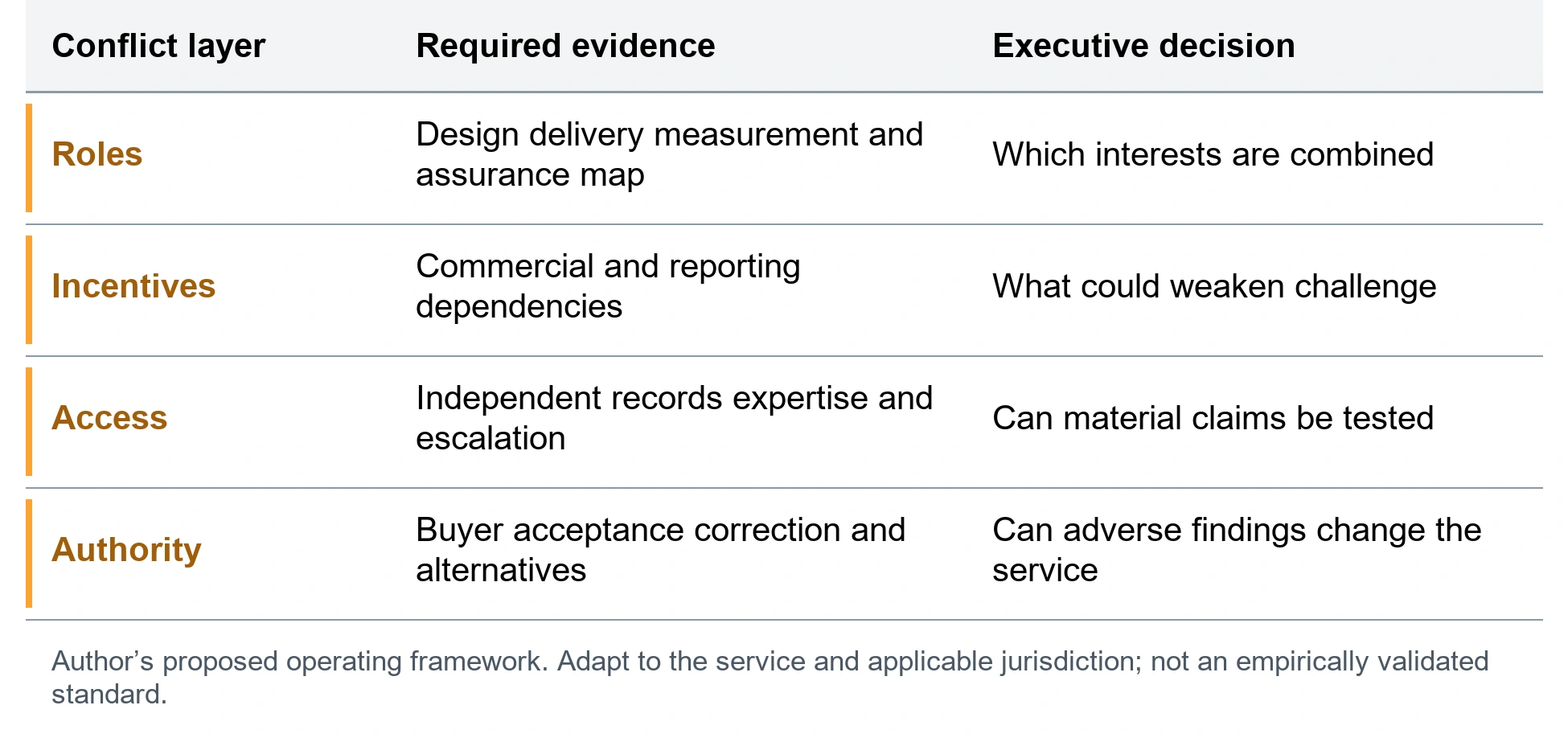
Figure 1 proposes four elements: combined roles, economic interests, evidence access, and decision rights. Record the conflict or dependency, relevant safeguards, residual limitation, and owner. Keep the review proportionate to the consequence of the claim.
Mayer Brown’s provider contracting analysis emphasizes explicit responsibility and authority.3 The buyer should extend that clarity to measurement and assurance. The contract should support evidence access, challenge, correction, and a route outside the delivery chain for material concerns.
Possible safeguards include buyer-owned outcome reconciliation, a reviewer outside the delivery incentive structure, independent specialist work, and direct escalation to the responsible buyer body. Their effectiveness should be demonstrated rather than inferred from a policy statement.
Preserve Local Independence and Accountability Requirements
EU, UK, Swiss, US, and other legal, audit, professional, sector, and procurement requirements can impose specific restrictions or duties. Qualified specialists should establish applicable conclusions. The proposed record is an operating assessment, not a legal determination of independence.
Bundling should not make incident evidence or corrective action contingent on resolving a commercial dispute within the supplier group. Identify who can preserve records, restrict action, and support the buyer’s responsible decision. Keep urgent operating response separate from cost and liability allocation.
Assess transition and concentration. A bundle may create common technology, personnel, knowledge, and contractual dependencies that are difficult to separate. Determine whether the buyer can replace a deficient component or obtain independent review without losing the complete service.
Approve the Bundle with a Credible Challenge Route
A reasonable objection is that separating roles increases cost and weakens coordination. The executive should compare those costs with the consequence of unchallenged material claims. Not every activity requires a separate firm, but important conclusions need a defensible assessment of independence and evidence.
Before commitment, test a disputed outcome or adverse finding through the proposed governance route. Confirm that the reviewer can obtain records, report the limitation, and trigger an appropriate buyer decision. Resolve barriers before the bundle becomes a critical dependency.
The executive should approve bundled delivery when coordination benefits coexist with effective challenge. The buyer remains responsible for understanding what it relies on, who tested it, and where interests or access limitations could weaken the conclusion. A comprehensive offer should not become an unexamined source of its own assurance.
Evidence and Source Note
The study is a nonrepresentative cross-section of 850 vendor delivery-team respondents on 150 engagements serving Tier 1 financial institutions, collected during January–June 2026. Neither banks nor vendors corroborated the accounts. It establishes reported experience, not causation, legal breach, or market prevalence. Its application here is a mechanism to investigate, not an estimate of conditions in other industries. The author-supplied version 1.8.2 is dated November 1, 2026 and is cited as a forthcoming manuscript consulted October 23, 2026.4
This is an analytical decision paper based on the supplied study and selected primary public sources checked through October 23, 2026. The original contribution is a bundled-role challenge record connecting commercial interests, evidence provenance, practical independence, and buyer decision authority. The proposed method has not been independently validated. Legal requirements depend on the entity, activity, jurisdiction, and effective provisions; supervisory observations, research, and professional commentary have distinct authority.
Notes
- Shefali Patil et al., “The Hidden Costs of Outsourcing Judgment to AI Suppliers,” California Management Review Insights, March 10, 2026, discussion of supplier entrenchment; conceptual analysis rather than a measured AI failure rate, https://cmr.berkeley.edu/assets/documents/pdf/2026-03-the-hidden-costs-of-outsourcing-judgment-to-ai-suppliers.pdf. ↩
- Phil Hatch, Agentic AI Outsourcing at Tier 1 Financial Institutions: Full Study Report, version 1.8.2 (Akholi, forthcoming manuscript dated November 1, 2026), Part 5, “The Five Manual Alteration Methods” and “Disclosure of Manual Alteration,” table 5.8, https://doi.org/10.2139/ssrn.7164559; Hatch, Agentic AI Outsourcing, Part 2, sec. 5.1, “Agent Actions Visible Only Inside Each Firm’s Own Tools”. ↩
- Scott F. Young and Jon McPherson, “Contracting Opportunities and Challenges for Emerging Agentic AI Companies,” Mayer Brown, October 13, 2026, provider contracting analysis of authority, data, liability, and service terms, https://www.mayerbrown.com/en/insights/publications/2026/10/contracting-opportunities-and-challenges-for-emerging-agentic-ai-companies. ↩
- Hatch, Agentic AI Outsourcing, Introduction, “Executive Summary” and “Evidentiary Basis and Its Limits”. ↩
Bibliography
- Hatch, Phil. Agentic AI Outsourcing at Tier 1 Financial Institutions: Full Study Report. Version 1.8.2. Akholi. Forthcoming manuscript dated November 1, 2026. Author-supplied manuscript consulted October 23, 2026. https://doi.org/10.2139/ssrn.7164559.
- Patil, Shefali, Tinglong Dai, and Christopher G. Myers. “The Hidden Costs of Outsourcing Judgment to AI Suppliers.” California Management Review Insights. March 10, 2026. https://cmr.berkeley.edu/assets/documents/pdf/2026-03-the-hidden-costs-of-outsourcing-judgment-to-ai-suppliers.pdf.
- Young, Scott F., and Jon McPherson. “Contracting Opportunities and Challenges for Emerging Agentic AI Companies.” Mayer Brown. October 13, 2026. https://www.mayerbrown.com/en/insights/publications/2026/10/contracting-opportunities-and-challenges-for-emerging-agentic-ai-companies.
Explore this subject
Category: Commercial and Vendor Management
Topics: Concentration Risk Independent Audit Supplier Selection
Audience: Buy-side Boards and Executives
Industry: Cross-industry