
Identify the People Who Make the Service Work
The executive should ask which individuals understand the exceptions, corrections, customer context, and recovery methods that keep the agentic service reliable. A high automation claim can coexist with dependence on a small number of experienced staff who resolve the work the agent cannot finish.
McKinsey’s organizational analysis identifies expertise development as an important consequence of changing work.1 It is not a turnover-risk estimate. The executive should establish the actual service dependency before accepting a staffing plan that assumes operational knowledge is already embedded in technology.
Map critical knowledge to the decisions and actions it supports. Include buyer and provider staff, technical administrators, domain specialists, and informal coordinators. An individual is a material dependency when absence prevents an important outcome or control, even if that person is not named as a key resource in the contract.
Distinguish Stored Information from Usable Knowledge
The study describes operational knowledge in personal notes and experienced staff.2 That finding does not prove knowledge loss after turnover. It identifies why documentation should be tested for practical use rather than counted as a completed handover deliverable.
For a hypothetical service, an experienced analyst may know which apparently valid records require further checking and how to resolve an unusual exception. A procedure listing the normal steps may omit that judgment. The buyer should identify the consequential cases the successor must recognize and the authority needed to resolve them.
Agent memory can preserve some context, but it may be incomplete, inaccurate, inaccessible, or subject to rights and retention limits. Do not treat stored conversation history as a complete substitute for qualified interpretation. The service needs an accountable method for maintaining and challenging operational knowledge.
Use a Knowledge Continuity Record
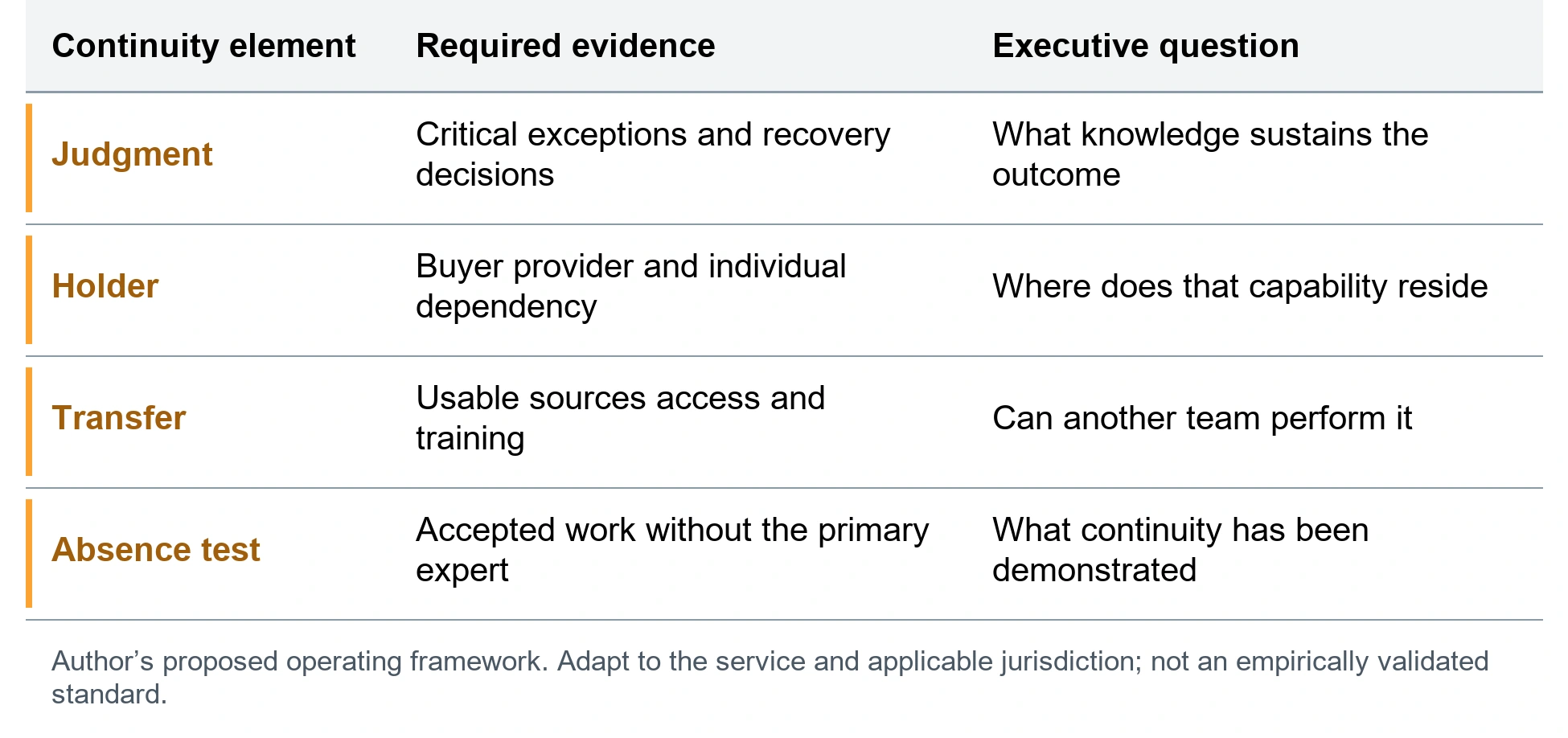
Figure 1 proposes four elements: critical judgment, current holder, demonstrated transfer, and absence test. Record the evidence a successor needs, the approved source, access, and decision authority. Prioritize knowledge whose loss would affect a consequential outcome or recovery capability.
Berkeley’s conceptual analysis highlights the risk of dependence on outsourced judgment.3 The continuity response is to preserve the buyer’s ability to understand and challenge material decisions while ensuring the provider can maintain its delivery expertise. Neither objective requires copying every proprietary technical detail.
Test a representative difficult case with the primary expert unavailable. Ask the replacement team to explain the issue, obtain the right evidence, make or escalate the decision, and verify the result. Record where the team still relies on undocumented personal assistance.
Align Staffing Incentives and Access Controls
Include knowledge transfer, cross-training, succession, and current documentation in the delivery plan and economics. A savings target that removes experienced staff before transfer is demonstrated creates a different risk from an orderly reduction after the new capability is proven.
EU, UK, Swiss, US, and other labor, privacy, secrecy, professional, and sector requirements affect staffing and information sharing. Qualified owners should establish local conditions. Preserve necessary knowledge lawfully and withdraw departing staff access without erasing the records needed for continuity or investigation.
Contract terms should support notice for material staffing changes, transition assistance, and access to relevant service knowledge. A provider may need flexibility to manage its workforce; the buyer needs continuity of capability. Define the outcome and evidence rather than rely only on named-person restrictions.
Approve Staffing Changes Against Demonstrated Capability
A reasonable objection is that every service contains some expert dependence. Prioritize consequences and realistic absence scenarios. The goal is a proportionate continuity capability, with residual dependencies visible, rather than an impossible claim that no individual matters.
Before material staff reduction or transition, require a tested handover and an absence exercise for critical work. Review unresolved knowledge gaps, backup coverage, and the recovery plan. Repeat after major service changes or turnover in key buyer and provider roles.
The executive should approve the staffing model when the necessary judgment survives the people change. An automated workflow is resilient only if the organization can still recognize exceptions, direct the service, and recover when the people who previously made it work are no longer available.
Evidence and Source Note
The study is a nonrepresentative cross-section of 850 vendor delivery-team respondents on 150 engagements serving Tier 1 financial institutions, collected during January–June 2026. Neither banks nor vendors corroborated the accounts. It establishes reported experience, not causation, legal breach, or market prevalence. Its application here is a mechanism to investigate, not an estimate of conditions in other industries. The author-supplied version 1.8.2 is dated November 1, 2026 and is cited as a forthcoming manuscript consulted October 23, 2026.4
This is an analytical decision paper based on the supplied study and selected primary public sources checked through October 23, 2026. The original contribution is a knowledge-continuity record testing whether consequential judgment and recovery capability survive buyer or provider staff turnover. The proposed method has not been independently validated. Legal requirements depend on the entity, activity, jurisdiction, and effective provisions; supervisory observations, research, and professional commentary have distinct authority.
Notes
- McKinsey & Company, “AI Is Changing Work. Now It Has to Change the Organization,” McKinsey & Company, October 5, 2026, “Operating model,” “Talent,” and “Enabling AI reinvention”, https://www.mckinsey.com/capabilities/people-and-organization/our-insights/ai-is-changing-work-now-it-has-to-change-the-organization. ↩
- Phil Hatch, Agentic AI Outsourcing at Tier 1 Financial Institutions: Full Study Report, version 1.8.2 (Akholi, forthcoming manuscript dated November 1, 2026), Part 4, “Knowledge at Risk of Departure”, https://doi.org/10.2139/ssrn.7164559. ↩
- Shefali Patil et al., “The Hidden Costs of Outsourcing Judgment to AI Suppliers,” California Management Review Insights, March 10, 2026, discussion of supplier entrenchment; conceptual analysis rather than a measured AI failure rate, https://cmr.berkeley.edu/assets/documents/pdf/2026-03-the-hidden-costs-of-outsourcing-judgment-to-ai-suppliers.pdf. ↩
- Hatch, Agentic AI Outsourcing, Introduction, “Executive Summary” and “Evidentiary Basis and Its Limits”. ↩
Bibliography
- Hatch, Phil. Agentic AI Outsourcing at Tier 1 Financial Institutions: Full Study Report. Version 1.8.2. Akholi. Forthcoming manuscript dated November 1, 2026. Author-supplied manuscript consulted October 23, 2026. https://doi.org/10.2139/ssrn.7164559.
- McKinsey & Company. “AI Is Changing Work. Now It Has to Change the Organization.” McKinsey & Company. October 5, 2026. https://www.mckinsey.com/capabilities/people-and-organization/our-insights/ai-is-changing-work-now-it-has-to-change-the-organization.
- Patil, Shefali, Tinglong Dai, and Christopher G. Myers. “The Hidden Costs of Outsourcing Judgment to AI Suppliers.” California Management Review Insights. March 10, 2026. https://cmr.berkeley.edu/assets/documents/pdf/2026-03-the-hidden-costs-of-outsourcing-judgment-to-ai-suppliers.pdf.
Explore this subject
Category: People and Capability
Topics: Retained Capability Service Continuity Workforce Continuity
Audience: Buy-side Boards and Executives
Industry: Cross-industry