
Retain the Capability Behind Accountability
The executive should identify which judgments the buyer must continue to make after outsourcing. These include defining a useful result, interpreting exceptions, assessing provider explanations, accepting change, and deciding when the service should stop. Accountability requires practical capability to perform those judgments.
Berkeley’s conceptual analysis warns that outsourcing judgment can create dependence on the supplier’s own framing.1 It does not measure agentic failure rates. The relevant executive question is whether the buyer can form an informed view that is not wholly dependent on the provider’s interpretation.
Begin with the consequential decisions in the service. Identify the retained roles, knowledge, records, and authority needed to challenge each. A small qualified team can preserve control, but a nominal owner without time, access, or expertise cannot.
Find Where Delivery Knowledge Has Moved
The study describes operational knowledge held in personal notes and experienced staff.2 It does not prove a future loss of buyer capability. It identifies why the executive should understand where the knowledge needed to govern and recover the service resides.
For a hypothetical service, the provider may become the only party able to explain why cases are excluded or how exceptions are resolved. The buyer should preserve the business rules, decision rationale, material case history, and operating dependencies needed to evaluate the result without duplicating every technical task.
Distinguish proprietary implementation from knowledge the buyer needs to meet its responsibilities. A provider can protect confidential technology while supplying adequate evidence and explanation. Where the boundary prevents meaningful challenge, make the limitation explicit in the sourcing decision.
Use a Retained Judgment Record
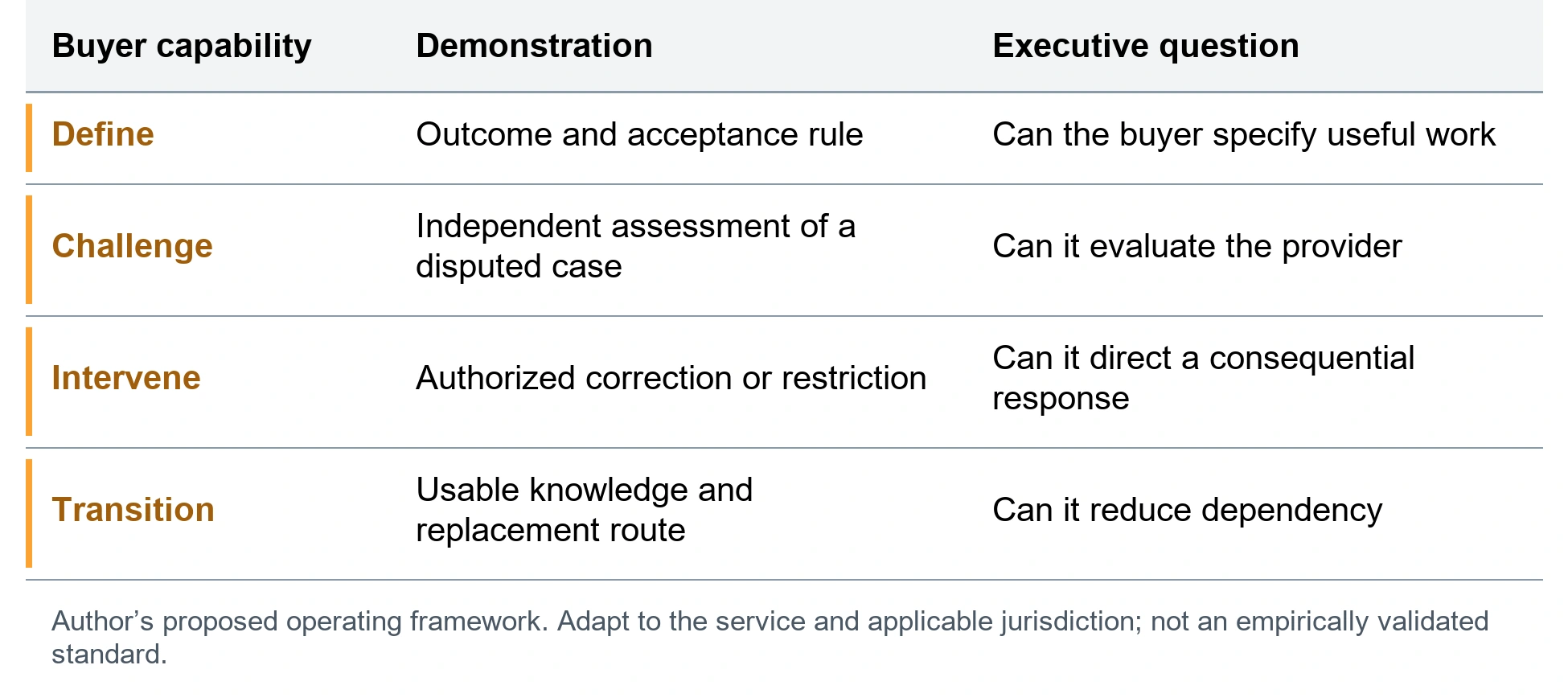
Figure 1 proposes four capabilities: define, challenge, intervene, and transition. For each material service, identify who can perform the capability and demonstrate it through a real or controlled case. Record dependencies on individuals or provider assistance.
The retained team should be able to compare supplier claims with authoritative outcomes and recognize when additional expertise is needed. It need not reproduce every model computation. Its task is to assess whether the purchased function is useful, permitted, complete, and sufficiently supported by evidence.
Stanford’s deployment playbook emphasizes complementary skills and organizational changes around useful AI.3 Its selected cases do not establish a universal retained-team design. The buyer should determine the capability needed for its own operating model and consequences.
Fund Control as Part of the Business Case
Include retained expertise, training, evidence access, and periodic challenge exercises in the functional cost baseline. If the savings case removes all of that capability, the executive should understand the resulting dependency. A lower supplier charge can come with a higher cost of directing or replacing the service.
EU, UK, Swiss, US, and other regulated activities may require particular qualifications, oversight, records, or retained responsibilities. Establish the applicable conclusions before delegating decisions. A supplier’s competence does not automatically remove the buyer’s need for qualified judgment.
Use contract terms to support knowledge transfer, explainability appropriate to the task, record access, and transition. Test whether those rights can be exercised with the actual people and systems. A broad right to receive documentation is weaker than a demonstrated ability to operate with it.
Test Independence Through a Consequential Case
A reasonable objection is that retaining expertise duplicates the provider. The buyer should preserve the capacity to govern outcomes rather than recreate the entire delivery organization. Separate routine execution from the judgments necessary to direct, challenge, and recover the service.
Ask the retained team to assess a disputed case, challenge the provider’s explanation, authorize a correction, and explain a feasible continuity route. Identify where the team cannot proceed without unexamined supplier assertions. Fund the most consequential gaps and test again.
The executive should approve a delivery model in which the buyer remains an informed principal. Outsourcing can expand capability, but control becomes fragile when the organization loses the judgment needed to know what it has purchased, whether it is working, and when it must change.
Evidence and Source Note
The study is a nonrepresentative cross-section of 850 vendor delivery-team respondents on 150 engagements serving Tier 1 financial institutions, collected during January–June 2026. Neither banks nor vendors corroborated the accounts. It establishes reported experience, not causation, legal breach, or market prevalence. Its application here is a mechanism to investigate, not an estimate of conditions in other industries. The author-supplied version 1.8.2 is dated November 1, 2026 and is cited as a forthcoming manuscript consulted October 23, 2026.4
This is an analytical decision paper based on the supplied study and selected primary public sources checked through October 23, 2026. The original contribution is a retained-judgment capability record distinguishing buyer accountability from the practical expertise and evidence needed to exercise it. The proposed method has not been independently validated. Legal requirements depend on the entity, activity, jurisdiction, and effective provisions; supervisory observations, research, and professional commentary have distinct authority.
Notes
- Shefali Patil et al., “The Hidden Costs of Outsourcing Judgment to AI Suppliers,” California Management Review Insights, March 10, 2026, discussion of supplier entrenchment; conceptual analysis rather than a measured AI failure rate, https://cmr.berkeley.edu/assets/documents/pdf/2026-03-the-hidden-costs-of-outsourcing-judgment-to-ai-suppliers.pdf. ↩
- Phil Hatch, Agentic AI Outsourcing at Tier 1 Financial Institutions: Full Study Report, version 1.8.2 (Akholi, forthcoming manuscript dated November 1, 2026), Part 4, “Knowledge at Risk of Departure”, https://doi.org/10.2139/ssrn.7164559. ↩
- Elisa Pereira et al., The Enterprise AI Playbook: Lessons from 51 Successful Deployments, Stanford Digital Economy Lab, April 2026, methodology and chapters 1–3 and 8; purposive successful-case sample, https://digitaleconomy.stanford.edu/app/uploads/2026/03/EnterpriseAIPlaybook_PereiraGraylinBrynjolfsson.pdf. ↩
- Hatch, Agentic AI Outsourcing, Introduction, “Executive Summary” and “Evidentiary Basis and Its Limits”. ↩
Bibliography
- Hatch, Phil. Agentic AI Outsourcing at Tier 1 Financial Institutions: Full Study Report. Version 1.8.2. Akholi. Forthcoming manuscript dated November 1, 2026. Author-supplied manuscript consulted October 23, 2026. https://doi.org/10.2139/ssrn.7164559.
- Patil, Shefali, Tinglong Dai, and Christopher G. Myers. “The Hidden Costs of Outsourcing Judgment to AI Suppliers.” California Management Review Insights. March 10, 2026. https://cmr.berkeley.edu/assets/documents/pdf/2026-03-the-hidden-costs-of-outsourcing-judgment-to-ai-suppliers.pdf.
- Pereira, Elisa, Alvin Wang Graylin, and Erik Brynjolfsson. The Enterprise AI Playbook: Lessons from 51 Successful Deployments. Stanford Digital Economy Lab. April 2026. https://digitaleconomy.stanford.edu/app/uploads/2026/03/EnterpriseAIPlaybook_PereiraGraylinBrynjolfsson.pdf.
Explore this subject
Category: People and Capability
Topics: Domain Judgment Retained Capability Sourcing Strategy
Audience: Buy-side Boards and Executives
Industry: Cross-industry