
Identify the Work the Fallback Must Carry
The delivery manager should ask what work must continue when the agentic service is stopped or unavailable. Specify priority cases, minimum service, deadlines, and the volume that can be deferred. A promise to revert to manual processing is incomplete until the parties identify who will do the work and with what resources.
The FCA’s practice review emphasizes tested fallbacks and exit capability for AI-supported financial services.1 Outside that sector, it supplies a mechanism to consider rather than a new obligation. The manager’s test is whether the fallback works in the particular service and failure scenario.
Separate short interruption from sustained outage. A small expert team may handle a few urgent cases but not the normal daily volume. The plan should state the demonstrated capacity and the decisions needed when demand exceeds it, including customer communication and controlled suspension of lower-priority work.
Reconcile the Fallback with the Savings Plan
The study reports risks to operational knowledge and delivery processes not redesigned for agentic work.2 Those reports do not establish a fallback failure rate. They identify why headcount reduction and recovery assumptions should be reviewed together.
For a hypothetical service, a business case may remove the team that previously handled exceptions while a continuity plan still lists that team as the manual backup. The manager should reconcile the two documents before approving the change. The fallback cost belongs in the service economics.
Check named personnel, qualifications, current instructions, data access, tool access, working hours, and decision authority. Include the buyer’s role. A provider operator who can prepare a case may still need a buyer specialist to approve the consequential action.
Use a Fallback Capacity Record
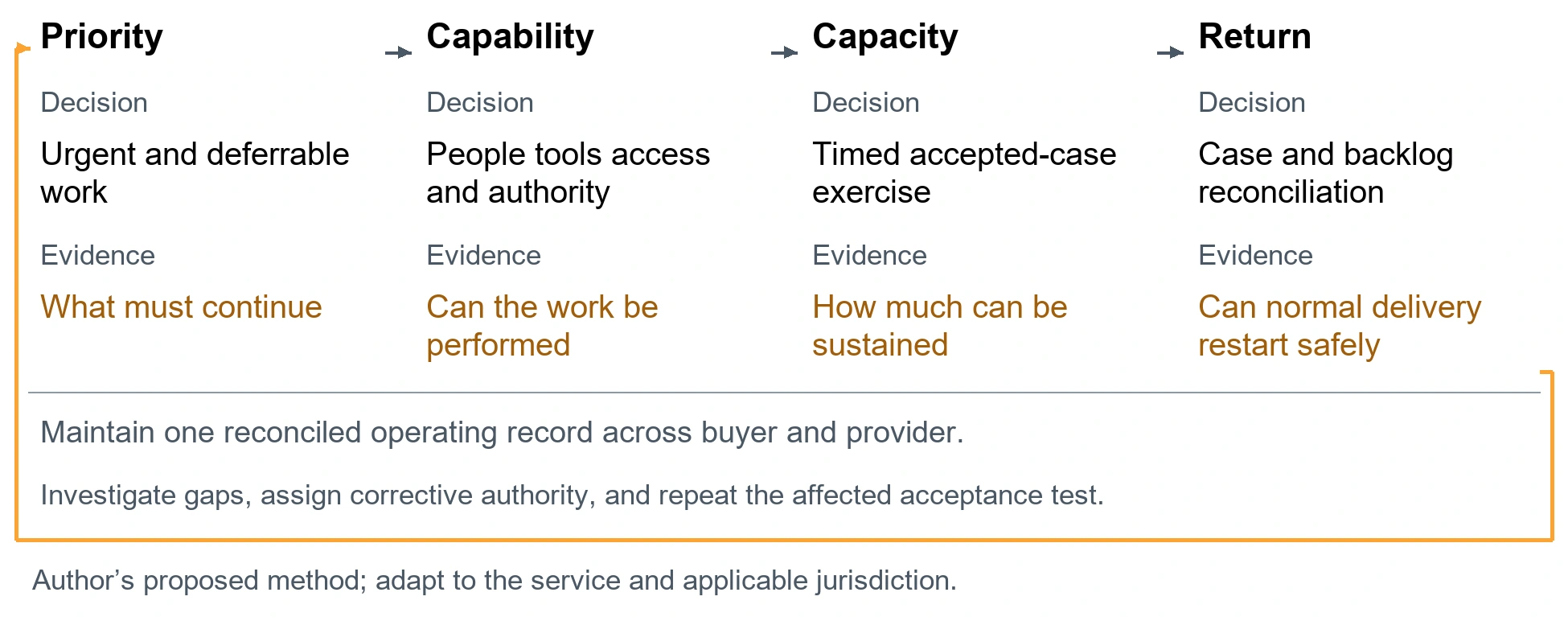
Figure 1 proposes four decisions: prioritize the work, preserve the capability, demonstrate throughput, and reconcile return to automation. Measure accepted cases rather than attempted cases. Record the conditions under which capacity was demonstrated and which assumptions may fail during a wider incident.
A useful exercise includes incomplete work already in flight. The team should identify what was attempted, what completed, and what remains unsafe to repeat. Manual fallback can create duplicate or contradictory actions if it begins from a clean queue while the interrupted agent has already changed external systems.
Allied operational-resilience guidance highlights the need for human intervention and recoverable operation around AI.3 Apply that principle to the actual workflow. The manager needs an operating method that qualified staff can execute without depending on the unavailable component.
Retain a Proportionate Capability
A fully duplicated manual workforce may be uneconomic. Compare restricted service, deferred work, cross-trained staff, a separate provider, and selective manual recovery. Choose an option against the consequences and duration of interruption. State the remaining shortfall rather than imply full continuity.
EU, UK, Swiss, US, and other services may impose different continuity, safety, professional, labor, or recordkeeping duties. Qualified owners should establish what can be deferred or restricted. A commercial recovery target does not authorize unsafe work or waive an affected customer’s rights.
Maintain capability through scheduled practice and current access. Knowledge and permissions decay when unused. Model or workflow changes should trigger review of the manual instructions, and staff turnover should trigger reassessment of the fallback roster rather than leave an obsolete name in the plan.
Test the Route Back to Normal Delivery
A reasonable objection is that manual recovery undermines the purpose of automation. Its role is to cover a defined residual exposure, not to reproduce every automated task indefinitely. The manager should fund the minimum credible capability that supports the accepted continuity decision.
After an exercise, reconcile manually completed cases, deferred work, corrections, and records before restarting the agentic route. Identify who accepts the backlog and who confirms that repeated execution will not duplicate consequential actions. Recovery is incomplete until the two operating modes agree on the service state.
Accept the fallback only when the people, tools, authority, and demonstrated capacity exist. If the automation deal removes them, revise the recovery decision and its economics. A plan that depends on capability already eliminated is an unrecognized service restriction, not a functioning continuity measure.
Evidence and Source Note
The study is a nonrepresentative cross-section of 850 vendor delivery-team respondents on 150 engagements serving Tier 1 financial institutions, collected during January–June 2026. Neither banks nor vendors corroborated the accounts. It establishes reported experience, not causation, legal breach, or market prevalence. Its application here is a mechanism to investigate, not an estimate of conditions in other industries. The author-supplied version 1.8.2 is dated November 1, 2026 and is cited as a forthcoming manuscript consulted October 23, 2026.4
This is an analytical decision paper based on the supplied study and selected primary public sources checked through October 23, 2026. The original contribution is a fallback-capacity record reconciling automation savings, retained expertise, actual recovery throughput, and safe return to automated operation. The proposed method has not been independently validated. Legal requirements depend on the entity, activity, jurisdiction, and effective provisions; supervisory observations, research, and professional commentary have distinct authority.
Notes
- Financial Conduct Authority, “AI in Financial Services: Good Practice and Areas for Improvement,” Financial Conduct Authority, October 19, 2026; updated October 20, 2026, secs. 1.2, 2, 3.4 and 4.2; illustrative practices, not new requirements, https://www.fca.org.uk/publications/good-poor-practice/ai-financial-services. ↩
- Phil Hatch, Agentic AI Outsourcing at Tier 1 Financial Institutions: Full Study Report, version 1.8.2 (Akholi, forthcoming manuscript dated November 1, 2026), Part 4, “Knowledge at Risk of Departure”, https://doi.org/10.2139/ssrn.7164559; Hatch, Agentic AI Outsourcing, Part 2, “The Shift From Managing People to Managing Agents”; Part 6, “The Executive Action Plan”. ↩
- Australian Signals Directorate’s Australian Cyber Security Centre et al., Careful Adoption of Agentic AI Services (Australian Signals Directorate, May 1, 2026), “Manage third-party components,” “Identity management,” “Resilience,” and “Human in the loop”, https://www.cyber.gov.au/publication/careful-adoption-of-agentic-ai-services. ↩
- Hatch, Agentic AI Outsourcing, Introduction, “Executive Summary” and “Evidentiary Basis and Its Limits”. ↩
Bibliography
- Australian Signals Directorate’s Australian Cyber Security Centre et al.. Careful Adoption of Agentic AI Services. Australian Signals Directorate, May 1, 2026. https://www.cyber.gov.au/publication/careful-adoption-of-agentic-ai-services.
- Financial Conduct Authority. “AI in Financial Services: Good Practice and Areas for Improvement.” Financial Conduct Authority. October 19, 2026; updated October 20, 2026. https://www.fca.org.uk/publications/good-poor-practice/ai-financial-services.
- Hatch, Phil. Agentic AI Outsourcing at Tier 1 Financial Institutions: Full Study Report. Version 1.8.2. Akholi. Forthcoming manuscript dated November 1, 2026. Author-supplied manuscript consulted October 23, 2026. https://doi.org/10.2139/ssrn.7164559.
Explore this subject
Category: Resilience and Exit
Topics: Contract Design Service Continuity Workforce Continuity
Audience: Buy-side Delivery and Vendor Managers
Industry: Cross-industry