
Define the Promise Before Negotiating the Cap
A provider selling autonomous execution should specify which actions it undertakes to perform and the conditions under which that promise holds. Liability negotiations become incoherent when the proposal promises completed business outcomes while the contract disclaims responsibility for every consequential action. Commercial leaders should resolve that contradiction before fixing price.
The relevant question is which failures the provider can prevent, detect, contain, or repair, and which dependencies require buyer action. A provider can accept meaningful responsibility for its configuration, access enforcement, change control, and recovery work without guaranteeing every external business result. Those distinctions need operational definitions and supporting evidence.
Mayer Brown’s integration-contract analysis treats liability, performance dependencies, and upstream indemnity gaps as separate negotiation issues. The analysis concerns integration deals; an outsourced managed service may require different provisions. Its useful lesson is to align the commercial structure with who controls the work and its prerequisites.1
Build Responsibility Around Loss Scenarios
Use a small set of material scenarios rather than a general statement that AI is uncertain. In a hypothetical order-management service, an agent could place the wrong order, repeat a submission, expose customer data, or fail to process a time-sensitive instruction. Each event has different prevention, evidence, and recovery requirements.
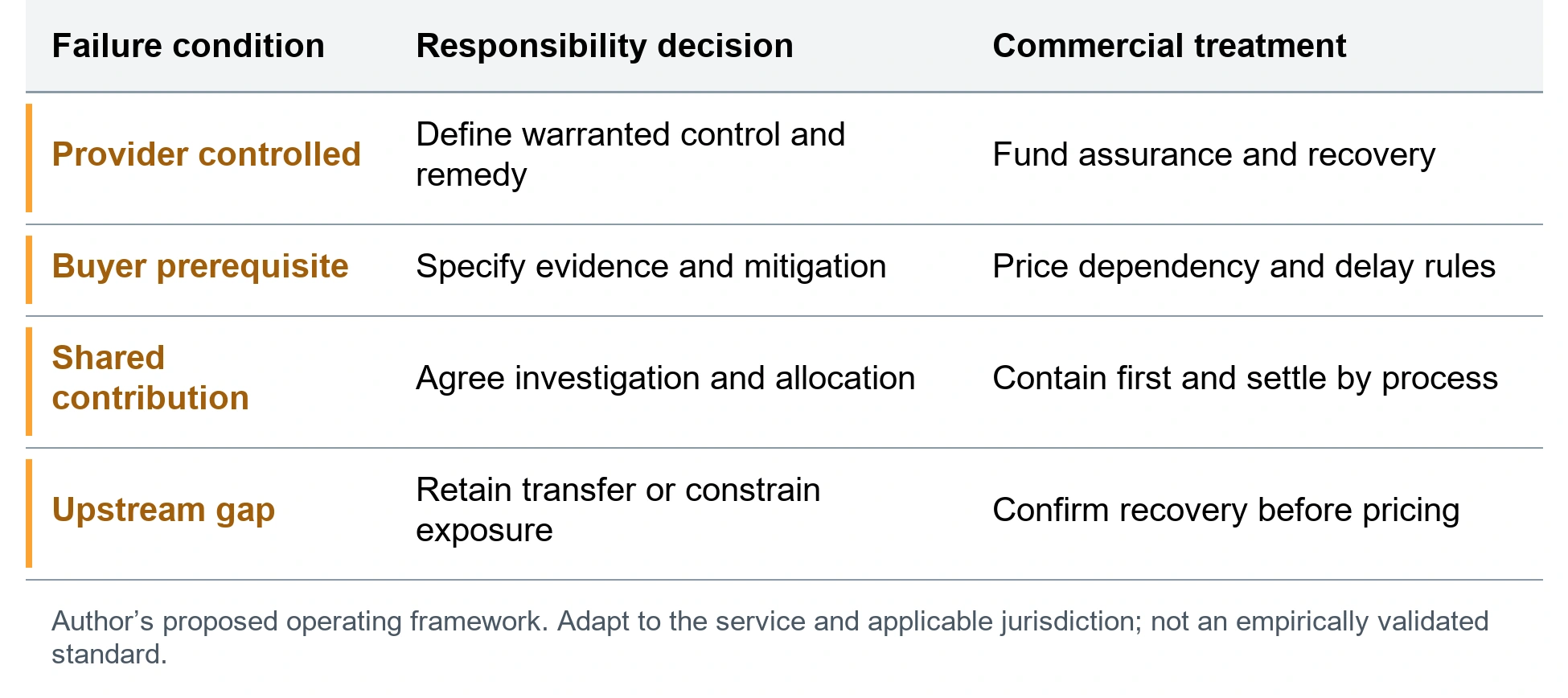
For each scenario, identify the authorized action, the condition that failed, the party controlling that condition, and the response needed. Separate a provider configuration defect from an inaccurate buyer instruction or an unavailable external system. Shared contribution should trigger a defined investigation and allocation process, not an assumption that one party caused the entire loss.
The study’s reports of manual correction show why a provider should understand its real delivery method before accepting a price or warranty. Unrecorded human effort can make an apparently autonomous service depend on staff intervention that the contract and operating budget do not recognize. The study does not establish contractual liability.2
Price the Duties That Make the Promise Credible
Figure 1 links responsibility to commercial treatment. The provider should price normal operation, assurance, and agreed recovery capacity explicitly. Emergency cooperation should begin under the incident plan while allocation is investigated, with a defined process for settling disputed charges. Delaying containment until fault is agreed can increase both parties’ exposure.
Buyer prerequisites need measurable definitions. If the provider relies on timely approval, clean reference data, or a particular access configuration, the agreement should say how nonperformance is identified, communicated, and mitigated. A dependency clause should not excuse unrelated provider failures or allow a minor buyer delay to invalidate the entire service promise.
The provider should also examine upstream limits. A model supplier may provide narrow remedies while the provider sells a broader business service. Passing through upstream terms may leave the buyer without the recovery the proposal implies. The commercial decision is to absorb, insure, constrain, or renegotiate that gap before the service begins.
Distinguish Service Credits from Loss Allocation
Service credits compensate according to an agreed service mechanism; they may be inadequate for a harmful unauthorized action. The parties should decide whether credits are exclusive for specific failures, how they interact with damages and indemnities, and which obligations continue despite a dispute. Counsel should test the complete clause structure under the governing law.
Clifford Chance identifies gaps between agent actions and legacy technology-contract remedies, including narrow third-party indemnities and exclusions. The consulted PDF is dated January 21, 2026, although its web publication is later. Its analysis supports reviewing actual wording rather than assuming a general technology cap covers the intended exposure.3
Providers should avoid promising that insurance will fill every gap. Coverage depends on the policy, insured activity, exclusions, conditions, available limits, and applicable law. Obtain a scenario-specific coverage analysis with the broker or insurer and legal team. Any unconfirmed recovery should remain outside the service’s economic justification.
Sell Evidence of Control and Recovery
The provider’s proposal should include an authority schedule, dependency record, test scope, intervention reporting, and recovery commitments. These are commercial deliverables because they explain what the buyer is purchasing. They also give the provider a basis for refusing unpriced expansion of autonomy, data use, or consequential action.
Deal leaders should test a combined-cause scenario before signature. Suppose the buyer supplies an incorrect reference and the provider ignores a configured validation failure. The contract should permit immediate correction and preserve evidence while the parties assess their respective contributions. Pricing should fund the agreed response even though final allocation is uncertain. This avoids a false choice between accepting every downstream loss and disclaiming responsibility for a control that the provider sold and operated.
A responsibility review should consider EU, UK, Swiss, and other relevant service locations and customer obligations. Governing law, regulatory duties, data rights, and enforceability can point to different results. Use local legal advice for the transaction while keeping the operational description consistent across the deal documents.
Where the buyer will not fund the controls required for a consequential service, the provider should offer a narrower design. That might mean recommendation-only operation, restricted transaction values, or a smaller set of tools. A lower-authority service with a credible recovery promise can be more defensible than an unlimited autonomy claim.
Approve a Commercial Position That Operations Can Deliver
Before signature, the provider’s commercial, legal, risk, and delivery leaders should approve the same responsibility matrix. The sign-off should identify retained losses, priced duties, excluded authority, unresolved dependencies, and the evidence supporting the service promise. Material runtime changes should reopen that approval.
The purpose is a service that can be explained when a failure occurs: what was promised, who controlled the failed condition, what evidence exists, and how recovery proceeds. Pricing accountability at the outset protects the credibility of the offer and gives both parties a workable basis for managing consequential agent actions.
Evidence and Source Note
The study is a nonrepresentative cross-section of 850 vendor delivery-team respondents on 150 engagements serving Tier 1 financial institutions, collected during January–June 2026. Neither banks nor vendors corroborated the accounts. It establishes reported experience, not causation, legal breach, or market prevalence. Its application here is a mechanism to investigate, not an estimate of conditions in other industries. The author-supplied version 1.8.2 is dated November 1, 2026 and is cited as a forthcoming manuscript consulted October 23, 2026.4
This is an analytical decision paper based on the supplied study and selected primary public sources checked through October 23, 2026. The original contribution is a provider responsibility and pricing matrix organized around controllable conditions and recovery obligations. The proposed method has not been independently validated. Legal requirements depend on the entity, activity, jurisdiction, and effective provisions; supervisory observations, research, and professional commentary have distinct authority.
Notes
- Rohith P. George et al., “Key Contract Issues in Agentic AI Implementation and Integration Deals,” Mayer Brown, June 16, 2026, “Liability,” “Performance commitments and dependencies,” and “Exit and transition”, https://www.mayerbrown.com/en/insights/publications/2026/06/key-contract-issues-in-agentic-ai-implementation-and-integration-deals. ↩
- Phil Hatch, Agentic AI Outsourcing at Tier 1 Financial Institutions: Full Study Report, version 1.8.2 (Akholi, forthcoming manuscript dated November 1, 2026), Part 5, “Five Manual Alteration Methods” and “Disclosure of Manual Alteration,” table 5.8, https://doi.org/10.2139/ssrn.7164559. ↩
- Clifford Chance, Agentic AI: The Liability Gap Your Contracts May Not Cover (Clifford Chance, January 21, 2026), pp. 1–4; date printed in the consulted PDF, https://www.cliffordchance.com/content/dam/cliffordchance/briefings/2026/02/agentic-ai-theliability-gap-your-contracts-may-not-cover.pdf. ↩
- Hatch, Agentic AI Outsourcing, Introduction, “Executive Summary” and “Evidentiary Basis and Its Limits”. ↩
Bibliography
- Clifford Chance. Agentic AI: The Liability Gap Your Contracts May Not Cover. Clifford Chance, January 21, 2026. https://www.cliffordchance.com/content/dam/cliffordchance/briefings/2026/02/agentic-ai-theliability-gap-your-contracts-may-not-cover.pdf.
- George, Rohith P., Veronica R. Glick, Arsen Kourinian, et al.. “Key Contract Issues in Agentic AI Implementation and Integration Deals.” Mayer Brown. June 16, 2026. https://www.mayerbrown.com/en/insights/publications/2026/06/key-contract-issues-in-agentic-ai-implementation-and-integration-deals.
- Hatch, Phil. Agentic AI Outsourcing at Tier 1 Financial Institutions: Full Study Report. Version 1.8.2. Akholi. Forthcoming manuscript dated November 1, 2026. Author-supplied manuscript consulted October 23, 2026. https://doi.org/10.2139/ssrn.7164559.
Explore this subject
Category: Commercial and Vendor Management
Topics: Contract Design Liability and Insurance Supplier Viability
Audience: Service Providers
Industry: Cross-industry