
Map the Actual Use Before Asking Whether It Is Licensed
The manager should describe which data an agent retrieves, where it processes and stores it, which parties receive it, and how outputs are used. A human user’s entitlement or an available API should not be assumed to authorize every provider workflow.
London Stock Exchange lists current 2026 data agreements separately from future 2027 agreements.1 The manager should identify the agreement and effective policy that govern the use. A future document should not be represented as already controlling the current service.
For a hypothetical research agent, data may move from a buyer subscription into a provider orchestrator, model context, logs, memory, and client-facing output. Each material use and recipient should be evaluated against the relevant contract and policy rather than covered by one general statement that the bank owns its data.
Separate Technical Access from Contractual Permission
LSEG describes a connector giving agents structured access to licensed content.2 That product description does not establish permission for every customer use or downstream recipient. The bank should assess its own entitlements, agreements, and approved configuration.
The study reports downstream dependency and access difficulties in banking delivery.3 It does not establish market-data license breaches. The transferable issue is whether the bank knows which parties and tools use the content and can control that use.
Ask legal and data-licensing specialists to assess relevant categories such as non-display use, redistribution, derived data, service-provider access, retention, and model training where the agreement uses them. Do not assume those terms have identical meanings across exchanges and data vendors.
Use a Market Data Permission Record
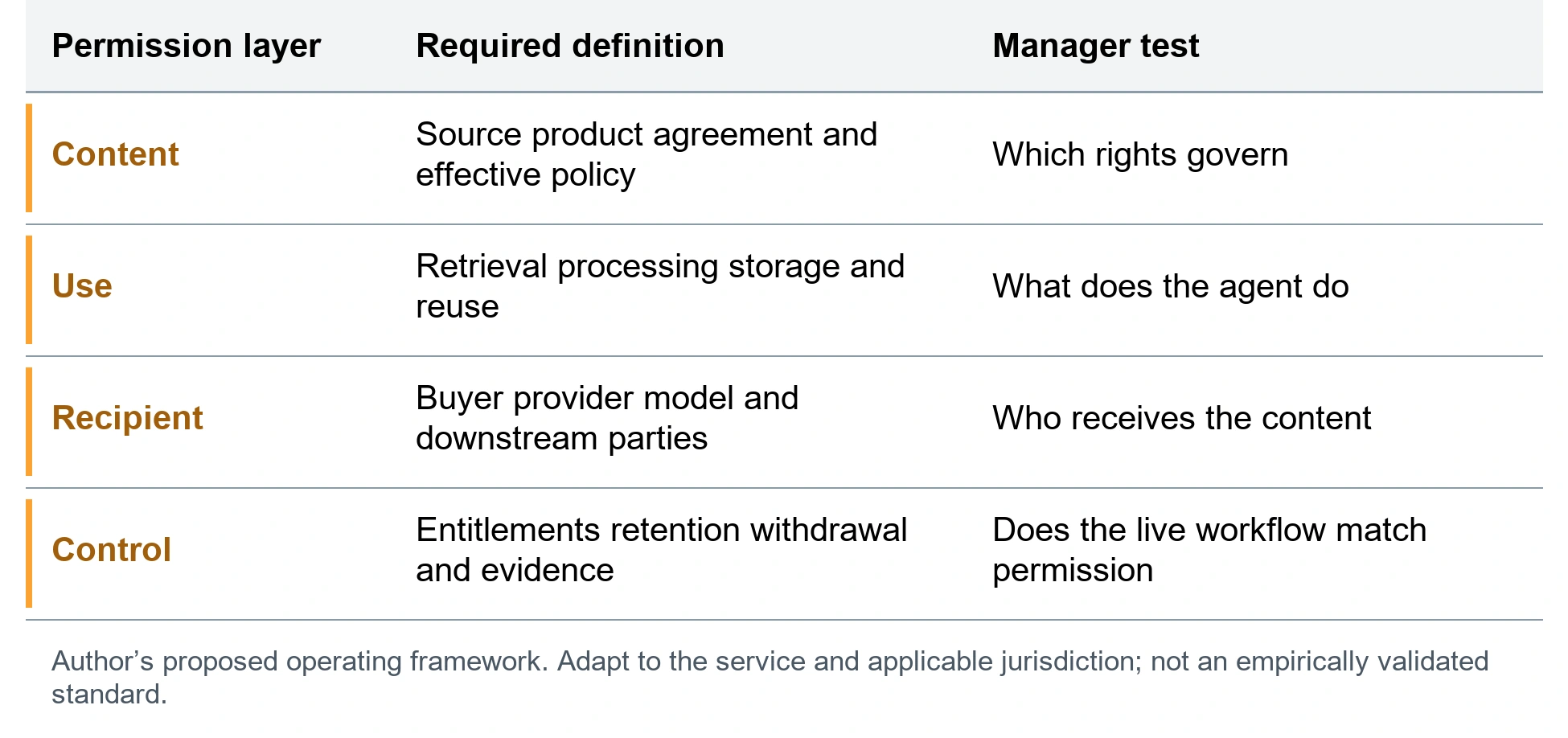
Figure 1 proposes four links: content, use, recipient, and control. Record the governing agreement, effective date, permitted purpose, restrictions, responsible owner, and evidence of implementation. Mark unresolved interpretation rather than treating silence as permission.
Include prompts, retrieved snippets, cached data, embeddings, logs, outputs, and support access where relevant. Determine whether the material remains subject to contractual conditions after transformation. A new technical representation does not automatically remove the rights attached to the source content.
Test the actual workflow against approved entitlements. Verify access restrictions, retention, onward disclosure, and withdrawal. The agent should not reach unapproved content through a different tool or shared credential after the intended route denies access.
Maintain Permissions Through Change and Exit
EU, UK, Swiss, US, and other operations may combine different exchange agreements, confidentiality duties, privacy rules, and financial-services obligations. Qualified specialists should establish the applicable conclusions. A group-wide technology design should preserve material contract and entity distinctions.
New models, tools, provider locations, recipients, or reuse purposes should trigger reassessment. A workflow approved for internal research may need a different conclusion when used to produce client material or train a shared model. Keep the permission record linked to the accepted service configuration.
At exit, determine what may be returned, retained, transferred, or deleted, including backups and derived artifacts. A buyer’s transition right cannot grant a successor permission held only by another party. Resolve the required license or substitute before depending on portability.
Authorize the Workflow the Rights Support
A reasonable objection is that detailed mapping slows access to useful data. Prioritize material sources and consequential uses, use approved patterns, and obtain vendor clarification where needed. An unresolved material permission should shape a bounded scope rather than an unrestricted deployment.
Before production, reconcile the data-flow map, license conclusions, receiving parties, technical controls, and retention settings. Ask the provider to demonstrate the approved route and a denied use. Record limitations and an owner for future policy changes.
The manager should approve permissioned use across the full agentic chain. Connectivity makes content reachable; the governing rights determine how it may be used. Keeping those facts connected protects the bank’s service, commercial position, and ability to change providers.
Evidence and Source Note
The study is a nonrepresentative cross-section of 850 vendor delivery-team respondents on 150 engagements serving Tier 1 financial institutions, collected during January–June 2026. Neither banks nor vendors corroborated the accounts. It establishes reported experience, not causation, legal breach, or market prevalence. The author-supplied version 1.8.2 is dated November 1, 2026 and is cited as a forthcoming manuscript consulted October 23, 2026.4
This is an analytical decision paper based on the supplied study and selected primary public sources checked through October 23, 2026. The original contribution is a market-data permission record connecting licensed content to agent uses, downstream recipients, technical enforcement, and transition. The proposed method has not been independently validated. Legal requirements depend on the entity, activity, jurisdiction, and effective provisions; supervisory observations, research, and professional commentary have distinct authority.
Notes
- London Stock Exchange, “Pricing and Policies,” London Stock Exchange, accessed October 23, 2026, current 2026 agreements effective August 1; future 2027 agreements listed separately, https://www.londonstockexchange.com/en/markets-products/market-data/pricing-and-policies. ↩
- Emily Prince, “The Hidden Economics of AI Agents—and How LSEG’s MCP Connector Helps Improve Token Efficiency,” LSEG, July 17, 2026, licensed content, permissioned access, and customer-controlled agent workflow, https://www.lseg.com/en/about-us/new-at-lseg/the-hidden-economics-of-ai-agents-and-how-lsegs-mcp-connector-helps-improve-token-efficiency. ↩
- Phil Hatch, Agentic AI Outsourcing at Tier 1 Financial Institutions: Full Study Report, version 1.8.2 (Akholi, forthcoming manuscript dated November 1, 2026), Part 3, Third-Party Ecosystem, sec. 6.1, “Mapping of Third and Fourth Party Dependencies,” indicator C196, https://doi.org/10.2139/ssrn.7164559; Hatch, Agentic AI Outsourcing, Part 3, Financial Institution Readiness, sec. 4.1, “Ability to Provision Access and Identities for Agents,” indicator C108. ↩
- Hatch, Agentic AI Outsourcing, Introduction, “Executive Summary” and “Evidentiary Basis and Its Limits”. ↩
Bibliography
- Hatch, Phil. Agentic AI Outsourcing at Tier 1 Financial Institutions: Full Study Report. Version 1.8.2. Akholi. Forthcoming manuscript dated November 1, 2026. Author-supplied manuscript consulted October 23, 2026. https://doi.org/10.2139/ssrn.7164559.
- London Stock Exchange. “Pricing and Policies.” London Stock Exchange. Accessed October 23, 2026. https://www.londonstockexchange.com/en/markets-products/market-data/pricing-and-policies.
- Prince, Emily. “The Hidden Economics of AI Agents—and How LSEG’s MCP Connector Helps Improve Token Efficiency.” LSEG. July 17, 2026. https://www.lseg.com/en/about-us/new-at-lseg/the-hidden-economics-of-ai-agents-and-how-lsegs-mcp-connector-helps-improve-token-efficiency.
Explore this subject
Category: Data, Technology, and Security
Topics: Architecture and Dependencies Contract Design Data Licensing
Audience: Buy-side Delivery and Vendor Managers
Industry: Banking Capital Markets Financial Services