
Approve a Service That Can Continue
The board should require management to demonstrate how a critical outsourced service continues when its agentic delivery route fails. Restoring a platform and continuing a banking function are different outcomes. The bank needs a defined minimum service, a tolerable period of disruption, and a feasible route for handling the work that cannot wait.
The BIS third-party-risk summary includes continuity and exit within the bank’s management responsibilities.1 For agentic delivery, the practical question is whether the assumed replacement mode has survived the automation decision. A manual procedure is not capacity if the trained staff, current records, or system access are no longer available.
Select a critical business service and specify the outage being tested. Loss of a model, provider operating team, identity service, cloud region, or shared platform creates different constraints. A successful exercise for one condition should not be presented as proof that the service can withstand every provider failure.
Find the Work Hidden by the Normal Service
The study’s workforce accounts describe operational knowledge held in personal notes and experienced staff. They do not measure the capacity remaining after a future outage or establish that critical knowledge holders subsequently left.2 Management should use those accounts to question whether its own continuity plan depends on people whose availability has never been confirmed.
The provider should identify the interventions that keep normal delivery working: repairing inputs, resolving access failures, correcting outputs, interpreting exceptions, and reconciling results. The bank should determine which of these tasks it would inherit during disruption and whether its retained team can perform them with the available evidence.
A hypothetical payment-support service may generate recommendations automatically while analysts resolve the difficult cases. During a model outage, those analysts may receive the entire workload, with less preparation time and incomplete context. Counting their normal exception capacity as full manual replacement capacity would overstate the fallback.
Commission a Joint Capacity Exercise
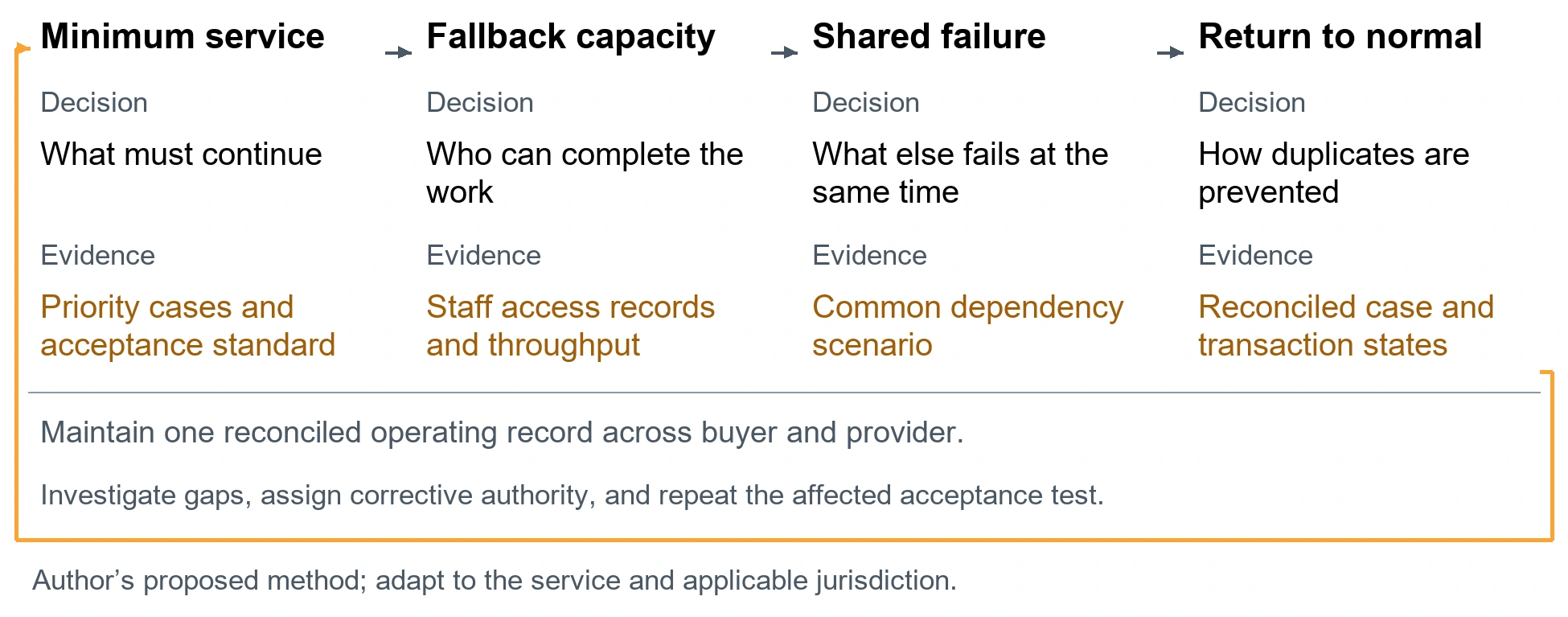
Figure 1 proposes four tests for the continuity decision. Establish the priority workload and the minimum acceptable outcome first. Then demonstrate the necessary records, authorized access, trained people, and usable throughput under the outage assumptions. Include the backlog arriving while the exercise is in progress.
Management should measure completed and accepted cases, unresolved exceptions, oldest pending work, and constraints that would stop the fallback. Exclude unavailable staff and inaccessible tools from the assumed capacity. Where the exercise uses synthetic or simplified cases, state the limitation and identify which conclusions need confirmation under representative conditions.
The bank should also test the return to normal operation. Work completed through fallback must not be repeated when the provider recovers. Reconcile case states, financial postings, customer communications, and outstanding instructions before restoring unattended execution. Recovery that creates duplicate actions can turn a contained outage into a second incident.
Test Common Dependencies and Local Duties
The UK critical-third-party regime began overseeing designated providers in July 2026 while retaining regulated firms’ own responsibilities.3 Oversight of a major supplier does not demonstrate that this bank’s replacement route works. A nominal second provider may depend on the same unavailable cloud, model, identity service, or specialist workforce.
For EU, UK, Swiss, and US operations, management should connect the continuity mode to local service obligations, records, secrecy constraints, and external market deadlines. A group recovery target should not replace the analysis of a particular payment, customer, or market service. Cross-border transfer of work may itself require approvals and access that an outage cannot create instantly.
A board should distinguish the capacity it can demonstrate from the capacity it hopes to obtain during a market-wide incident. Emergency supplier commitments should state availability assumptions and competing demand. Where simultaneous disruption defeats the fallback, management should identify the service restriction, communication, and recovery choice requiring executive authority.
Fund the Gap Before Removing the Old Route
Maintaining fallback capacity has a cost. That is a reason to choose a proportionate minimum service, not to assume the cost disappears because the normal process uses agents. The business case should include necessary training, access, rehearsals, retained knowledge, and supplier cooperation. Management may choose a narrower commitment if it states the consequences clearly.
The committee should receive the exercise results, demonstrated capacity, outstanding gaps, common dependencies, and funded correction plan. A failed test should lead to a specific decision: retain the existing route, restrict the service, add capacity, or change the proposed architecture. Repeating the recovery policy without resolving the failed assumption is not remediation.
The board’s approval should follow the service evidence. Continue automation only with a continuity mode appropriate to the bank’s obligations and the criticality of the work. The decisive proof is that the required banking function can continue and be reconciled, not that the provider has a document called a business continuity plan.
Evidence and Source Note
The study is a nonrepresentative cross-section of 850 vendor delivery-team respondents on 150 engagements serving Tier 1 financial institutions, collected during January–June 2026. Neither banks nor vendors corroborated the accounts. It establishes reported experience, not causation, legal breach, or market prevalence. The author-supplied version 1.8.2 is dated November 1, 2026 and is cited as a forthcoming manuscript consulted October 23, 2026.4
This is an analytical decision paper based on the supplied study and selected primary public sources checked through October 23, 2026. The original contribution is a bank-provider continuity capacity exercise linking minimum service, hidden human work, common dependencies, and reconciliation on recovery. The proposed method has not been independently validated. Legal requirements depend on the entity, activity, jurisdiction, and effective provisions; supervisory observations, research, and professional commentary have distinct authority.
Notes
- Bank for International Settlements, Financial Stability Institute, “Sound Management of Third-Party Risk—Executive Summary,” Bank for International Settlements, Financial Stability Institute, March 25, 2026, principles 1–9 and intended application, https://www.bis.org/publications/fsi-summary-sound-management-third-party-risk-executive-summary. ↩
- Phil Hatch, Agentic AI Outsourcing at Tier 1 Financial Institutions: Full Study Report, version 1.8.2 (Akholi, forthcoming manuscript dated November 1, 2026), Part 4, “Knowledge at Risk of Departure”, https://doi.org/10.2139/ssrn.7164559. ↩
- Bank of England, “UK Financial Regulators to Begin Overseeing Critical Third Parties Announced by HM Treasury,” Bank of England, July 10, 2026, retained firm responsibilities and notes to editors 23–26, https://www.bankofengland.co.uk/news/2026/july/uk-financial-regulators-to-begin-overseeing-critical-third-parties-announced-by-hmt. ↩
- Hatch, Agentic AI Outsourcing, Introduction, “Executive Summary” and “Evidentiary Basis and Its Limits”. ↩
Bibliography
- Bank for International Settlements, Financial Stability Institute. “Sound Management of Third-Party Risk—Executive Summary.” Bank for International Settlements, Financial Stability Institute. March 25, 2026. https://www.bis.org/publications/fsi-summary-sound-management-third-party-risk-executive-summary.
- Bank of England. “UK Financial Regulators to Begin Overseeing Critical Third Parties Announced by HM Treasury.” Bank of England. July 10, 2026. https://www.bankofengland.co.uk/news/2026/july/uk-financial-regulators-to-begin-overseeing-critical-third-parties-announced-by-hmt.
- Hatch, Phil. Agentic AI Outsourcing at Tier 1 Financial Institutions: Full Study Report. Version 1.8.2. Akholi. Forthcoming manuscript dated November 1, 2026. Author-supplied manuscript consulted October 23, 2026. https://doi.org/10.2139/ssrn.7164559.
Explore this subject
Category: Resilience and Exit
Topics: Incident Recovery Service Continuity Workforce Continuity
Audience: Buy-side Boards and Executives
Industry: Banking Capital Markets Financial Services