
Follow the Service Below the Prime Contract
The buyer vendor manager should identify which downstream parties can affect the contracted outcome. A prime provider may depend on model hosting, tools, data sources, specialist support, and further subcontractors. The buyer needs an operating explanation of those dependencies, not merely a list of corporate names.
The study reports incomplete third- and fourth-party mapping in banking delivery.1 The relevant cross-industry question is whether the buyer can follow responsibility from its contract to the place where the work is performed. The study does not measure the prevalence of supply-chain gaps in other sectors.
Select a material action and trace the actual execution route. Identify who controls each component, which party can change it, what information passes through it, and what happens if it fails. Include dependencies introduced dynamically by an agent where the architecture permits them. An unapproved new tool can change the supply chain without a new prime contract.
Allocate Operating Duties as Well as Commercial Liability
For each material dependency, distinguish responsibility to the buyer from the ability to act on the component. The prime may remain contractually responsible while lacking direct access to a downstream record or the ability to stop a hosted service. That limitation should be resolved or made explicit before the buyer relies on the promised response.
Morgan Lewis identifies growing dependency and the need to revisit governance across AI-enabled outsourcing relationships.2 The buyer should require the prime to obtain cooperation, notice, evidence, and transition rights appropriate to the service. A generic statement that obligations flow down does not prove that the downstream agreement supplies those rights.
A hypothetical incident may require the prime to preserve a model interaction while only the platform supplier holds the relevant record. The operating schedule should identify the request route, retention window, access conditions, and escalation authority. Without that connection, the buyer’s audit right may arrive too late to obtain useful evidence.
Use a Dependency Responsibility Record
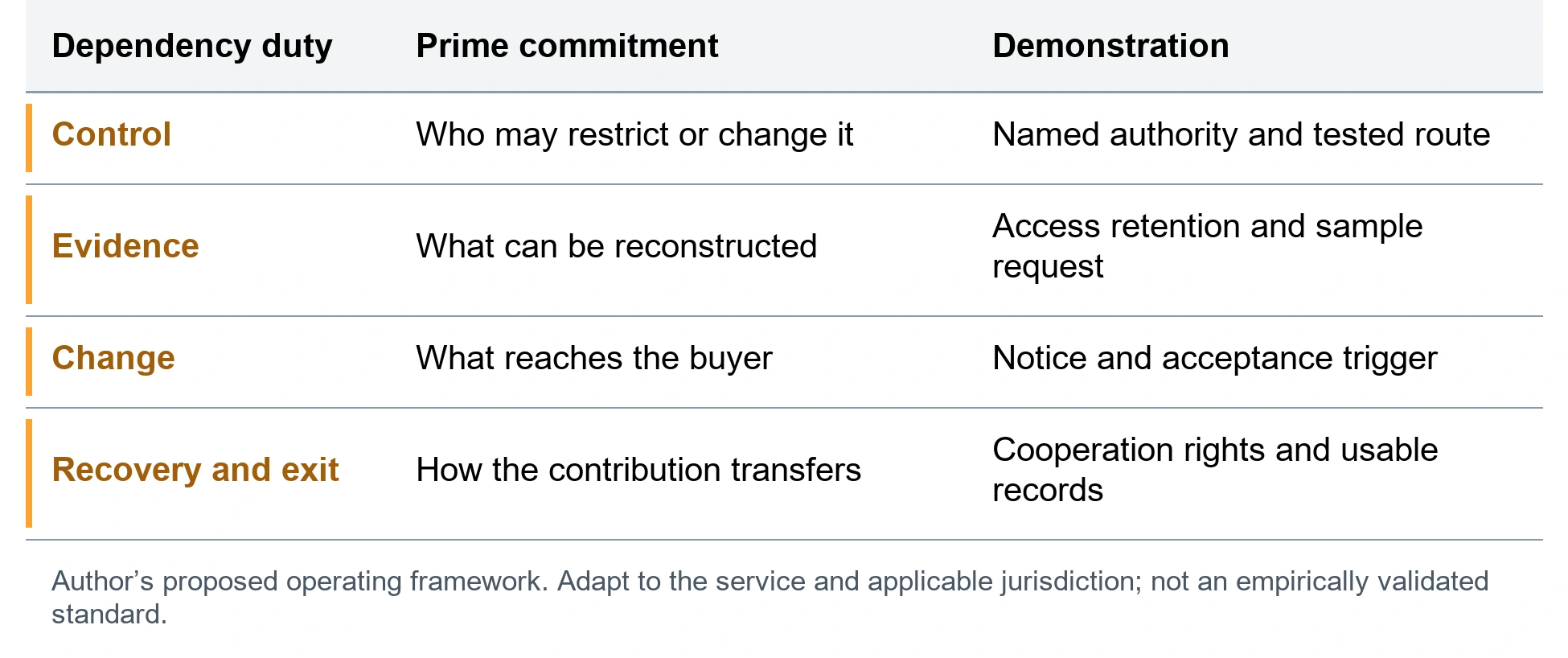
Figure 1 proposes a record linking the dependency’s contribution to control, evidence, change, and recovery. Assign an owner at the prime for each row. The buyer should know which duties are directly enforceable, which depend on the prime’s cooperation, and which remain unsupported assumptions.
Ask the prime to demonstrate one evidence request, one material change notification, and one failure response across a selected downstream boundary. The test should show elapsed time and unresolved constraints. A successful tabletop discussion is useful preparation but should not be confused with a completed technical or contractual demonstration.
Where the provider invokes confidentiality, agree protected review rather than accept a blank field. The buyer may not need every commercial term, but it needs enough evidence to judge the service. If material rights cannot be established, management should restrict the affected activity or accept the resulting exposure explicitly.
Keep Privacy Roles Separate from Contract Labels
EDPB guidance determines controller and processor roles from the actual processing relationship, rather than contractual labels alone.3 A prime/subcontractor label therefore does not settle privacy responsibilities. Privacy specialists should assess purposes, instructions, recipients, further processing, and required authorizations for the relevant personal data.
EU, UK, Swiss, and US services may have different secrecy, privacy, access, and sector conditions. Record which entity’s duties govern each material flow. A global subcontracting approval should not silently authorize a new purpose, location, or data recipient. The prime should identify the change and obtain the necessary decision before the flow expands.
The same discipline applies to nonpersonal confidential information and licensed data. The prime must establish whether its downstream use is permitted and whether the buyer can recover the evidence and working context it needs. Technical reachability does not establish a right to use or transfer the information.
Reconcile the Chain Throughout the Relationship
A manager may reasonably object that a complete map of every supplier is impossible. Prioritize dependencies whose loss, change, or misuse can materially affect the outcome or a buyer obligation. Record the rationale for excluding minor components and revisit it when the service changes. Proportionality should make the map useful rather than incomplete without explanation.
Review actual execution against the approved dependency record. Investigate unlisted endpoints, new tools, changed support routes, and missing evidence. Exit exercises should test whether downstream rights and records remain usable when the prime relationship ends or becomes disputed.
The buyer should accept a chain of demonstrated responsibility rather than a chain of names. The prime’s commitment is credible when it can show how the people controlling a material dependency will cooperate with investigation, restriction, correction, and transfer. Unresolved links should remain visible deployment conditions.
Evidence and Source Note
The study is a nonrepresentative cross-section of 850 vendor delivery-team respondents on 150 engagements serving Tier 1 financial institutions, collected during January–June 2026. Neither banks nor vendors corroborated the accounts. It establishes reported experience, not causation, legal breach, or market prevalence. Its application here is a mechanism to investigate, not an estimate of conditions in other industries. The author-supplied version 1.8.2 is dated November 1, 2026 and is cited as a forthcoming manuscript consulted October 23, 2026.4
This is an analytical decision paper based on the supplied study and selected primary public sources checked through October 23, 2026. The original contribution is a dependency responsibility record testing whether the prime provider can obtain the downstream control, evidence, change, and transition cooperation promised to the buyer. The proposed method has not been independently validated. Legal requirements depend on the entity, activity, jurisdiction, and effective provisions; supervisory observations, research, and professional commentary have distinct authority.
Notes
- Phil Hatch, Agentic AI Outsourcing at Tier 1 Financial Institutions: Full Study Report, version 1.8.2 (Akholi, forthcoming manuscript dated November 1, 2026), Part 3, Third-Party Ecosystem, sec. 6.1, “Mapping of Third and Fourth Party Dependencies,” indicator C196, https://doi.org/10.2139/ssrn.7164559. ↩
- Barbara Murphy Melby et al., “AI-Enabled Outsourcing: Key Contract, Pricing, and Governance Considerations,” Morgan Lewis, July 2026, public report overview and key takeaways, https://www.morganlewis.com/pubs/2026/07/ai-enabled-outsourcing-key-contract-pricing-and-governance-considerations. ↩
- European Data Protection Board, Guidelines 07/2020 on the Concepts of Controller and Processor in the GDPR (European Data Protection Board, adopted July 7, 2021; version 2.1 corrected September 20, 2022), version 2.1, executive summary and part I, secs. 2–3, https://www.edpb.europa.eu/system/files/documents/2023-10/EDPB_guidelines_202007_controllerprocessor_final_en.pdf. ↩
- Hatch, Agentic AI Outsourcing, Introduction, “Executive Summary” and “Evidentiary Basis and Its Limits”. ↩
Bibliography
- European Data Protection Board. Guidelines 07/2020 on the Concepts of Controller and Processor in the GDPR. European Data Protection Board, adopted July 7, 2021; version 2.1 corrected September 20, 2022. https://www.edpb.europa.eu/system/files/documents/2023-10/EDPB_guidelines_202007_controllerprocessor_final_en.pdf.
- Hatch, Phil. Agentic AI Outsourcing at Tier 1 Financial Institutions: Full Study Report. Version 1.8.2. Akholi. Forthcoming manuscript dated November 1, 2026. Author-supplied manuscript consulted October 23, 2026. https://doi.org/10.2139/ssrn.7164559.
- Melby, Barbara Murphy, Marina G. Aronchik, and C. Kari Krusmark. “AI-Enabled Outsourcing: Key Contract, Pricing, and Governance Considerations.” Morgan Lewis. July 2026. https://www.morganlewis.com/pubs/2026/07/ai-enabled-outsourcing-key-contract-pricing-and-governance-considerations.
Explore this subject
Category: Commercial and Vendor Management
Topics: Architecture and Dependencies Contract Design Retained Accountability
Audience: Buy-side Delivery and Vendor Managers
Industry: Cross-industry