
Approve Meaning Before Consequential Use
The executive sponsor should ask whether the bank and provider interpret critical data consistently. A field called available balance, customer status, exposure, or completed transaction can have different meanings across systems. A technically valid interface can transmit the wrong business meaning with high reliability.
Cambridge’s global financial-services research identifies data quality and fragmented systems as material adoption constraints.1 Its surveys use different populations by question and do not establish the readiness of this bank. The relevant action is to resolve the definitions needed for the contracted workflow.
Start with consequential decisions rather than a programme to clean all enterprise data. Identify the fields and policy concepts that determine an action, the authoritative owner, applicable source, timing, units, and permitted transformation. Unknown meaning should remain visible as a readiness limitation.
Separate Format Conversion from Business Interpretation
A provider may normalize dates, labels, codes, or units to make data usable. Some changes are mechanical; others embed judgment about what a value represents. The bank should approve material interpretive choices rather than let them become undocumented delivery assumptions.
The study reports manual alterations involving financial-institution data and processes.2 It does not establish that normalization is inherently improper. It identifies why the buyer should know what the provider changes and whether those changes preserve the intended meaning.
For a hypothetical account field, a zero may mean no balance, unavailable information, or an uninitialized value. Treating all three as the same can change an agent’s decision. The acceptance test should include these boundary meanings and the required response when interpretation cannot be established.
Use a Semantic Readiness Record
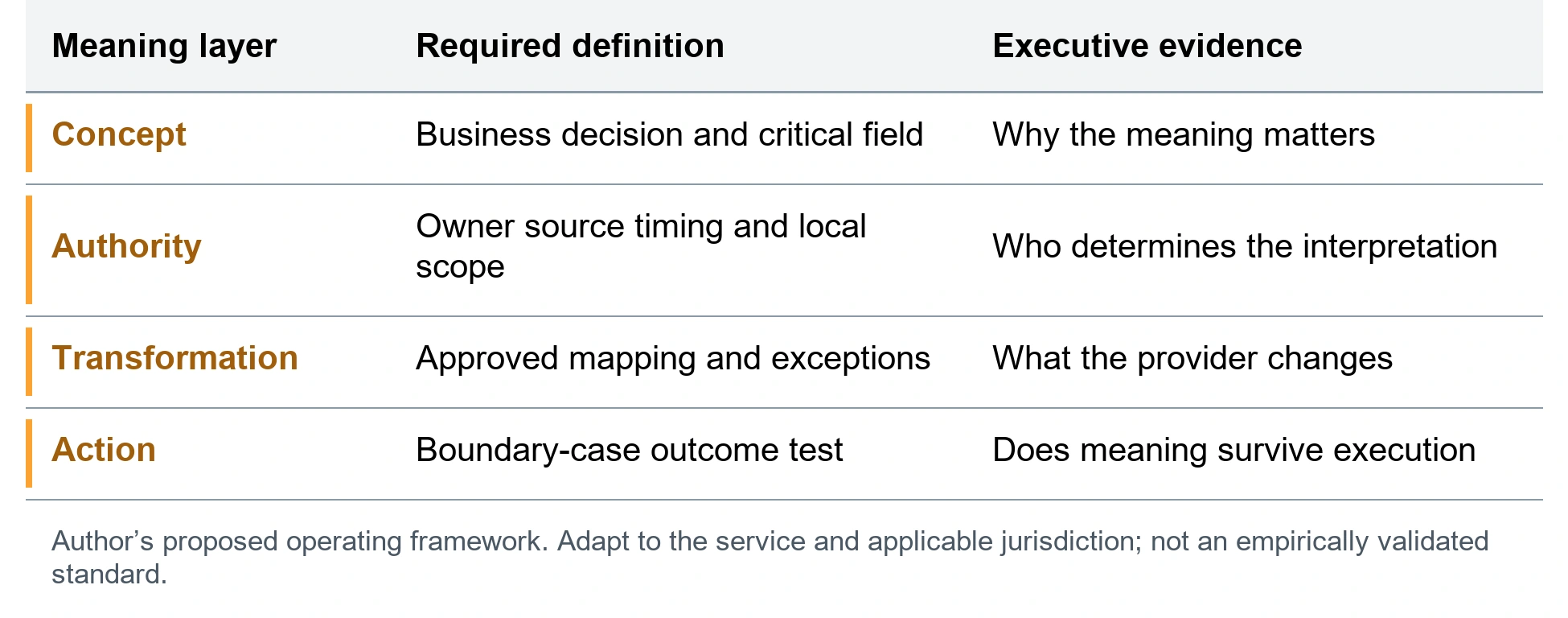
Figure 1 proposes four links: concept, authoritative definition, transformation, and action test. Record the bank owner who can resolve uncertainty and the provider owner who implements the interpretation. Preserve the version and relevant local scope.
Test representative and difficult values through the complete service. Include missing, stale, contradictory, out-of-range, and changed data. Verify the resulting business action rather than only the converted field. A correct mapping can still support an incorrect decision if its timing or policy context is wrong.
BCG’s regulated-agent platform discussion includes controlled knowledge, memory, and interoperability.3 Technical architecture can support shared definitions. It cannot decide what a bank-specific field or policy means without authoritative business ownership.
Maintain the Definition as the Service Changes
Data meaning can change when products, systems, legal entities, or policies change. Establish notice and reassessment triggers. A provider should not continue using an old mapping merely because the interface schema has not changed. The source owner should identify material semantic changes.
EU, UK, Swiss, US, and other banking operations can differ in legal definitions, accounting treatment, privacy, and permitted use. Maintain local conclusions where required while reusing common definitions that remain valid. One group glossary should not erase a material entity-specific distinction.
The record should distinguish an unresolved definition from an accepted tolerance or temporary restriction. Do not call the artifact a regulatory certificate. It is an internal management record supporting a scoped decision about whether the service has sufficient meaning to act reliably.
Fund the Definitions That Determine the Outcome
A reasonable objection is that data remediation can become an endless enterprise programme. Limit the initial work to the concepts necessary for the accepted service and its material exceptions. Expand coverage as authority and use cases expand. Proportionality requires a clear boundary, not an assumption that all ambiguity is harmless.
Before granting production execution rights, require the relevant bank owners and provider to demonstrate the critical mappings and boundary cases. Resolve consequential uncertainty or restrict the affected action. Include maintenance of definitions and evidence in the delivery business case.
The executive should approve a service that operates on agreed business meaning. Connectivity makes data reachable; semantic readiness makes it suitable for a defined decision. The bank’s investment should target the meanings that determine whether the outsourced function produces the result it intends.
Evidence and Source Note
The study is a nonrepresentative cross-section of 850 vendor delivery-team respondents on 150 engagements serving Tier 1 financial institutions, collected during January–June 2026. Neither banks nor vendors corroborated the accounts. It establishes reported experience, not causation, legal breach, or market prevalence. The author-supplied version 1.8.2 is dated November 1, 2026 and is cited as a forthcoming manuscript consulted October 23, 2026.4
This is an analytical decision paper based on the supplied study and selected primary public sources checked through October 23, 2026. The original contribution is a scoped semantic-readiness record connecting bank-owned definitions to provider transformations and consequential action tests. The proposed method has not been independently validated. Legal requirements depend on the entity, activity, jurisdiction, and effective provisions; supervisory observations, research, and professional commentary have distinct authority.
Notes
- Cambridge Centre for Alternative Finance, University of Cambridge, The 2026 Global AI in Financial Services Report: Adoption, Impact and Risks (Cambridge Centre for Alternative Finance, University of Cambridge, April 2026), survey limitations and pp. 74–77, 93–96, and 128, https://www.jbs.cam.ac.uk/wp-content/uploads/2026/05/ccaf-2026-04-28-global-ai-in-financial-services-report-2.pdf. ↩
- Phil Hatch, Agentic AI Outsourcing at Tier 1 Financial Institutions: Full Study Report, version 1.8.2 (Akholi, forthcoming manuscript dated November 1, 2026), Part 5, “The Five Manual Alteration Methods” and “Disclosure of Manual Alteration,” table 5.8, https://doi.org/10.2139/ssrn.7164559. ↩
- Daniel Martines et al., “Building Enterprise AI Agents in Regulated Industries,” Boston Consulting Group, July 20, 2026, enterprise platform and identity control sections, https://www.bcg.com/publications/2026/building-enterprise-ai-agents-in-regulated-industries. ↩
- Hatch, Agentic AI Outsourcing, Introduction, “Executive Summary” and “Evidentiary Basis and Its Limits”. ↩
Bibliography
- Cambridge Centre for Alternative Finance, University of Cambridge. The 2026 Global AI in Financial Services Report: Adoption, Impact and Risks. Cambridge Centre for Alternative Finance, University of Cambridge, April 2026. https://www.jbs.cam.ac.uk/wp-content/uploads/2026/05/ccaf-2026-04-28-global-ai-in-financial-services-report-2.pdf.
- Hatch, Phil. Agentic AI Outsourcing at Tier 1 Financial Institutions: Full Study Report. Version 1.8.2. Akholi. Forthcoming manuscript dated November 1, 2026. Author-supplied manuscript consulted October 23, 2026. https://doi.org/10.2139/ssrn.7164559.
- Martines, Daniel, Cullen Breithaupt, Drew Ingalls, Sawan Ruparel, and Prithvi Vadlamudi. “Building Enterprise AI Agents in Regulated Industries.” Boston Consulting Group. July 20, 2026. https://www.bcg.com/publications/2026/building-enterprise-ai-agents-in-regulated-industries.
Explore this subject
Category: Data, Technology, and Security
Topics: Data Meaning and Lineage Production Acceptance Retained Accountability
Audience: Buy-side Boards and Executives
Industry: Banking Financial Services