
Approve the Loss the Buyer Will Retain
The general counsel, chief financial officer, and chief risk officer should approve the buyer’s retained-loss position before signing a material agentic service. The buyer may owe duties to customers or regulators while its recovery from the provider remains limited or disputed. The investment decision should reflect that gap.
Start with plausible harmful actions in the contracted workflow. Examples include an unauthorized transaction, disclosure of confidential information, incorrect customer communication, interrupted service, or destruction of a needed record. The purpose is to examine actual exposure and recovery, not to assign a market probability unsupported by evidence.
Clifford Chance’s agentic-contract analysis identifies narrow indemnities, excluded losses, and limited oversight rights as potential gaps in legacy terms. The consulted PDF is dated January 21, 2026. Its warning supports a scenario review of the specific contract rather than a conclusion that every provider agreement is inadequate.1
Separate Liability from Indemnity and Coverage
A liability clause determines contractual exposure and its limits. An indemnity allocates defined claims or losses under its wording. An insurance policy provides coverage subject to insured status, scope, exclusions, conditions, limits, and other terms. None establishes that money will be available for every operational loss the buyer may suffer.
A provider certificate can show that a policy exists without establishing coverage for the buyer’s scenario. An indemnity may apply to third-party intellectual property claims but not the buyer’s own rework or interruption. A high headline cap can be irrelevant when the loss category is excluded or the obligation sits outside the relevant clause.
Counsel should read the provisions together with warranties, exclusive remedies, dependency clauses, notification conditions, and dispute terms. The finance team should assess timing and collectability. A theoretical damages claim does not provide immediate cash or operational assistance during a service failure.
Build a Scenario Recovery Matrix
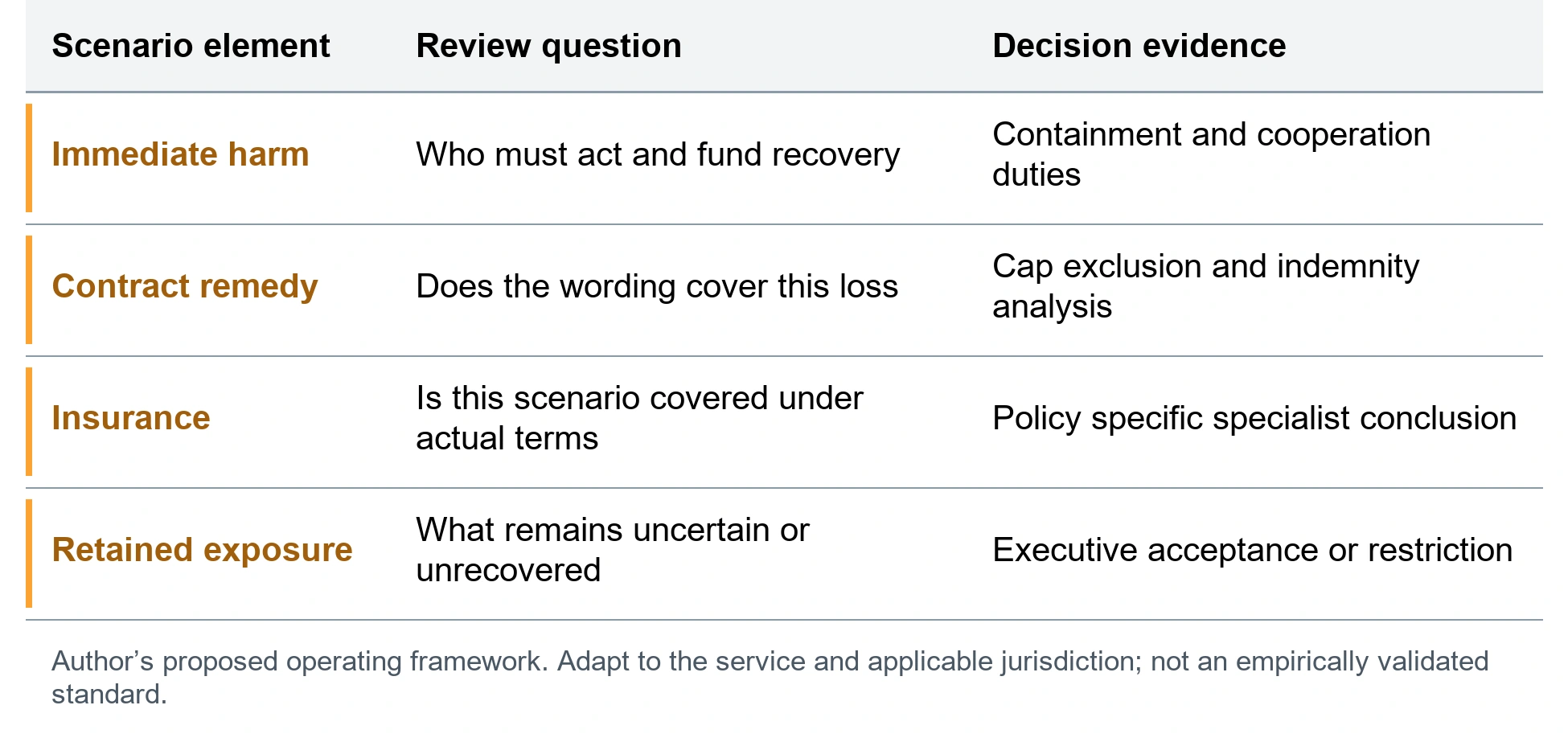
Figure 1 proposes a matrix that follows a loss from event to retained exposure. Identify the affected party, immediate response, contractual remedy, applicable cap or exclusion, possible insurance, and unresolved amount. Do not treat separate policies as additive until specialists assess how their terms interact.
For a hypothetical erroneous supplier payment, distinguish the amount transferred, recovery efforts, customer or supplier claims, investigation cost, and service interruption. Some amounts may be recoverable through payment processes; others may depend on contract or policy wording. Record assumptions separately so an uncertain recovery cannot silently reduce the investment’s risk estimate.
Mayer Brown recommends addressing indemnities separately from liability caps and examining upstream provider gaps in agentic integration deals. For an outsourced service, buyers should extend that inquiry to the managed operation and the provider’s own subcontracting chain. The actual allocation requires transaction-specific legal analysis.2
Connect Risk Transfer to the Authority Granted
The buyer should reduce exposure through operating design before negotiating financial transfer. Narrower permissions, transaction limits, independent approval, and recoverable workflows can change the loss scenario. Those controls should be tested; a contractual statement that the buyer controls the agent does not establish that the runtime enforces its instructions.
The study provides reported mechanisms of hidden intervention and fragmented evidence, not legal findings or insurance loss data. Its relevance is that a buyer may misunderstand the work and evidence underlying a service promise. That uncertainty should be resolved through delivery review rather than converted into an invented loss estimate.3
Require the provider to preserve records and cooperate with containment and claims. If essential evidence is unavailable, the buyer may struggle to establish cause, notify insurers correctly, or recover under the agreement. Evidence access and emergency cooperation therefore belong in the commercial review.
Obtain Jurisdiction and Policy Specific Conclusions
A global service can create obligations under several legal systems while the contract selects one governing law. Counsel should distinguish enforceability, third-party rights, regulatory duties, and insurability in the relevant EU, UK, Swiss, US, or other jurisdictions. A single global statement that fines or AI losses are insured is not a defensible conclusion.
The approval should show the effect of delayed recovery. A provider may dispute liability for months while the buyer must fund immediate customer remediation and service restoration. The CFO should distinguish eventual possible recovery from liquidity available during the event. Contractual cooperation, access to evidence, and interim funding can therefore matter as much as the headline cap. Their treatment should be explicit in the scenario review and the final retained-loss decision.
Ask the broker, insurer, and legal team to review the actual scenarios and policy forms. Record confirmed coverage, contested interpretation, exclusions, retentions, limits, notification requirements, and remaining uncertainty. Where confirmation is unavailable, retain the uncertainty in the decision rather than describe the insurance as assured recovery.
The provider’s financial capacity also matters. A remedy that exceeds its ability to pay may offer limited protection. Management should assess concentration of claims and the durability of the provider’s recovery commitments, particularly where multiple customers could be affected by the same underlying failure.
Choose Which Exposure to Retain Transfer or Constrain
The executive decision should state which scenarios are acceptable within existing authority, which require revised terms or controls, and which should prevent deployment. Assign a named owner and review trigger for each unresolved material gap. Price savings should not be reported without recognizing the corresponding retained exposure.
The matrix does not promise complete risk transfer. It gives the buyer a clear explanation of the loss that remains after controls, contract remedies, and confirmed coverage. Approving that position explicitly is more defensible than treating a liability cap and an insurance certificate as equivalent to protection.
Evidence and Source Note
The study is a nonrepresentative cross-section of 850 vendor delivery-team respondents on 150 engagements serving Tier 1 financial institutions, collected during January–June 2026. Neither banks nor vendors corroborated the accounts. It establishes reported experience, not causation, legal breach, or market prevalence. Its application here is a mechanism to investigate, not an estimate of conditions in other industries. The author-supplied version 1.8.2 is dated November 1, 2026 and is cited as a forthcoming manuscript consulted October 23, 2026.4
This is an analytical decision paper based on the supplied study and selected primary public sources checked through October 23, 2026. The original contribution is a buyer retained-loss matrix separating operational containment, contractual recovery, and confirmed insurance coverage. The proposed method has not been independently validated. Legal requirements depend on the entity, activity, jurisdiction, and effective provisions; supervisory observations, research, and professional commentary have distinct authority.
Notes
- Clifford Chance, Agentic AI: The Liability Gap Your Contracts May Not Cover (Clifford Chance, January 21, 2026), pp. 1–4; date printed in the consulted PDF, https://www.cliffordchance.com/content/dam/cliffordchance/briefings/2026/02/agentic-ai-theliability-gap-your-contracts-may-not-cover.pdf. ↩
- Rohith P. George et al., “Key Contract Issues in Agentic AI Implementation and Integration Deals,” Mayer Brown, June 16, 2026, “Liability,” “Performance commitments and dependencies,” and “Exit and transition”, https://www.mayerbrown.com/en/insights/publications/2026/06/key-contract-issues-in-agentic-ai-implementation-and-integration-deals. ↩
- Phil Hatch, Agentic AI Outsourcing at Tier 1 Financial Institutions: Full Study Report, version 1.8.2 (Akholi, forthcoming manuscript dated November 1, 2026), Part 5, “Five Manual Alteration Methods” and “Disclosure of Manual Alteration,” table 5.8, https://doi.org/10.2139/ssrn.7164559.; Hatch, Agentic AI Outsourcing, Part 2, sec. 5.1, “Agent Actions Visible Only Inside Each Firm’s Own Tools”. ↩
- Hatch, Agentic AI Outsourcing, Introduction, “Executive Summary” and “Evidentiary Basis and Its Limits”. ↩
Bibliography
- Clifford Chance. Agentic AI: The Liability Gap Your Contracts May Not Cover. Clifford Chance, January 21, 2026. https://www.cliffordchance.com/content/dam/cliffordchance/briefings/2026/02/agentic-ai-theliability-gap-your-contracts-may-not-cover.pdf.
- George, Rohith P., Veronica R. Glick, Arsen Kourinian, et al.. “Key Contract Issues in Agentic AI Implementation and Integration Deals.” Mayer Brown. June 16, 2026. https://www.mayerbrown.com/en/insights/publications/2026/06/key-contract-issues-in-agentic-ai-implementation-and-integration-deals.
- Hatch, Phil. Agentic AI Outsourcing at Tier 1 Financial Institutions: Full Study Report. Version 1.8.2. Akholi. Forthcoming manuscript dated November 1, 2026. Author-supplied manuscript consulted October 23, 2026. https://doi.org/10.2139/ssrn.7164559.
Explore this subject
Category: Commercial and Vendor Management
Topics: Contract Design Delegated Authority Liability and Insurance
Audience: Buy-side Boards and Executives
Industry: Cross-industry