# Protect the Expertise Pipeline While Automating the Work

An Executive Decision on Future Judgment Capacity

Author: Phil Hatch
Publisher: Akholi
Paper ID: AAO-120
Published: October 23, 2026
Language: en
Canonical: https://akholi.com/papers/protect-the-expertise-pipeline-while-automating-the-work/
Audience: CHRO, COO and executive sponsor

Executives should redesign how people acquire expertise when agentic delivery removes foundational work. Current productivity should not be purchased by eliminating the practice, feedback, and progressively responsible decisions that develop the specialists needed to govern future services.

<h2 id="section-1">Identify Which Learning Work Is Disappearing</h2>
<p>The executive should ask how junior and developing staff currently learn the function being automated. Research, drafting, reconciliation, case preparation, and routine analysis can teach pattern recognition and judgment as well as produce output. Removing tasks can change that learning route even when the formal job remains.</p>
<p>McKinsey’s organizational analysis identifies the <a href="https://www.mckinsey.com/capabilities/people-and-organization/our-insights/ai-is-changing-work-now-it-has-to-change-the-organization">risk of losing apprenticeship as AI absorbs foundational work.</a><sup id="ref-1"><a href="#note-1" aria-label="Note 1">1</a></sup> It is a design concern, not proof that every automation programme reduces future expertise. The organization should examine the actual development pathway in its retained and provider teams.</p>
<p>For a hypothetical analyst role, reviewing an agent’s polished summary may not provide the same exposure to source quality, conflicting evidence, and error diagnosis as constructing the analysis. The executive should identify which experiences still matter and how people will obtain them deliberately.</p>
<h2 id="section-2">Connect Expertise to Future Service Control</h2>
<p>The <a href="https://akholi.com/outsourcing-2026-agentic-ai-tier-1-banks/part-4-delivery-workforce/">study</a> describes operational knowledge concentrated in experienced staff and personal records.<sup id="ref-2"><a href="#note-2" aria-label="Note 2">2</a></sup> It does not measure long-term skill decline. It identifies why the organization should understand how critical judgment is maintained and transferred before the experienced cohort leaves.</p>
<p>A retained team may need fewer routine operators while needing stronger people who can interpret exceptions, challenge the provider, and recover the function. Those capabilities require a development route. Buying a service does not automatically create the next generation of buyer or provider experts.</p>
<p>Map future judgments to required experiences: inspecting sources, identifying ambiguity, understanding consequences, applying policy, making bounded decisions, and receiving feedback. Distinguish knowledge that can be taught from judgment that needs supervised practice in the relevant context.</p>
<h2 id="section-3">Use an Expertise Pipeline Record</h2>
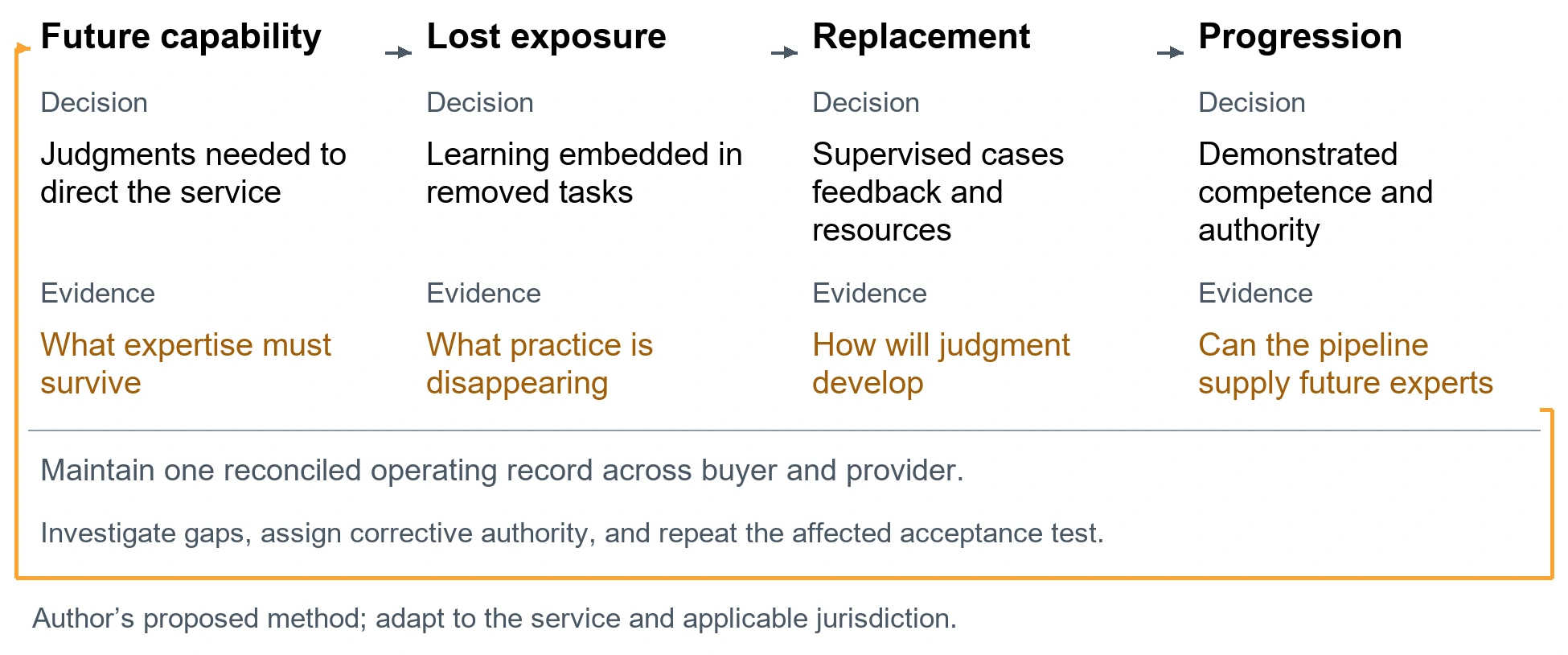
<p>Figure 1 proposes four decisions: future capability, lost learning exposure, replacement practice, and demonstrated progression. Assign accountable buyer and provider owners where both teams depend on the expertise. Include time, supervision, access, and assessment in the plan.</p>
<p><a href="https://digitaleconomy.stanford.edu/app/uploads/2026/03/EnterpriseAIPlaybook_PereiraGraylinBrynjolfsson.pdf">Stanford’s deployment playbook emphasizes complementary organizational investment.</a><sup id="ref-3"><a href="#note-3" aria-label="Note 3">3</a></sup> Its selected successful cases do not validate a particular apprenticeship design. The organization should test whether its chosen practice produces the capability needed for the service rather than count course completions.</p>
<p>Options can include supervised source reconstruction, deliberate exception exercises, rotated responsibility, paired review, and increasingly consequential case decisions. Use real work where appropriate and protected simulations where live consequences would be unsuitable. Preserve qualified oversight and applicable restrictions.</p>
<figure><img loading="lazy" src="https://akholi.com/wp-content/uploads/2026/10/120-f1.webp" width="1950" height="814" alt="The expertise pipeline record. Future capability. Decision: Judgments needed to direct the service. Evidence: What expertise must survive. Lost exposure. Decision: Learning embedded in removed tasks. Evidence: What practice is disappearing. Replacement. Decision: Supervised cases feedback and resources. Evidence: How will judgment develop. Progression. Decision: Demonstrated competence and authority. Evidence: Can the pipeline supply future experts. Maintain one reconciled operating record across buyer and provider.. Investigate gaps, assign corrective authority, and repeat the affected acceptance test.. Author’s proposed method; adapt to the service and applicable jurisdiction."><figcaption>Figure 1. The expertise pipeline record<small><a href="https://akholi.com/outsourcing-2026-agentic-ai-tier-1-banks/">Phil Hatch, proposed framework developed for this paper.</a></small></figcaption></figure>
<h2 id="section-4">Align Incentives and Commercial Expectations</h2>
<p>If performance measures reward only immediate throughput, managers may remove the time needed to develop judgment. Make learning capacity an explicit operating investment. The cost should be compared with future dependence, succession gaps, and the inability to challenge or recover the service.</p>
<p>EU, UK, Swiss, US, and other roles can require professional qualifications, supervised experience, records, labor protections, and specific training. Qualified owners should establish applicable conditions. Internal practice should support, rather than be represented as replacing, required credentials.</p>
<p>Provider contracts and workforce plans should address continuity of expertise, not merely headcount. The buyer can seek evidence of qualified succession and knowledge transfer while allowing the supplier to manage its people. A named expert clause alone does not create a sustainable capability pipeline.</p>
<h2 id="section-5">Approve Automation with a Credible Development Route</h2>
<p>A reasonable objection is that preserving learning can appear to retain work automation made unnecessary. The objective is not to protect every old task. It is to preserve the experiences that produce necessary judgment through a more deliberate and efficient development design.</p>
<p>Before major task removal, require a future-capability map and a funded practice plan. Test whether developing staff can handle representative difficult cases with appropriate supervision, then progress their authority as competence is demonstrated. Review gaps alongside turnover and service change.</p>
<p>The executive should approve a productivity model that can sustain its own future expertise. Agentic delivery changes how work is done and how people learn to govern it. The organization should capture present value while deliberately developing the judgment on which its next operating model will depend.</p>
<h2 id="section-6">Evidence and Source Note</h2>
<p>The study is a nonrepresentative cross-section of 850 vendor delivery-team <a href="https://akholi.com/outsourcing-2026-agentic-ai-tier-1-banks/introduction/">respondents</a> on 150 engagements serving Tier 1 financial institutions, collected during January–June 2026. Neither banks nor vendors corroborated the accounts. It establishes reported experience, not causation, legal breach, or market prevalence. Its application here is a mechanism to investigate, not an estimate of conditions in other industries. The author-supplied version 1.8.2 is dated November 1, 2026 and is cited as a forthcoming manuscript consulted October 23, 2026.<sup id="ref-4"><a href="#note-4" aria-label="Note 4">4</a></sup></p>
<p>This is an analytical decision paper based on the supplied study and selected primary public sources checked through October 23, 2026. The original contribution is an expertise-pipeline record connecting automation-driven task removal to deliberate practice, qualified progression, and future service-governance capacity. The proposed method has not been independently validated. Legal requirements depend on the entity, activity, jurisdiction, and effective provisions; supervisory observations, research, and professional commentary have distinct authority.</p>
<h2 id="notes">Notes</h2><ol class="akp-notes"><li id="note-1">McKinsey &amp; Company, “AI Is Changing Work. Now It Has to Change the Organization,” McKinsey &amp; Company, October 5, 2026, “Operating model,” “Talent,” and “Enabling AI reinvention”, <a href="https://www.mckinsey.com/capabilities/people-and-organization/our-insights/ai-is-changing-work-now-it-has-to-change-the-organization">https://www.mckinsey.com/capabilities/people-and-organization/our-insights/ai-is-changing-work-now-it-has-to-change-the-organization</a>. <a href="#ref-1" aria-label="Return to note 1">↩</a></li><li id="note-2">Phil Hatch, <i>Agentic AI Outsourcing at Tier 1 Financial Institutions: Full Study Report</i>, version 1.8.2 (Akholi, forthcoming manuscript dated November 1, 2026), Part 4, “Knowledge at Risk of Departure”, <a href="https://doi.org/10.2139/ssrn.7164559">https://doi.org/10.2139/ssrn.7164559</a>. <a href="#ref-2" aria-label="Return to note 2">↩</a></li><li id="note-3">Elisa Pereira et al., <i>The Enterprise AI Playbook: Lessons from 51 Successful Deployments,</i> Stanford Digital Economy Lab, April 2026, methodology and chapters 1–3 and 8; purposive successful-case sample, <a href="https://digitaleconomy.stanford.edu/app/uploads/2026/03/EnterpriseAIPlaybook_PereiraGraylinBrynjolfsson.pdf">https://digitaleconomy.stanford.edu/app/uploads/2026/03/EnterpriseAIPlaybook_PereiraGraylinBrynjolfsson.pdf</a>. <a href="#ref-3" aria-label="Return to note 3">↩</a></li><li id="note-4">Hatch, <i>Agentic AI Outsourcing</i>, Introduction, “Executive Summary” and “Evidentiary Basis and Its Limits”. <a href="#ref-4" aria-label="Return to note 4">↩</a></li></ol>
<h2 id="bibliography">Bibliography</h2><ul class="akp-bibliography"><li>Hatch, Phil. <i>Agentic AI Outsourcing at Tier 1 Financial Institutions: Full Study Report</i>. Version 1.8.2. Akholi. Forthcoming manuscript dated November 1, 2026. Author-supplied manuscript consulted October 23, 2026. <a href="https://doi.org/10.2139/ssrn.7164559">https://doi.org/10.2139/ssrn.7164559</a>.</li><li>McKinsey &amp; Company. “AI Is Changing Work. Now It Has to Change the Organization.” McKinsey &amp; Company. October 5, 2026. <a href="https://www.mckinsey.com/capabilities/people-and-organization/our-insights/ai-is-changing-work-now-it-has-to-change-the-organization">https://www.mckinsey.com/capabilities/people-and-organization/our-insights/ai-is-changing-work-now-it-has-to-change-the-organization</a>.</li><li>Pereira, Elisa, Alvin Wang Graylin, and Erik Brynjolfsson. <i>The Enterprise AI Playbook: Lessons from 51 Successful Deployments.</i> Stanford Digital Economy Lab. April 2026. <a href="https://digitaleconomy.stanford.edu/app/uploads/2026/03/EnterpriseAIPlaybook_PereiraGraylinBrynjolfsson.pdf">https://digitaleconomy.stanford.edu/app/uploads/2026/03/EnterpriseAIPlaybook_PereiraGraylinBrynjolfsson.pdf</a>.</li></ul>
