# Train the Retained Team to Govern Provider Agents

A Management Programme for Two-Party Delivery Competence

Author: Phil Hatch
Publisher: Akholi
Paper ID: AAO-119
Published: October 23, 2026
Language: en
Canonical: https://akholi.com/papers/train-the-retained-team-to-govern-provider-agents/
Audience: Retained organization leads and vendor-governance managers

Buyer organizations should train retained teams to direct and oversee two-party agentic delivery. The programme should develop practical competence in authority, acceptance, evidence, exceptions, change, economics, and recovery, rather than stop at instruction on using AI tools.

<h2 id="section-1">Teach the Responsibilities the Buyer Retains</h2>
<p>The vendor-management leader should define what sourcing, business owners, risk functions, operations, finance, legal, and specialist reviewers must do in the new delivery model. Each role needs enough understanding to perform its own decisions and recognize when another authority is required.</p>
<p>Deloitte’s agent-governance research identifies a <a href="https://www.deloitte.com/us/en/insights/topics/emerging-technologies/ai-agents-scaling-faster.html">gap between deployment and mature governance in surveyed organizations.</a><sup id="ref-1"><a href="#note-1" aria-label="Note 1">1</a></sup> It does not assess the competence of this buyer team. The training decision should begin with the actual service responsibilities and operating evidence.</p>
<p>A manager may need to distinguish a generated recommendation from an executed action, an approved tool from an approved business mandate, or a supplier rate reduction from complete functional savings. These distinctions directly affect acceptance and oversight. They should be taught through the work the person will perform.</p>
<h2 id="section-2">Build the Programme Around Joint Cases</h2>
<p>The <a href="https://akholi.com/outsourcing-2026-agentic-ai-tier-1-banks/part-2-five-failure-categories/">study</a> <a href="https://akholi.com/outsourcing-2026-agentic-ai-tier-1-banks/part-5-manual-alteration/">reports governance-function departures, manual alterations, and mismatched decision speed.</a><sup id="ref-2"><a href="#note-2" aria-label="Note 2">2</a></sup> It does not prove that training alone remedies those conditions. It identifies situations the retained team should be able to recognize and manage with the provider.</p>
<p>Use cases involving missing authority, incomplete evidence, concealed human work, buyer delay, a material update, and interrupted execution. Ask participants to identify the decision, required facts, responsible owner, permitted action, and verification of the result. Avoid a course that rewards vocabulary without operating judgment.</p>
<p>Include provider counterparts for relevant exercises. The buyer should know how to request a decision-ready exception, while the provider should know what information and timing the buyer requires. Training should reveal gaps in the joint workflow rather than teach each firm an incompatible method.</p>
<h2 id="section-3">Use a Retained Team Competence Record</h2>
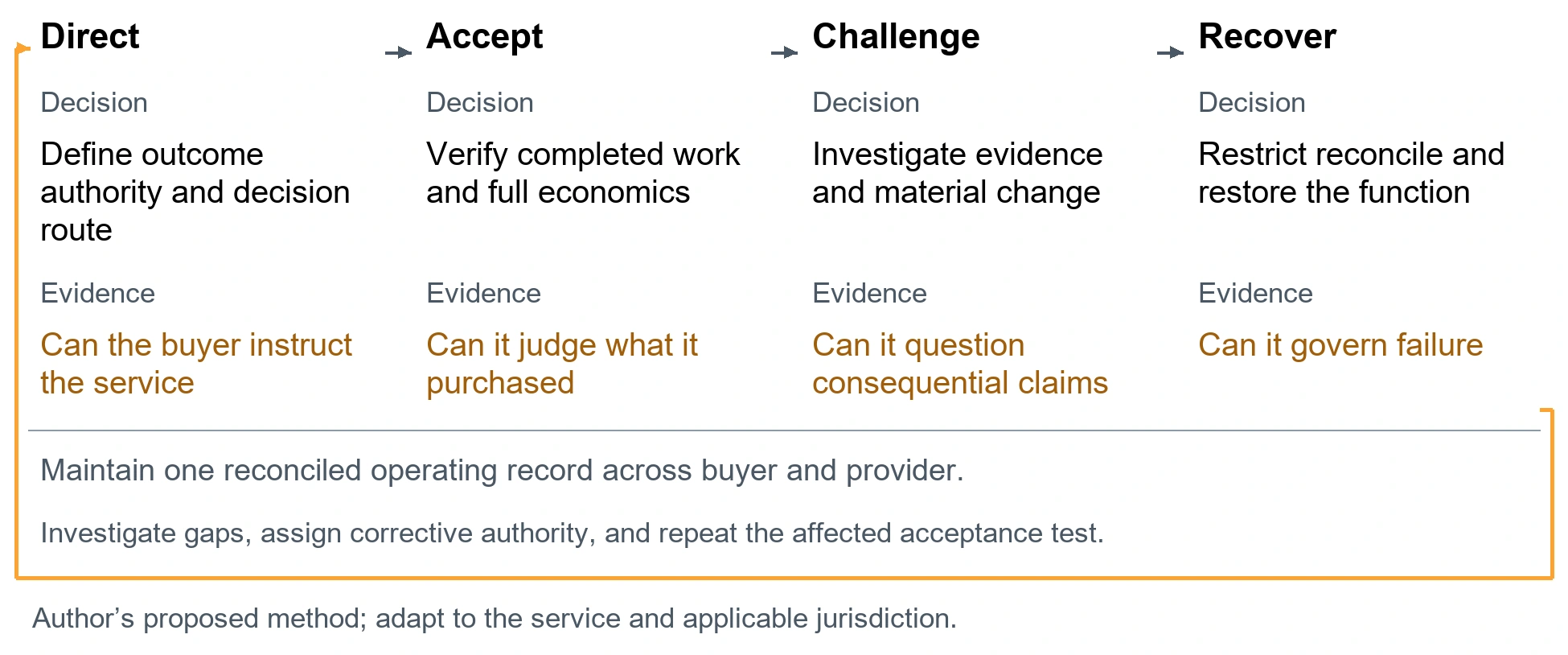
<p>Figure 1 proposes four domains: direct, accept, challenge, and recover. Define role-specific tasks and observable standards. Record the scope a person can perform, evidence from practical exercises, development needs, and necessary supervision.</p>
<p>McKinsey’s organizational analysis <a href="https://www.mckinsey.com/capabilities/people-and-organization/our-insights/ai-is-changing-work-now-it-has-to-change-the-organization">emphasizes role-based development and opportunities to demonstrate new work.</a><sup id="ref-3"><a href="#note-3" aria-label="Note 3">3</a></sup> The proposed programme applies that direction to outsourced delivery. Attendance is evidence of participation, while competence requires an appropriate decision in a realistic case.</p>
<p>Train finance and commercial owners on functional baselines, complete cost, pricing units, and benefit capture. Train operations and control owners on authority, evidence, intervention, and change. Give all roles a common account of the service so that handoffs do not depend on inconsistent terminology.</p>
<figure><img loading="lazy" src="https://akholi.com/wp-content/uploads/2026/10/119-f1.webp" width="1950" height="814" alt="The retained team competence record. Direct. Decision: Define outcome authority and decision route. Evidence: Can the buyer instruct the service. Accept. Decision: Verify completed work and full economics. Evidence: Can it judge what it purchased. Challenge. Decision: Investigate evidence and material change. Evidence: Can it question consequential claims. Recover. Decision: Restrict reconcile and restore the function. Evidence: Can it govern failure. Maintain one reconciled operating record across buyer and provider.. Investigate gaps, assign corrective authority, and repeat the affected acceptance test.. Author’s proposed method; adapt to the service and applicable jurisdiction."><figcaption>Figure 1. The retained team competence record<small><a href="https://akholi.com/outsourcing-2026-agentic-ai-tier-1-banks/">Phil Hatch, proposed framework developed for this paper.</a></small></figcaption></figure>
<h2 id="section-4">Fix Operating Conditions Alongside Skills</h2>
<p>Training cannot create authority, access, time, or qualified staffing that the organization has not supplied. When an exercise reveals an impossible decision route, assign the operating defect to an accountable owner. Do not treat every failure as an individual knowledge gap.</p>
<p>EU, UK, Swiss, US, and other services may require specific qualifications, professional decisions, privacy safeguards, records, or training. Qualified owners should establish those requirements. Internal training should complement required credentials rather than be represented as a substitute.</p>
<p>Refresh the programme after material changes in models, tools, authority, processes, obligations, or provider roles. New staff and people moving between services need the relevant context. Competence should remain linked to the work authorized, not to a permanent generic certificate.</p>
<h2 id="section-5">Authorize Practice Through Demonstrated Capability</h2>
<p>A reasonable objection is that retained teams are already overloaded. Prioritize consequential decisions, use role-specific modules, and integrate exercises into mobilization and change. Include the necessary time and cost in the outsourcing model rather than treat governance competence as free.</p>
<p>Before a person takes a material role, require representative and difficult-case demonstrations using the actual evidence and escalation routes. Provide feedback and supervised practice. Track whether the programme improves the team’s ability to obtain decisions, challenge claims, and verify outcomes.</p>
<p>The manager should require a retained team capable of governing the service it buys. Effective two-party agentic training develops the judgment and coordination needed to direct delivery under uncertainty. Knowing how to operate an AI interface is useful, but it is only a small part of that responsibility.</p>
<h2 id="section-6">Evidence and Source Note</h2>
<p>The study is a nonrepresentative cross-section of 850 vendor delivery-team <a href="https://akholi.com/outsourcing-2026-agentic-ai-tier-1-banks/introduction/">respondents</a> on 150 engagements serving Tier 1 financial institutions, collected during January–June 2026. Neither banks nor vendors corroborated the accounts. It establishes reported experience, not causation, legal breach, or market prevalence. Its application here is a mechanism to investigate, not an estimate of conditions in other industries. The author-supplied version 1.8.2 is dated November 1, 2026 and is cited as a forthcoming manuscript consulted October 23, 2026.<sup id="ref-4"><a href="#note-4" aria-label="Note 4">4</a></sup></p>
<p>This is an analytical decision paper based on the supplied study and selected primary public sources checked through October 23, 2026. The original contribution is a retained-team training and competence record focused on directing, accepting, challenging, and recovering two-party agentic delivery. The proposed method has not been independently validated. Legal requirements depend on the entity, activity, jurisdiction, and effective provisions; supervisory observations, research, and professional commentary have distinct authority.</p>
<h2 id="notes">Notes</h2><ol class="akp-notes"><li id="note-1">Andy Bayiates, “Business and IT Leaders Report AI Agents Are Scaling Faster Than Their Guardrails,” Deloitte Insights, April 24, 2026, survey scope and governance discussion, <a href="https://www.deloitte.com/us/en/insights/topics/emerging-technologies/ai-agents-scaling-faster.html">https://www.deloitte.com/us/en/insights/topics/emerging-technologies/ai-agents-scaling-faster.html</a>. <a href="#ref-1" aria-label="Return to note 1">↩</a></li><li id="note-2">Phil Hatch, <i>Agentic AI Outsourcing at Tier 1 Financial Institutions: Full Study Report</i>, version 1.8.2 (Akholi, forthcoming manuscript dated November 1, 2026), Part 2, secs. 4.2–4.3, “Human Review Capacity Against Agent Output Volume” and “Routine Approval of Agent Output at Human Review Points”, <a href="https://doi.org/10.2139/ssrn.7164559">https://doi.org/10.2139/ssrn.7164559</a>; Hatch, <i>Agentic AI Outsourcing</i>, Part 5, “The Five Manual Alteration Methods” and “Disclosure of Manual Alteration,” table 5.8; Hatch, <i>Agentic AI Outsourcing</i>, Part 2, sec. 5.2, “Joint Decision Speed Mismatched to Agent Speed”. <a href="#ref-2" aria-label="Return to note 2">↩</a></li><li id="note-3">McKinsey &amp; Company, “AI Is Changing Work. Now It Has to Change the Organization,” McKinsey &amp; Company, October 5, 2026, “Operating model,” “Talent,” and “Enabling AI reinvention”, <a href="https://www.mckinsey.com/capabilities/people-and-organization/our-insights/ai-is-changing-work-now-it-has-to-change-the-organization">https://www.mckinsey.com/capabilities/people-and-organization/our-insights/ai-is-changing-work-now-it-has-to-change-the-organization</a>. <a href="#ref-3" aria-label="Return to note 3">↩</a></li><li id="note-4">Hatch, <i>Agentic AI Outsourcing</i>, Introduction, “Executive Summary” and “Evidentiary Basis and Its Limits”. <a href="#ref-4" aria-label="Return to note 4">↩</a></li></ol>
<h2 id="bibliography">Bibliography</h2><ul class="akp-bibliography"><li>Bayiates, Andy. “Business and IT Leaders Report AI Agents Are Scaling Faster Than Their Guardrails.” Deloitte Insights. April 24, 2026. <a href="https://www.deloitte.com/us/en/insights/topics/emerging-technologies/ai-agents-scaling-faster.html">https://www.deloitte.com/us/en/insights/topics/emerging-technologies/ai-agents-scaling-faster.html</a>.</li><li>Hatch, Phil. <i>Agentic AI Outsourcing at Tier 1 Financial Institutions: Full Study Report</i>. Version 1.8.2. Akholi. Forthcoming manuscript dated November 1, 2026. Author-supplied manuscript consulted October 23, 2026. <a href="https://doi.org/10.2139/ssrn.7164559">https://doi.org/10.2139/ssrn.7164559</a>.</li><li>McKinsey &amp; Company. “AI Is Changing Work. Now It Has to Change the Organization.” McKinsey &amp; Company. October 5, 2026. <a href="https://www.mckinsey.com/capabilities/people-and-organization/our-insights/ai-is-changing-work-now-it-has-to-change-the-organization">https://www.mckinsey.com/capabilities/people-and-organization/our-insights/ai-is-changing-work-now-it-has-to-change-the-organization</a>.</li></ul>
